Weiner’s latest book, “Best Friends Forever,” just made it to the number one spot on The New York Times‘ best-seller list this week. Pretty exciting!
From Poynter Online piece:
Best-selling author Jennifer Weiner, whose seventh book, “Best Friends Forever,” came out in stores last week, recently visited The Poynter Institute to talk with local community members about her life as a journalist turned novelist.
During her talk she shared insights into how her work as a Philadelphia Inquirer reporter helped her become a novelist, and why the skills she acquired as a journalist made her a better writer.
Weiner, who attended Poynter’s fellowship for young journalists in 1991, also shared witty and thoughtful tips on how she gets inspiration for books, how she deals with criticism and how she balances life as a full-time mother, wife and writer.
The St. Petersburg (Fla.) Times is getting up there in age. This month the paper turns 125.
The paper’s longevity is a testament to the good work that its journalists have produced throughout the years and that they continue to produce during a tumultuous time in the news industry. In a special, July 19 pull-out section commemorating the paper’s birthday, Paul Tash, editor, chairman and CEO of the Times, listed 10 reasons why the Times has made it to its 125th birthday:
Also in the birthday pull-out section is a thoughtful article about Nelson Poynter, a former editor of the St. Petersburg Times who ran the paper for nearly 40 years. Wanting to keep the paper locally controlled, he created a nonprofit educational institution that would own the Times, ensuring that it remained independent.
I should note that I work at this institution, The Poynter Institute for Media Studies. Journalists worldwide know of this institute, but when I mention it to people outside of the profession, they often frown at me and ask for explanation. For those who need more help understanding it, here’s a good explanation from the aforementioned article. (I couldn’t find it online or I’d link to it.)
“Poynter embraced no idea more firmly than his desire to keep his newspaper locally controlled, in the hands of a single person, once he died. But to do that, he took the extraordinary step of giving the paper away. Although he left a widow and two daughters, Poynter stipulated in his will that most of his stock in the paper would go to a nonprofit educational institution that he established to help train working and student journalists. The institution would own majority interest in the Times and its stock would be voted by an executive whom Poynter designated as his successor. That ensured that his beloved newspaper would not have to be sold to pay estate taxes. It also would be safe from chain ownership.
“The institution, which began in 1975 in an old bank building two blocks from the paper in downtown St. Petersburg, was first called Modern Media Institute. Several years after Poynter’s death, it was renamed the Poynter Institute for Media Studies and moved into a new, elegant building near the city waterfront. Although the institute is tax exempt, the newspaper is a private, for-profit company that pays federal, state and local taxes. …”
I wish I could have met Poynter, the man who played such a critical role in making the Times the paper that it is today and who understood and valued the importance of local ownership and professional training. I wish I could thank him for giving me a place to grow and work as a young journalist, and congratulate him on helping the Times reach its 125th birthday. Good work, Nelson, and happy b-day, St. Pete Times.
Next week I’m meeting up with some friends for a documentary club meeting. The past two weeks the group has watched “The Fog of War: Eleven Lessons from the Life of Robert S. McNamara” and “Man on Wire,” which won an Oscar last year. Next on the list: “I Am Trying to Break Your Heart,” a documentary about the band Wilco.
Here are some of the other documentaries my friends have recommended: (I must admit I had nothing to do with this list, as my knowledge of documentaries is lacking. I’m about to fix that, though!)
Afghan Star (2009)
Gaea Girls (2009)
Pressure Cooker (2009)
The Yes Men Fix the World (2009)
Iron Maiden: Flight 666 (2009)
Helvetica (2007)
My Kid Could Paint That (2007)
Nanking (2007)
Jesus Camp (2006)
Jonestown: The Life and Death of Peoples Temple (2006)
Dispatches: Undercover in the Secret State (2005)
Grizzly Man (2005)
Guns, Germs and Steel (2005)
Enron: The Smartest Guys in the Room (2004)
Control Room (2004)
The Corporation (2003)
War Photographer (2001)
Mr. Death: The Rise and Fall of Fred A. Leuchter, Jr. (1999)
Louis Theroux’s Weird Weekends (1998-2000)
Superstar: The Karen Carpenter Story (1987)
What other documentaries should we add to the list?
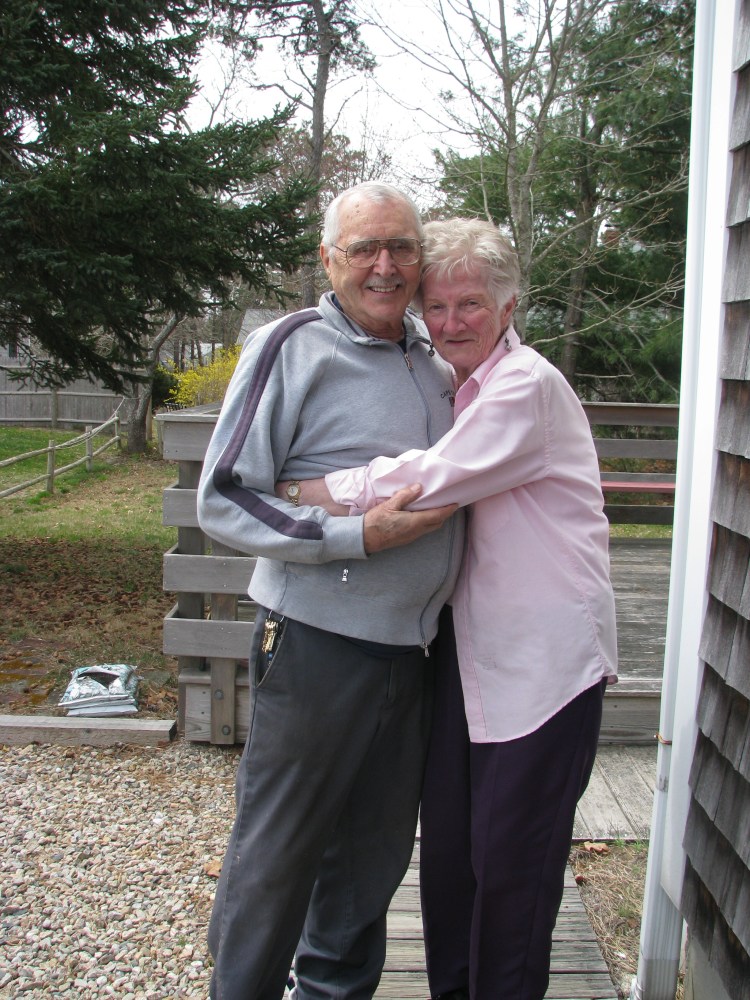
My grandma, “Gramz,” is the most special woman I know. She’s my surrogate mom, the person I’ve always turned to when I’ve needed advice or help finding my way through the labyrinth of love. At 86, Gramz has some pretty solid relationship advice and an uncanny ability to understand guys.
For years she lived vicariously through me, always wanting to know who I was going on a date with, where we were going and what my initial impressions of the guy were. When I moved to Florida, 1,400 miles away from her, she became even more curious about my “exciting” love life (or lack thereof).
But then Gramz started having her own fun. A widow for 11 years after my grandfather died, she never thought she’d have that butterflies in your stomach feeling again. That was before Gordon came knocking. Gordon Pepper has lived next door to Gramz for 36 years and recently started courting her after his own wife passed away in spring 2008.
Every day around 5:30 p.m. he crosses the vegetable garden that separates his house from my grandma’s so that he can eat a home-cooked meal and watch “Wheel of Fortune” and “Jeopardy!” with Gramz. They hold hands on the couch and cuddle. On Friday and Saturday nights they have “sleepovers.”
I couldn’t help but want to write about their relationship, so I pitched a story about it to the St. Petersburg Times. When Gramz heard it was running in this Sunday’s paper, she laughed and said something to the effect of, “All of my old neighbors and friends in Venice, Fla., are going to see the story and wonder what’s gotten into me!”
Since dating Gordon, who is a bit of a prankster, Gramz has become much less uptight and more liberal in her thinking. It makes me happy to see the transformation in her and to know that she’s no longer alone. Sixty three years separate my grandmother and I, but the love we have for each other and the new love she has found – have brought us even closer throughout the last year.
Gramz’s relationship with Gordon is no doubt a reminder that, for all its ups and downs, love has longevity. It doesn’t end with old age, and it doesn’t come easily. Life and loss happen.
Gramz will tell you, though, that tempting as it is to hold out for “the right one” or to avoid the search altogether, you have to stray from the narrow paths and wander a little, even if it’s just through the vegetable garden in your backyard.
It’s been a crazy past couple of weeks, but I’m now settled in my new apartment and will have more free time for my blog. Work has been busy, too, but in a good way. I’ve been mostly editing stories and Webinars and haven’t had as much time for writing lately, but I’ve found a little time to write stories and moderate live chats in recent weeks. Here are some recent examples:
St. Petersburg, Fla., was declared “City of Writers” a couple of months ago, shortly after local poet Peter Meinke was named a poet laureate. The city has been home at one point or another to some notable writers — Jack Kerouac and Pulitzer prize winning journalists Tom French, Lane DeGregory to name a few.
I won’t lie; I like the idea of saying I live in a city of writers and hope I can contribute to the education of young writers who come through The Poynter Institute and the city’s schools. I’m especially proud that St. Pete has been deemed a City of Writers because I know how much work my colleague, Roy Peter Clark, put into helping the city get this title.
I think, though, that there are plenty of cities that are just as deserving of the title. The Northeast has been home to so many amazing writers — Nathaniel Hawthorne, Henry David Thoreau, Louisa May Alcott, etc.
I remember visiting these authors’ houses as a little girl. My mom and I would visit Louisa’s house in Concord, Mass., after going to the nearby toy store where I’d play with bouncy balls and log onto the store’s computers for a game of “Oregon Trail.” (I didn’t have a computer growing up. My mom bought me a Smith Corona because “all great writers need a typewriter.” Computers, she said, were just a “passing phase” …!)
Mom and I would visit Hawthorne’s house around Halloween after we had mingled with the wannabe witches who flock every October to Salem, the city of the witchcraft trials. During the summer, we’d visit Thoreau’s little shack in the woods after a swim in Waldon Pond.
Mom figured it was best for me to see where great literary figures lived, maybe for inspiration, maybe to show me that all the stories I used to write about crossing bridges into imaginary lands could someday morph into novels that would actually be published.
We need moms to give us hope like that.
I always got a similar feeling of motivation whenever I visited Provincetown, a town on the tip of Cape Cod that I visited most summers when vacationing at my grandma’s house in Dennisport, Mass. The town is beautiful beaches, harbor, etc. You can walk down the main street and listen to drag queen a capella groups, then head to a nearby dock for a sliver of serenity.
The two extremes seem to reflect the tensions that writers seek, the kind of escapism that lets one be shamelessly outlandish in public and then retreat to places like Province Lands, 3,500 of national parkland near Provincetown.
Many literary greats have inhabited this area; Norman Mailer, Micheal Cunningham and poet Mary Oliver come to mind. Oliver once wrote: “I too fell in love with the town, that marvelous convergence of land and water; Mediterranean light; fishermen who made their living by hard and difficult work from frighteningly small boats; and, both residents and sometime visitors, the many artists and writers.”
Provincetown may not have the official “City of Writers” label as St. Petersburg does, but I’d say it’s pretty deserving of the title. And it’s well worth a visit if you haven’t been, especially if you want to write.
I’ve been house-hopping for the past few months, as my old apartment was infested with termites. Being a nomad, so to speak, is a strange experience; your routine gets disrupted and you begin to feel as though you’ve lost all sense of stability.
I stopped running (in large part because of a minor knee injury), I hardly cooked for myself and I spent a lot of time digging through my car for stuff I had misplaced in between moves. Fortunately, I have caring colleagues who put me and my roommate up for the month that we were out of our apartment. And fortunately I had a roommate to commiserate and laugh with when thinking about the ridiculousness of our situation.
Now I’m in my new place which, to my surprise, came fully furnished. My landlord, who lives on the first floor of the house with her husband, made the apartment feel like home the day I moved in; she hung up rustic-looking artwork, put plants around the place and made my bed for me, putting a straw hat and magazines at the foot of it. (There are so many pillows that it takes me about 10 minutes to make every morning!)
The apartment, which was built in 1899, has an old-fashioned feel to it. I’ve always loved older homes; they seem to have so much character to them and are a lot less cookie-cutter than a lot of newer houses. The yard has a rustic feel to it, too. There are gardens lining the side of the house, along with a gazebo, a hammock, a fireplace, etc.
Turns out, termites were a blessing in disguise. If it hadn’t been for them, I would never have moved into this place. I had to be away from my cat, who was staying with a friend for the past month, but I got her back Monday night. She’s been meowing nonstop since I brought her home, but she seems content. She’s already marked her territory — smack in the middle of my bed. Naturally, she likes being the center of attention.
So, here’s to a termite-free apartment and to getting back into a regular routine. The routine starts tomorrow with a morning jog. Speaking of which, I should go to bed … now.
When best-selling author Jennifer Weiner told her mother about her first book, “Good in Bed,” her mom started to cry.
“Darling, what’s it called?” Mom asked.
“Hm, ‘Good in Bed.'”
“What was that? ‘Good and Bad?'”
“No. ‘Good in Bed.'”
“‘Good in Bed’?! How much research did you do?!”
Weiner, who was at The Poynter Institute last weekend for a conversation with the community, is perhaps just as good a verbal storyteller as she is a written one. Stories about her mother, her ex-boyfriends, her husband and her children were woven into stories about her books, some of which have characters who are loosely based off of the people in her life.
Weiner began writing her first novel after breaking up with her boyfriend of three years. She said she remembers driving and crying as Celine Dion’s “My Heart Will Go On” blared in the background. It was a low moment for the then 28-year-old Weiner, but one that gave her the inspiration to write fiction.
“What do I know how to do?” she asked herself after the breakup. “I know how to tell a story. I’m going to write a story. The girl will be a lot like me. The guy will be a lot like Satan.”
“The miserable love life” is second on her list of life experiences/factors that contribute to being a great novelist. “Unrequited crushes, romantic despair, a few memorable break-ups, will give you something to write about, an understanding of grief,” Weiner writes on her Web site. “No prospect of heartbreak in sight? I can provide phone numbers upon request.”
Being a mom has also helped Weiner’s writing, particularly in terms of management skills. While at Poynter, Weiner talked about the often unglamorous life of motherhood. Babies, after all, cry and scream (usually at the most inopportune times) and rarely “nap in a basket at your feet.” She wouldn’t be able to write as much as she does, she said, if she didn’t have a sitter who watches the kids while she goes to a coffee shop to work on her novels.
Weiner is used to writing under hectic circumstances. Prior to writing novels, she was a young journalist at The Poynter Institute and later a columnist at The Philadelphia Inquirer, where she wrote about pop culture.
As a journalist, Weiner said, “you don’t have the luxury of being blocked.” All those “years of doing the story on deadline, under less than ideal circumstances” helped her to be so prolific as an author. “I think the best training you can get for being a novelist is to be a reporter,” she said. “The difference between people who have a story to tell and those who do it is the willingness to sit down and actually write it. As a reporter, you write it all and you do not romanticize the act of writing.”
Though her writing is often classified as “chick lit,” Weiner said she thinks of this as a “sexist, condescending term.” But people read her “chick lit” books, which often have pink covers and lettering, and that’s ultimately what matters more than how they’re classified: “I have an audience,” Weiner said. “Do I want to care about my readers or do I want to be cared about by reviewers?” She noted that some reviewers frustrate her, particularly The New York Times, which doesn’t regularly review her books. Still, she has full-page ads for her books in the Times — not so much for the general audience of thepaper but for the booksellers who may see them.
Though she admits that criticism, whether it be from readers or reviewers, is tough to receive, Weiner said she actively solicits it from her husband and trusted friends before submitting manuscripts to her editor.
Weiner used an analogy to illustrate the relationship between writers and editors: An editor and writer are crawling through the desert, dehydrated and desperate for water. Eventually, they come to a reservoir and the reporter says, “Look! It’s a reservoir!” The editor gets to the water first and starts peeing in it. “What are you doing?!” asks the reporter. “Making it better,” the editor says. Hm. I can relate to this from both sides!
This was just one of many laughable moments during Weiner’s talk. I was impressed by her honesty and her witty sense of humor. She struck me as someone who was genuine and in touch with her readers. Her talk made me want to read more of her books, as well as those she recommended: “The Help” by Kathryn Stockett, “Admission” by Jean Hanff Korelitz and books by Susan Isaacs.
I’m going to add these books to my reading list. Their titles aren’t quite as catchy as “Good in Bed,” (or “Good and Bad” as Weiner’s mother would have preferably titled it), but I guess I shouldn’t judge a book by its title — or by its pink cover.
Senior year of college I took a “Literature of Boston” course in which I came to know Boston through a literary lense that spanned decades of the historic city’s past.
We read the usual suspects, including: Edwin O’Connor’s “The Last Hurrah,” John P. Marquand’s “The Late George Apply,” and Henry James’ “The Bostonians.”
My favorite book in the course was Jean Stafford’s “Boston Adventure,” primarily because of the dozen or so books that we read, it was the only book aside from “The Scarlet Letter” that featured a female as its protagonist.
I felt as though i could relate to the main character, Sonie Marburg, a young working class immigrant who lives by the seaside and longs to move to Boston in her search for meaning and love. What she finds when she eventually gets to the city is not what she had imagined.
My classmates said they didn’t mind Sonie, but they thought the book was dry. When it came time at the end of the course to vote on which book we liked best, I was the only one who raised my hand for Stafford’s book. Poor Stafford, a talented author who’s fame is perhaps more commonly defined by her infamous relationship with Boston-born poet Robert Lowell than for her skills as a writer.
Given how much my classmates didn’t like Stafford’s book, it didn’t surprise me to see that “Boston Adventure” was ranked last on Boston.com’s new “Essential New England Books” feature. I’d argue this is more so because most people probably haven’t read the book and therefore wouldn’t have an occasion to rate it.
I know I’m not giving you much of an incentive to read “Boston Adventure,” but really, if you can find it, (I doubt most bookstores sell it), read it and let me know what you think. Hey, Boston.com thinks it’s “essential” reading!
Other “Essential New England Books” include Louisa May Alcott’s “Little Women” (if you ever go to Concord, Mass., check out Alcott’s house, which I used to visit all the time growing up); Slyvia Plath’s “The Bell Jar” (not the most uplifting read, but none of Plath’s work really is…); Mike Stanton’s “The Prince of Providence” (a good read about the former mayor of Providence, Buddy Cianci, who revitalized the city but was brought down by corruption and crime); and Junot Diaz’s “The Brief Wondrous Life of Oscar Woa,” which I recently read for the book club I’m in and loved.
And we can’t forget the children’s books that made the list: Robert McCloskey’s “Make Way for Ducklings” (reminds me of visiting Boston Common and climbing on the gold statues of these ducklings); Eric Carle’s “The Very Hungry Caterpillar” (a little hardcover book that I used to carry around with me when I was little); and E.B. White’s “Charlotte’s Web” (what child doesn’t love Wilbur?!)
Given how many great books are on the list, “Boston Adventure” may not be the best, but it’s up there. The book, as well as so many others from the list, remind me of home.
Which New England/Boston-based books would you recommend?
Looking to write a story about the Associated Press Stylebook’s Web site redesign, I interviewed a few of the people who help run the site and the printed version of the stylebook. They told me that Web traffic had increased, which led me to think that sales of the printed version had likely decreased. Not so.
In recent years, print sales have increased by 100 percent from 30,000 in 2004 to 60,000 in 2008. Part of this growth, some at the AP believe, has to do with displaced journalists introducing the stylebook to colleagues in their new jobs outside of journalism.
At a time when struggling news organizations are outsourcing copy editors and slashing copy desks, the Associated Press Stylebook is maintaining its place in newsrooms and is steadily growing its audience — online and in print.
Sales for the AP Stylebook have increased significantly in recent years, from 30,000 in 2004 to 60,000 in 2008. Traffic on the AP Stylebook Web site, which was redesigned last month, is also growing. Monthly page views are at 300,000 — a 3 to 4 percent increase from before the redesign and a 6.5 percent increase from last year. There’s talk, too, about a mobile version of the style guide being released this summer.
Though its primary audience remains journalists and college students, some at the AP suspect that former journalists are using the style guide in their new jobs and introducing it to professionals in different industries.


 Senior year of college I took a “Literature of Boston” course in which I came to know Boston through a literary lense that spanned decades of the historic city’s past.
 Word on the Street