Throughout the past month or so, I’ve discovered a lot of new songs and artists, and re-discovered some old ones. Some are from music reviews I read, some are from friends and others are songs that I just stumbled upon. As you’ll see, I have a pretty eclectic taste in music.
I want to hear what you’ve been listening to, so feel free to leave your music suggestions in the comments section of this post.
I can’t help but cringe when I hear about girls on “The Bachelor” getting highly expensive gifts — beautiful lodging, designer clothes, diamond necklaces — when so many people in this economy are struggling to survive day to day.
I just finished watching this show, so the lavishness of it all is on my mind. I get a similar feeling when I think about all of the money that’s spent making films and music videos.
Sarah McLachlan, my fav singer, put together a great music video back in 2004 for her song “World on Fire.” The video only cost $15 to make. It’s not the best-produced video (the text, at times, runs across the screen too quickly), but for $15 it’s pretty darn good. And its message is even better. Watch the video to better understand McLachlan’s belief that a little money can go a long way toward helping those less fortunate.
This is strange. It’s 10:14 p.m. and I’m ready for bed. My teeth are brushed, my face is washed, my contacts are out. It’s not unusual for me to go to bed at 2 a.m., only to get up five hours later for work.
“What do you do that late at night?” people ask me.
“I read, get lost online, write,” I say.
One of my old English professors used to say “The owl of Minerva flies at midnight.” I’ve always found this to be true. My creativity awakens at night and keeps me up.
Starting tonight, though, I’m going to go to bed at 11:30 p.m. I figure if I commit my goal to writing, I’ll be more likely to follow through with it. I hate being tired during the day and not having as much energy as I’d like. When I get a decent night’s sleep, I feel more well-rested, alert and happier.
Getting enough sleep signifies to some people that you must be less than passionate about your work and your life. It means, well, you’re lazy. Very often women workaholics forego sleep, because they’ve bought into the mentality that says sleep time is unproductive time.
Yet what have all this workaholism and sleep loss bought us?
Less productivity, less job satisfaction, less sex, and more inches around the waist. Doesn’t seem like a very good deal, does it?
Nope. I’ll let you know if I follow through with my goal. Now, if you’ll excuse me, I’m heading to bed … soon.
I had lunch on Wednesday with a mentor who shares my passion for personal writing. Before we even walked out the door, he handed me a copy of a personal essay he’d recently written. We talked about the piece and bounced ideas off of each other to help ourselves better understand our direction as writers. I found our talk to be especially helpful, so I’m sharing what I learned. Feel free to add other tips to the list.
1.) Talk out loud about what you’re working on. Sometimes ideas can grow cobwebs when they remain in the recesses of our minds. Talk about your ideas to help cement them in your memory. Share them with someone who will give you genuine feedback.
2.) Don’t get overwhelmed by large chunks of time. When I think about periods in my life that I want to write about, I sometimes feel lost. “Where do I start?” I wonder. Instead of trying to cover a couple of years in one essay, think about one day, one moment, that sticks out in your mind. Why do you remember that moment? How is it representative of the larger span of time you want to write about? How will that day/moment help people understand you and the overall meaning of your piece?
3.) Think of a question that you want to answer by the end of the piece. Questions can serve as “narrative engines” that help you navigate your way through a piece. They could be, “What did I learn from this experience?” or “How has this experience shaped who I am today?” You don’t necessarily need to answer the question directly in the story, as doing so can sometimes lead to forced or sappy endings. At the very least, though, the answer should be something that you come to understand through the writing process.
4.) Interviewing family members, friends, etc. Take advantage of the power of memory, and don’t assume that your recollections are necessarily correct. Ask a family member to help you round out your memory of something and to verify that it’s accurate. If you both have different accounts that don’t match, tell each other what you remember and see if it leads to an agreement over what actually happened.
It’s easy to forget, perhaps because we didn’t pay enough attention to something, or because we’re trying to shield ourselves from the memories in life we’d rather not remember. Most readers won’t know if you’re telling the truth or not, but getting the facts of your life straight is still important; it’s a matter of being true to yourself and to the people and memories that have helped shape you.
5.) Get a shoebox. Fill it with meaningful objects that describe who you are, what you enjoy, what you couldn’t live without. It’s the box you’d grab in the wake of a house fire or a flood. When it comes time to write a personal essay, take out the box and write about one of the objects. Why is that object so important to you?
6.) Once you have an idea as to where you want your essay to go, try to organize its narrative structure. Story board, if you will, with a paper and pen or with sugar packets. Read more about former St. Pete Times reporter Tom French’s sugar packet method.
There you have it. I’ll keep adding more tips as I get them.
What challenges do you face when writing personal essays?
An article in Sunday’s Los Angeles Times caught my eye. The piece, titled “Members of Kenyan Tribes Work Toward Reconciliation,” says that each Saturday, a few dozen Kenyans get together to forgive and ask to be forgiven:
“These traumatized victims of Kenya’s post-election clashes meet to talk, pray, sing and – they hope – heal. More than half a dozen tribes are represented, including ones that attacked one another in the weeks after the disputed December 2007 presidential voting ignited long-simmering ethnic tensions. More than 1,000 Kenyans died in the clash.”
I found it so refreshing to learn that Kenyans are using the power of forgiveness to help heal. The article reminded me of a conversation I had last week with a Dominican priest I knew from my alma mater, Providence College. We talked about forgiveness and how it has played out during some of the world’s tragedies and in people’s day-to-day lives. Our conversation made me realize that sometimes simply believing in the idea of forgiveness can lead to a deeper understanding of forgiveness as a remedy for emotional pain, as a kind of grace that helps us to heal from the wounds of the past.
The priest I spoke with mentioned the book “Amish Grace: How Forgiveness Transcends Tragedy,” which talks about the shootings at Amish schools on Oct. 2, 2006. That same day, the Amish forgave the gunman, who killed five girls, critically wounded others and then shot himself. People wondered how the Amish could forgive someone so quickly after what seemed like an unpardonable tragedy. I plan to read the book to learn more about why they forgave the gunman.
It seems as though the Amish and Kenyans could teach people a lot about what it means to genuinely forgive an enemy, avoid vengeance and, during troubling times, find grace.
I’ve thought a lot lately about the power of personal writing. “Anyone can have a blog and just write about themselves,” some people have recently told me, as though blogging about oneself is not a worthwhile pursuit.
The beauty of personal writing, though, is that it can be both personal and universal at the same time. Whenever I write personal essays, I try to ask myself: How can others benefit from what I’m writing? How might my feelings, thoughts and actions relate to other people? How can I help others feel as though they’re less alone in the joys, struggles and challenges they experience?
Good personal writing speaks to universal truths. It doesn’t say, “Look at me, I’m special.” It says, “Here’s what I’ve experienced/am experiencing. Here’s how I’m dealing with it, and here’s how it might relate to you.” And it does so in a way that doesn’t tell, but shows. In a recent piece I wrote about being grateful this holiday season, for example, I didn’t write, “It’s difficult not having a mom around the holidays.” Instead, I showed why it’s tough: “If Mom were here this Christmas,” I wrote, “she would have gone to midnight Mass with my dad and I, and she would have already filled my stocking with care. Dads do things differently. They fill stockings after midnight Mass, and don’t have as much to fill them with, not because they don’t care, but because they’re not Mom.”
In the same essay, I also included the pronoun “we” a couple of times, which I try to do in all of my personal essays to help people feel as though they’re part of the overall narrative: “The holidays are notorious for bringing up memories of people we’ve lost. It can be difficult to embrace these memories because they remind us of what we no longer have, and they make us yearn for better times, for desires unfulfilled, for the kind of joy that comes from loving relationships with parents, spouses and friends.”
I’m still learning a lot about personal writing, and I hope to get better at it in 2009. For people looking to write a book someday, like myself, it’s good practice. Writing smaller essays over time, rather than sitting down one day and trying to start a memoir from scratch, seems like a more feasible way of going about the process.
Sometimes, writing short, daily snippets of life can help too. I use Twitter daily as a way of communicating with people, but also as a way of keeping track of what I do day-to-day. I can look back on my Tweets a year or two from now and know what I was thinking, doing or feeling on a particular day. Mediabistro ran a piece earlier this week about using Twitter for personal writing.
Yes, “anyone can have a blog and just write about themselves.” The challenge is figuring out how to make your writing speak to others in such a way that will make them say, “Wow, I’m not alone. Someone else understands.”
What advice do you have for people interested in personal writing?
The snoring was loud enough to turn heads. On the otherwise quiet second floor of the Boston Public Library, a man sat with his head titled backward, his arms outstretched, his mouth wide open. I peered at him over the cover of Joan Didion’s “Democracy” and wondered what had made him so tired.
Was it that he was bored silly with whatever he’d been reading? Was it that he was overtired and needed to take a quick catnap? Was it that he had no other place to sleep? I’ve seen a lot of homeless people in the libraries up north throughout the past week or so. Better to wander in warmth, surrounded by labyrinths of literature, than fight the freezing cold, surrounded by staring strangers.
The sleeping library man seemed content being indoors, and apparently pretty comfortable. I’ll admit that I, too, have been guilty of falling asleep in the library. I used to take quick breaks, aka naps, when fatigue set in and my late-night readings of Chaucer and Shakespeare stopped making sense. (Yes, I took an entire class on “The Canterbury Tales” and two Shakespeare classes.)
Sophomore year, one of my fellow Chaucer classmates and I promised each other we’d sleep overnight in the school library before we graduated. We had heard about a couple of Providence College alums who had managed to “hide” amidst the archives in the basement of the library, which closed at 1 a.m. on weeknights. After the security guards did their last round of checks, the alums said goodbye to the archives and hello to a slumber party on the main level of the lib. My friend and I, who were both book-loving English majors, waited until the night before the last day of senior year to execute our sophomoric plan, but then chickened out.
Given my odd desire to sleep overnight in the library, I couldn’t help but want to document someone else’s bookish siesta. I snapped a couple photos of the sleeping library man, hoping my camera’s flash wouldn’t wake him. I wish I had found out his story, but I didn’t want to disturb him from his long winter’s nap. His wide open mouth, and the loudness of his snore, seemed to say: “Please, do not disturb the peace.”
It’s a classic question: When is it relevant to include someone’s race, ethnicity or religion in a story?
Journalists covering the Bernard Madoff scandal were faced with this question when trying to decide how to cover the religious angle of the Madoff scheme. Many stories about Madoff talked about his hefty donations to Jewish organizations, and subsequently made reference to his religion. The Jewish community responded, fearing that Madoff’s wrongdoings, and journalists’ mention of Madoff’s religion, would perpetuate stereotypes about Jews being miserly and obsessed with money.
I wrote a Poynter Online column on Friday about this and tried to shed some light on how journalists can cover the religious aspect of the Madoff scheme. After reading a New York Times article about Jews’ response to the scheme, I decided to get in touch with Clark Hoyt, the Times‘ public editor, for the column. He wasn’t in the office on Friday, but he responded to some of my questions via e-mail. Here is the intro to my piece:
Mention the name Bernard Madoff and words like “fraud,” “money” and “Wall Street” probably come to mind. For many in the Jewish community, however, the Madoff scandal isn’t just a story that details a major scam; it’s a story that fuels ignorance about centuries-old stereotypes.
Madoff, who is Jewish, donated hundreds of thousands of dollars to Jewish causes, which suffered significant financial losses as a result of his wrongdoings. He committed what’s called an “affinity fraud” — a scheme in which con-artists target their own ethnic, religious or professional groups.
Given the nature of such a fraud, those covering the Madoff case are faced with a challenging question: How do you report on the religion/ethnicity of a criminal and the group he’s affected without making it seem as though you’re perpetuating stereotypes?
My grandma, me and my dad on Christmas Eve. I took this photo with my MacBook, which explains the surprised looks and the somewhat warped-looking faces. Happy holidays to all!
I’m at home now, listening to the snow melt into the wee hours of Christmas day. My neighbors’ lights are turned off, and the streets are silent. No cars are rushing by, no sirens echo in the distance.
It’s a perfect night to curl under the covers with a warm fleece blanket and something cuddly — a pet, a stuffed animal, a loved one. It’s a perfect night for kids to fall asleep and dream about sugarplums and fairies. It’s a night to be with family, to go to midnight Mass and to sing “Silent Night” and “Hark the Herald Angels Sing.” And it’s a time to be grateful — for all that we have, all that we’ve gained, and all that we were lucky enough to have for so long.
I can’t help but think about my late mom around the holidays. She would stuff my stocking, which she made herself, with Hershey Kisses, tiny stuffed animals and costume jewelry. She always knew what I wanted. I’d wake up extra early in the morning, rush into my parents’ bedroom and say, “Mommy, Daddy, wake up! It’s Chriiiistmaaaas!”
“I know, Mal, Merry Christmas! Let’s just wait a little longer. Go back to bed until 7:30 a.m.,” Mom would say.
“But it’s Christmas! Do I have to?”
“Yes, two more hours.”
Two hours to an adult is hardly ever enough time. For a child, two hours can seem like an eternity.
When my alarm clock hit 7:29 a.m., I’d jump out of bed again and burst through my parents’ door.
“It’s time!! It’s time!!” I’d exclaim.
“OK, we’re getting up,” Dad would say as Mom stretched her arms and yawned.
I loved getting gifts (what child doesn’t?), but I also loved the pictures my dad would take of my mom and me. I loved the hugs mom and I would exchange when she bought me something I had wanted. Most years, she didn’t even have to ask me for a Christmas wish list. She just knew.
If Mom were here this Christmas, she would have gone to midnight Mass with me and my dad, and she would have already filled my stocking with care. Dads do things differently. They fill stockings after midnight Mass and don’t have as much to fill them with, not because they don’t care, but because they’re not Mom.
The loss of my mother is no doubt painful around this time of year, but when I start to get sad, I remind myself of how lucky I am to have had her for the time that I did. Some children don’t even get to know their moms. I had her for 11 years, long enough to have memories of our time together. Even if most of these memories are of her when she was sick with cancer, I still consider them worth having.
The holidays are notorious for bringing up memories of people we’ve lost. It can be difficult to embrace these memories because they remind us of what we no longer have, and they make us yearn for better times, for desires unfulfilled, for the kind of joy that comes from loving relationships with parents, spouses and friends. I have these yearnings — for a significant other, for friends who are far away, for my mom — but I know that I have much to be grateful for this holiday season, and that for now, I’m where I belong, here at home.
The snow is still melting, and the night is still silent. Soon, after one last-minute, 2 a.m. gift wrap, it’ll be time for bed. When I go to bed, I’ll say a prayer for my mom and for all those whom I know and love. I wish you a peaceful holiday season and the kind of happiness that comes from knowing that despite the hardships we face in life, we are all still lucky and still loved.
My grandmother uses a lot of expressions that I’ve come to understand over the years. As a child, though, I didn’t know what she was saying. It was as though she was speaking another language, or speaking in constant similies. One of her favorite expressions, for example, was “I slept like a top last night.” “How does a top sleep?” I’d ask her.
Now, there are lots of expressions and buzzwords I use that she doesn’t get. “I’m updating my Facebook status to say I’m at home,” I told her the other day. “What’s a Facebook status?” she asked. She knows what Facebook is and understands the basic premise of it, but she sometimes calls it “MyBook,” a combination of MySpace and Facebook. She laughs, knowing she’s not saying it correctly.
The expressions and buzzwords people use (or misuse) sometimes cloak the true meaning of what they’re trying to say. When Sen. John McCain kept saying “Joe the Plumber,” for example, people wondered, “Who is this guy?” Come to find out, he was a real person who represented the average guy. So why not just say “middle class” or even the more popular expression, “your average Joe” (or Josephine!)?
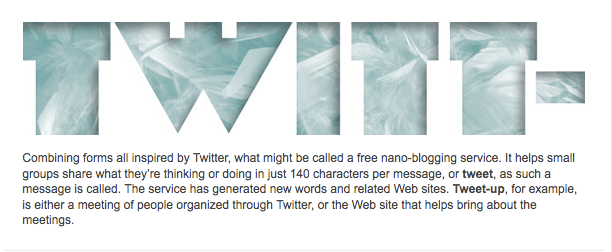
Buzzwords and expressions can often become part of our everyday vocabulary and, when spoken among people of different ages, can reflect a generational divide. The New York Times ran a piece in Sunday’s paper about 2008 buzzwords, most of which my grandmother probably doesn’t know. Heck, I hadn’t even heard of some of them. Among my favorites: “frugalista,” “staycation,” “lipstick on a pig,” “twitt-,” and “photobombing.”
I’ll have to share some of these with gram.
What are some of your favorite buzzwords and or expressions?


 Word on the Street