Reading the Newspaper: A Duty, Pleasure or Backwards Slide?

Roy Peter Clark‘s piece, “Your Duty to Read the Newspaper,” is generating more feedback than I’ve seen on Poynter.org in a long time. He writes that journalists have an obligation, a duty, to read the newspaper — in print, not pixels.

The fact that this article has sparked so much discussion is proof in and of itself that journalism still matters. If people didn’t care about the future of journalism, there wouldn’t be such a huge debate about online vs. print. A few years ago, I wrote a column for my local newspaper about newspapers being the “wave of the future” because, frankly, I feared the growing trend toward online journalism. I’ve never liked change, so the switch to the Web made me feel like something about journalism would be lost along the way. But now I’m a Web-a-holic. I still try to read the paper every day, but I get most of my news on the Web. This is where multimedia and journalism meet. It’s where the future of journalism’s continued growth seems to be headed, but that doesn’t mean we have to stop reading the print edition. Can’t we have both?

Are you a pixel or a paper type of guy/gal? Do you think we have a civic obligation to read the newspaper in print?

———————————————————————————————————————-

Here’s are some more thoughts, which I posted in response to Roy’s piece:

You bring up some interesting points, Roy. Though I read most of the day’s news on the Web, I look forward to the days when… You bring up some interesting points, Roy. Though I read most of the day’s news on the Web, I look forward to the days when I can switch from pixels to print.

Sunday mornings still remind me of hour-long breakfasts with my family, when we’d sit around the table and devour each section of the paper. The Web is undoubtedly an important part of the future and the here and now of journalism, but there’s something special about reading a print newspaper, something that a computer screen just can’t provide. The ink on your fingers, the turning of the pages, the layout of the content — this is all part of the newspaper-reading experience, a tangible encounter with the news that requires readers to actively engage with the stories they are reading.

Seeing people peer from behind broadsheets of print while in coffee shops or at the bookstore makes me hopeful about the future of journalism. I used to love it when my classmates at Providence College would grab a copy of The Providence Journal as they walked out of the dorms on their way to class. Though I later learned that some of them took a copy just for the crossword puzzle, the fact that they picked it up nonetheless sent the message that they had acknowledged the presence of journalism.

Every morning I try to acknowledge, and appreciate, journalism by picking up a copy of The St. Petersburg Times. I usually only skim the section fronts before turning to the Web, but I leave the copy on my desk all day because it comforts me to have it within reach just as much as it pains me to throw it away at the end of the day.

Here’s a column written by The Providence Journal‘s Mark Patinkin related to this discussion.

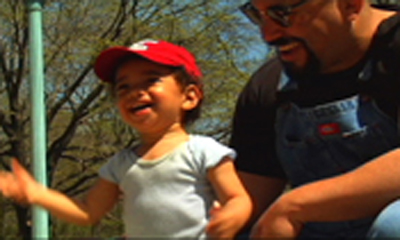
Dads at Home with Kids and Still ‘Manly’

fathers1.jpg

Time.com

TIME magazine ran an interesting piece about stay-at-home dads who, in leaving their jobs to raise kids, fear they may be abandoning their masculinity. If being a caring, stay-at-home dad means being “less manly,” than what does that say about a woman’s role as a mom? For some dads, staying at home with the kids isn’t a macho demotion — its a testosterone booster.

TIME reports:

“I’m probably a little whipped,” shrugs Lee Roberts, 45. He’s a part-time copy editor, married to a full-time journalist, who has stayed home for nine years to raise their two children. “There are definitely some guys who look at me and think, ‘What’s up with him?’ Do I care? Well, I guess I do a little because I just mentioned it,” he says. Haley speaks up to reassure him: “Kids remember, man. All that matters is that you’re there. Being there is being a man.”

Roberts’ sentiments reminded me of a book my dad gave me for Christmas last year called “Why a Daughter Needs a Dad.” The book is filled with photos of dads twirling their baby girls in one hand high above their heads, dads and daughters painting pictures propped on easels, dads holding onto the seat of the bicycle their daughter is riding, afraid of letting go …

The book is a bit gimmicky, and it seems to be written under the assumption that everyone has a caring father, but it still speaks to the importance of having a paternal figure in life, whether that figure is your actual dad, a good family friend, or someone who isn’t related to you but might as well be your surrogate dad.

How visible that paternal figure is depends a lot on work. While dads like Roberts might be able to stay at home and take care of the kids, for many dads, it’s still a challenge for many. Bureau of Labor Statistics from 2006 show that only 6 percent of dads stay at home with the kids while their wives work. I wonder how many of these dads are jobless by choice. I wonder, too, how a child’s behavior changes depending on which parent/parental figure they spend the most time with as a child …

Click here to see an audio slideshow about dads that a friend of mine put together during Poynter’s six-week summer fellowship.

What do you think about stay-at-home dads? Do you think moms are more nurturing than dads?

Stumbling Across Some ‘Shopping Treats’

dsc02676.jpg

Not gonna lie, I was pretty excited when I saw an Urban Outfitters in Ybor City today. I’ve bought a couple things from Urban Outfitters in the past — usually a funky handbag or jewelery — but I love just going in and looking at the different styles. Sometimes I wish I were more of a creative dresser. Walking into Urban Outfitters is like entering my friend Caitlin’s closet. She makes some of her own clothes/accessories — skirts out of jeans, hats out of knitted wool, sewn handbags — which are so good she could easily sell them. It seems some artists get inspiration from Urban Outfitters, too, which makes sense considering the crafty picture frames and furniture lining the shelves there.

Ybor also has some fun vintage shops that you can’t find at Channelside or other really commercialized areas. One of them, La France, was jam-packed with fur coats, flamenco-like dresses, shoes that my grandma wears but that have apparently come back in style, and ’40s-style hats like the kind that are buried in boxes in my grandma’s attic. Note to self: Save all your old clothes, even if they seem “so passee.” Nothing ever really goes out of style. Those silver pleather pants I wore my freshman year of high school when I used to call myself a rockstar? I’m convinced they’ll make a wild comeback in a couple years. (No lie, it’s always been my secret little dream to be a rockstar, and yes, I used to wear silver pants that I sadly sold in a yard sale. Guess some other girl will be lucky when they make their comeback.)

I didn’t try on any silvery, sparkling clothes today, but I sure as heck tried on some out-of-this world sunglasses at the vintage shop. There were sunglasses with martini glasses as the lenses, Mardi-Gras looking glasses, and glasses rimmed with colorful jewels. They’re what I like to call “shopping treats” — outlandish stuff you find when shopping, especially when window shopping. Urban Outfitter’s sunglasses weren’t quite as eye-appealing, and they were a bit more expensive. Maybe next time I hit up the Boston Urban Outfitter’s Bargain Basement, there’ll be a better, cheaper selection …

What shopping treats have you stumbled across recently?

Coolest Costume … What’s Yours?

shirt.jpg

http://www.etsy.com

Halloween used to be one of my favorite holidays, in part because of the free candy. My friends and I always went to the rich neighborhood in town in hopes of getting king-sized candy bars, and it usually worked. I “saved” my candy and hid it under my bed for when I really wanted it. But, by the time I was ready to finally eat it, the candy had either already melted or turned white and discolored. I guess it’s better to enjoy what you have in the moment.

Even more exciting than the candy were the costumes. October presented a crafty challenge to think of a costume that would top the previous year’s get-up. Check out this costume contest. The costume categories are “Green,” “Pet,” “Kid and Baby,” “T-shirt,” “Sci-Fi,” and my favorite, “General Awesomeness.” Here are some of the contestants’ costumes.

Growing up, my mom made what I like to think were “generally awesome” costumes. I once dressed up as:

— A singing California Raisin. I wore a big, black, stuffed garbage bag and black-tinted glasses, and held a microphone.

–A very scary looking troll with blue hair. (I was once mentioned in my hometown newspaper for having 365 trolls … yes, I had an affinity for these so-ugly-they’re-cute creatures.)

–A tube of toothpaste. I wore a felt costume that said “Crest” down the front of it, and topped it off with a lampshade on my head for the cap.
–A hot pink Crayola crayon with a felt cone on my head.

–A strip of dot candy. (I cut out two large pieces of cardboard and then cut Styrofoam balls in half and spray painted them. I glued the Styrofoam to the cardboard, then tied some string to the cardboard so I could wear one piece in the front and one on the back.)

–Other years I dressed up as a flapper, a 50s girl, a doctor, and Alice in Wonderland. This year I’m joining some friends and dressing up as Madonna throughout the ages. A dozen people could dress up as Madonna and all have completely different costumes …

Have any fun costume ideas/stories? Share, share, share!

A Little Journalistic Inspiration

This is a worthwhile package from PBS’s “EXPOSE: America’s Investigative Reports” show. Peter Zuckerman was a visiting faculty member during Poynter’s six-week summer fellowship and is a 2003 graduate of the program.

The EXPOSE videos are pretty inspiring because they show great journalism at work. I’ve always believed that to be a better journalist, it helps to talk about your stories with other journalists and share your ideas. And it helps to listen to what other journalists are saying and learn about the reporting and writing techniques that work for them. I’ve had great editors tell me that if you see a story in the paper that you like, contact the reporter and ask how he/she got the idea for the story, what type of reporting it involved, how long it took to write, etc.

Here is a good example of the type of Q&As that can help enlighten us. The Q&A is with Ken Weiss, a reporter at the Los Angeles Times, who won the 2007 Pulitzer Prize for explanatory reporting for his five-part series, “Altered Oceans.” Check out the compelling multimedia, too.

I’ve been collecting stories of this nature, as well as other journalism resources on my del.icio.us page. Do you have links to other articles that you think I should add?

A Glimpse Inside Writers’ Rooms

Will Self’s Writing Room: Note all the Post-its!

Will Self’s writing room — note all the Post-its!

I’m in love with writing outside. While in college, I used to sit outside the library against a large stone that served as my backrest. Though it wasn’t the comfiest place in the world, it was the place where I wrote some of my greatest college essays and where I did my best studying.

At times I got distracted – too many people walking in and out of the library could make for hours of great people-watching and listening, but the distractions helped me. I’m an organized person and like things to be in their place, but when I write, I need some dishevelment and distractions.

When I studied in the library at night or during the winter months at college, I would always read the dozens of scribbles on the cubicle walls. My mind would wander as I wondered whether calculus still sucks or whether Johnny still loves Whitney like he did back in 2003 when he dotted the “i” in Whitney’s name with a heart.

When writing, I like listening to music or glancing up every now and then and seeing cars drive by or hearing people talk. As I write this post from my porch, I’m smelling the barbeque my next-door neighbor is cooking, I’m listening to Rihanna’s “Hate That I Love You,” I’m watching an occasional car drive by (a cool red moped just sped down the street), and I’m feeling the dampness of the rain on the couch cushions I’m sitting on. Wow, just now a woman walked by the apartment complex talking to her dog about how much she thinks people here (at the apartment?) are rude. See, I never would have heard that if I were sitting inside!

But there’s something to be said for sitting inside, especially when you have a special room for writing. There’s a neat site I found when reading Snarkmarket that has photographs and descriptions of different writers’ rooms. My favorite rooms belong to Seamus Heaney, Antonio Fraser, and David Lodge. I like Heaney’s room because it’s in an attic. Attics emit an aura of mystery and history. They’re the place where trinkets are stored and treasures grow. I would think that such an environment would foster great story ideas.

Fresh air keeps the ideas flowing, too. I like Fraser’s room because of the wide open window and all the books, and Lodge’s room is cool because of the emphasis he places on his chair. Check out Lodge’s chair, which is “ergonomically state-of-the-art,” compared to Colm Toibin’s chair, which is “one of the most uncomfortable ever made.” Toibin adds, “After a day’s work, it causes pain in parts of the body you did not know existed.” Writers have their own ideas about what works for them.

Edna O’Brien doesn’t have a computer in her writing room. “I write by hand. I do not understand how people can arrive at even a flicker of creativity by means of a computer,” she says. Sarah Walters, on the other hand, says, “All I need in a study is a flat surface, a computer, and a closable door; a large ward- robe would probably do.”

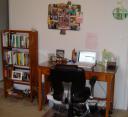
Here is my writing room: (My personal photos haven’t been uploading correctly…)


What do you need/like to have in your writing room? If you don’t have a room designated for writing, do you want one, or do you just like writing anyplace, anytime, anywhere?

Cancer Coverage: The Names Behind the Numbers

With so many articles about cancer, it’s hard to keep track of the latest technologies, treatments, and scientific findings. When I read stories saturated with stats, I can’t help but think, “Enough about numbers. What about the people?”

I didn’t need to ask this question after seeing an interesting package The New York Times ran last week about Deborah Lindler, 33, who chose to have a double mastectomy to avoid getting breast cancer. In the story, Times reporter Amy Harmon writes about Lindler’s decision to undergo this procedure after a DNA test showed that she carried the BRCA1 gene, which increases a woman’s chance of getting cancer by 60 to 90 percent. I’ve heard of women doing this before, but this story touched me more than the others because it had a voice, as did the accompanying video, lists of resources, and multimedia presentation of Lindler’s family tree.

Cancer has broken many branches on my family tree, prompting me to be extra conscious of the disease and its role in my own life. On the one hand, I can sympathize with women who might want to get genetically tested – they want to know if they carry the BRCA1 gene so they can start living a healthier lifestyle, or so they can decide, like Lindler, to get a double mastectomy. On the other hand, knowing they carry this gene might be even more detrimental to women’s health, causing them to worry incessantly about the day they will be diagnosed with cancer, if they get diagnosed at all. I wonder if the extra worry is worth it.

Another thing I wonder about is cost. The woman in the Times piece seemed well off, but what about all the women who don’t have the money/insurance to pay for these types of tests/surgeries?

Making up Lyrics to Songs, Listening to Bad Grammar

All too often, I make up lyrics to songs. Half the time I know I’m not singing the right words, but occasionally it’s fun to pretend jargon has meaning. It wasn’t until I started watching TV in my new apartment that I realized how often I make up lyrics when I can’t decipher what singers are saying. My TV has closed captioning. I haven’t bothered to figure out how to turn it off, so any time a performer appears on Dave Letterman, or whenever a song is playing in the background of a show, I see the lyrics and experience an “Ohhh” moment.

When the song “Linger” comes on the radio, for instance, I usually sing, “You know I’m searching food for you.” But when reading the lyrics on my TV screen the other night, I learned that the Cranberries are actually singing: “You know I’m such a fool for you.” “Searching food for you” doesn’t make much sense, especially when put in context, but phonetically, the lyrics sounded right, and they stuck with me.

Sometimes I just mumble words and don’t even pretend to know the lyrics, like when I listen to the Red Hot Chili Peppers’ song, “Under the Bridge.” At the end of the song, when the tone gets high-pitched, I usually sing, “da na na na da na.” Oddly enough, the lyrics I can’t decipher are perhaps the most important ones of the song: “Under the bridge downtown/Is where I drew some blood
Under the bridge downtown/I could not get enough/Under the bridge downtown/Forgot about my love/Under the bridge downtown
I gave my life away.” It’s funny how important messages can get muffled by misunderstandings.

I’ve also been singing the incorrect lyrics to Timbaland’s “The Way I Are.” I always thought the title, and the corresponding lyrics, were “Handle me the way you are.” I found out I had been singing it wrong after listening to a humorous podcast called “The Angry Grammarian.” Podcast number seven lists several songs with grammatically incorrect lyrics. You’d be surprised how often grammar is butchered in songs.

American Idol star Clay Aikon’s song, “If I Was Invisible” used to bug the heck out of me when I heard it on the radio. The title, and the related chorus, should be “If I Were Invisible.” Alas, I guess Simon doesn’t care so much about grammar.

Some of the discussion groups in the “Good Grammar Is Hot” Facebook group are entertaining/intriguing … not that I read them or anything. There are almost 1,400 discussion groups, and I’m sure at least one of them mentions bad grammar in songs.

Do you have any examples of made-up lyrics that you sing, or of songs that have bad grammar? Are there any songs you know of in which bad grammar sounds better than regular grammar?

One Story Leads to Another …

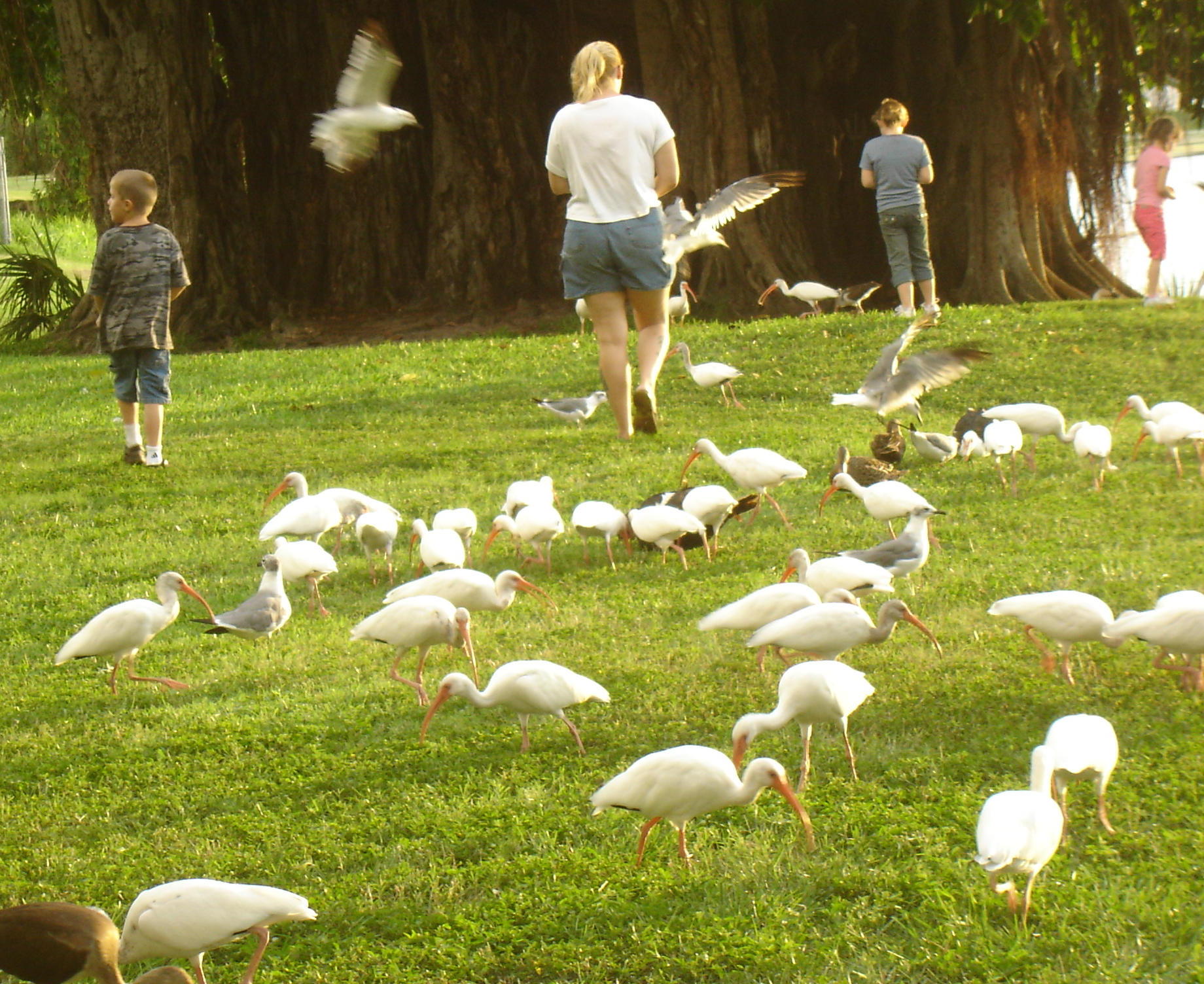
As I walked behind a family feeding ducks, I started to think a lot … about slap bracelets and cranberry-colored spandex. (Click here to see the family that inspired this post.)

It struck me tonight just how often present-day stories remind me of stories from my past. Just like life, the transitions between stories, between each chapter, aren’t always smooth. So I did a little experiment with today’s post: I started off writing one story, then kept writing until it reminded me of another story. Rather than worry about writing transitions and the flow of the post, I just wrote freely, letting the stories blend together and take a shape of their own …

I tend to walk and talk on my phone a lot. Sometimes, I walk around a lake near downtown St. Pete and just watch families feed ducks, middle-aged women power walking, or younger people walking their dogs. It’s a great place to people watch, and I always find myself imagining different stories about the people I see. There’s the old guy who I saw aimlessly walking around the lake with a big smile on his face, and then the group of high school cross-country boys who stampede through the park, shirtless and hairy. About five of these boys have long blond hair, which flops in their face with each step they take. I guess they’re not big fans of hair elastics. They often come charging toward me, their footsteps pounding behind me, getting closer, closer, closer, creating a beaten path.

I’m afraid they’ll run me over, like the time I was walking home from school and a boy twice my size came charging toward me on his bicycle. I used to walk to and from school and would read as I walked. (I suppose I’ve just always liked multitasking while walking.) I was about to cross a four-way intersection, when all of a sudden, I felt a huge bang against my back. My book went flying in the air, the clarinet case I had been carrying flew into the intersection, and I fell to the ground. I looked up and saw the kid who had practically ridden over me, bicycling down the hill. He hadn’t even stopped to say sorry! It was my first encounter with a hit-and-run. The crossing guard rushed over to me and called the police, who took me on my first ride in a police car. They asked me some questions then drove me home, front door service and all.

Naturally, when my mom opened the front door to our house and saw the police car, her eyes widened and she started asking what went wrong. One of the first things she noticed was my tattered clothing. The cranberry-colored spandex pants I had been wearing were decorated with a gaping hole in the knee. Forget the scratch on the clarinet case, or the tire marks on my book — my spandex pants were ruined, and my mom wasn’t feeling it. She wrote a letter to the school and demanded that Danny pay for a new pair of spandex. Danny never got in trouble, I think because he may have had a disability that caused him to act irrationally. I was too young at the time, though, to point fingers or know why he did what he did. A couple weeks after the hit-and-bike as I’ll call it, the school secretary called me to the main office and handed me an envelope with a crumpled $10 bill inside. No apologies, just cash. The cash seemed so valueless.

My mom’s insistence that Danny pay me reminded me of a similar instance involving a girl named Katie who used to sit next to me on the bus. One day, we were comparing slap bracelets. She had a white one with red delicious apples imprinted on it, while I had a sparkly silver one. I was always a glitter girl. Why have just plain crayons or glue when you can have glitter crayons or glitter glue? As a teenager, I wondered, “Why wear plain blue eyeshadow when I can wear blue eyeshadow with glitter? The glitter always got in my eyes, but it made them sparkle … literally. Anyhow, Katie and I used to play with our slap bracelets on the bus, and then one day, she just decided that glitter was cooler than red delicious apples, so she took my slap bracelet and wouldn’t give it back. The nerve! My mom called her mom and asked her if her daughter could give me back my bracelet. Leave it to my mom to settle these types of matters. The next day, my wrist was nicely decorated again with a silvery strip.

But that wasn’t the end of it. Katie used to take lots of my things, especially my pencils. When I would ask her why she was using my pencils, she would say, “My mom bought these for me at Fiske’s,” referring to our town’s general store. Sure. She had the same answer when I asked her why she was using the pencil I bought on a field trip to Sturbridge Village. Sure. The pencil had “Sturbridge Village” plastered all over it.

She wasn’t quite as amusing as the “pencil picker-upper,” though. I used to sit across from a boy named Ben. One day while learning third-grade math, I dropped my pencil and was soon amazed by the speed at which Ben reached down to pick up my pencil. “Here you go,” he said, chuckling. He would play with his pencils and often stick them between his two front teeth. My mom used to call him “Bucky Bucky Beaver.” Intrigued by his impressive pencil retrieving skills, I dropped my pencil again, and Ben quickly swept it off the floor. But alas, his smooth moves didn’t sweep me off my feet. Often throughout the rest of the school year, I would drop my pencil and see how quickly Ben would pick it up for me. It was kind of a game we had, though I don’t know how much Ben enjoyed it.

I was too busy staring across the room at a boy named Chris. One afternoon, when we were putting our chair on our desk (yes, the kinds of chairs with big huge tennis balls on the bottom to prevent the chairs from making noise when sliding across the floor), my classmate Travis walked up to me and whispered, “Mallary, Chris thinks you’re a cutie pie.” A cutie pie?! I thought. Wow, a cutie pie sounded so much better than just plain old “cute,” or “funny,” or “nice.” “Cutie” is better than “cute” because it has two additional letters tacked on to the end of it, and pies are, well, tasty and sweet. Nothing could be better than calling someone a cutie pie, I reasoned.

On Valentine’s Day, my mom and I rode our bikes to the local CVS and walked through the candy aisle to try to find a valentine for Chris. My mom finally picked one out for me, even though I thought it was a little too daring. It was a big chocolate heart that had a face and was driving a red car. Above the heart, the words “You drive me crazy” appeared. I stuck the valentine in Chris’ mailbox but signed it from “your secret admirer.” So cliche, but so fitting for a third-grader. What would he say when he saw the valentine? Would he eat the heart or savor it for years to come? What if he doesn’t eat chocolate? Would he figure out that I had been his admirer? I never found out the answers to these questions because I hardly talked to him after that. The cutie pie comment drew me to him, but scared me away, too.

I don’t know if my cranberry-colored spandex are still sitting in a Good Will somewhere in Massachusetts, or if my sliver slap bracelet is still slapping. I don’t know if Katie has a stash of “pencils she bought at Fiske’s” buried somewhere in a desk drawer, and I haven’t heard from Ben or Chris in years. Though these things and people are missing from my day-to-day life, their stories are never hard to find. Their stories exist in memory, ingrained in time and ready to be retrieved. Sometimes writing about these stories keep them alive, ensuring their longevity long after we die. Often, where memories fail, writing speaks. So when I observe something in the present day, I try to think about what it makes me think of — longing, childhood, fear of the future, laughter, solitude. Soon enough, by the time I’m done with my walk, I’ve sketched a labyrinth of stories for myself, one that tangles me up in time but also sets me free.