A few changes to the blog

You may have noticed that Word on the Street has a slightly different look now. I had been wanting to switch up the look and feel of my blog for some time, so when the widgets on my blog stopped working last week, I decided it was a good excuse for a change.

While browsing through the various WordPress blog templates, I found one called “Manifest,” which I chose for its simplicity. I like that it places an emphasis on the text and has a lot of white space surrounding each post. White space can be helpful for both writers and readers; in stories it acts as a visual index that draws people’s attention to a particular part of a story. On screens, it helps emphasize what is most important — which in this case is the blog posts.

I also did something I’ve been meaning to do for several years; I bought the domain name mallarytenore.com. I mapped it to my WordPress blog, so now I can direct people to mallarytenore.com instead of the clunky mallaryjeantenore.wordpress.com.

Lastly, I changed my blog’s tagline from “Thoughts from a young journalist looking for stories in the shadows of the Sunshine State” to “Articles & personal essays from a young journalist in the Sunshine State.” My new tagline is less wordy and more reflective of what my blog’s all about.

Ahhh/yesss! (That’s the sound of productiveness.) It feels refreshing to do something you’ve been meaning to do for a while. Sometimes, it’s just a matter of finding ambition from within — and embracing change.

How do you like the new look and feel of the blog?

New Yorker’s Orlean: ‘Writing is equal parts heart & muscle’

I love this tweet I saw last week from New Yorker writer and author Susan Orlean: “Writing is equal parts heart & muscle: the heart to fall in love with a story you want to tell, the muscle to get it done.” That’s so true, especially when it comes to personal stories that mean a lot to us but take strength to write.

The tweet was part of a live Twitter chat that Orlean held. Here are a few other great tweets from the chat:

On writing, reading books:

“When a story keeps growing and growing and feels sweeping in some way, it starts to seem like a book idea. It’s a gut feeling.”

“Making the story your own is more important than being the first writer to tell the story. It has to have your heart in it.”

“Reading a book should be like sitting with a charismatic person who is telling you a wonderful tale, fact or fiction.”

On oral storytelling, reading drafts out loud

“In all the best writing, you feel the presence of a real person talking to you, even if it’s not first person.”

“That’s why I turn to oral story-telling as a model: the best writing should feel like conversation, not written.”

“That’s why I read my drafts out loud always: the best, cheapest, fastest way to self-edit. You hear the slow and awkward parts.”

“You hear where the rhythm is off, where the pacing flags. Reading it on the page will convey all that, too.”

“The story — and the voice follows, once I feel I know the story well enough to tell it.”

“You want to do that reading aloud somewhere no one can hear you, lest they think you’re insane.”

But, she also says: “I read to my husband, who is a great editor and sounding board. And brutally honest, at his peril.”

“I read my own audiobook; I wanted to. I’d rather hear the author unless he/she isn’t a good reader.”

On story ideas:

“Finding good stories is the single biggest challenge. You need to look outside what’s familiar to be surprised and intrigued.”

“Story ideas lurk everywhere. I try to read, listen, ask as much as possible to stumble on new ideas.”

“Then I try to educate myself. I try to learn everything I can about the subject first-hand.”

“I read and listen to things outside my usual interests, hoping something will spark my curiosity. I eavesdrop, too.”

On cats, (just for fun):

“I’m fighting with my cat right now, who has suddenly fallen in love with the keyboard.”

3 simple steps to becoming a better writer: Read, write, and talk about reading and writing

I’ve always thought that to be a good writer, you have to be an avid reader. Reading exposes you to different writing styles and helps you figure out which style(s) you identify with most. It can also give you ideas for stories, characters or scenes.

I’ve always loved to read and write, and have often thought the two went hand-in-hand. I was the girl who was known for reading a book while walking nearly two miles to and from school every day. I spent weekends at the library. And I preferred reading and writing to sleeping. After saying goodnight to my parents, I’d turn on my secret flashlight and start reading or writing stories.

Not all writers enjoy reading, though. And not all book lovers enjoy writing.

At a recent book signing, author William Giraldi said he likes reading but doesn’t like to write. Giraldi, a Boston University professor, said his students are the opposite; they love to write but don’t seem as interested in reading. He said there’s an analogy there that he hasn’t been able to complete yet: “Wanting to write without wanting to read is like wanting to ____ without wanting to ____.”

The New Yorker’s Macy Halford, who was at the signing, explained:

[Giraldi would] come up with a couple, unsatisfying answers, one involving race cars, one involving sex (he wouldn’t tell us what they were). But he threw it out to the audience to ponder, and now I’m throwing it out to you. What is wanting to write without wanting to read like? It’s imperative that we figure it out, because Giraldi’s right: it’s both crazy and prevalent among budding writers. I’d also welcome theories on why it’s prevalent—is writing a more natural activity than reading? Does watching stories unfold on TV or in film give kids the same creative urge that reading does? Is it just that it’s easier to see your ego in words you wrote yourself?

Sure, it’s easier to see your ego in your own writing, but I wouldn’t say that’s why most people write. We write because we get something out of it — a release, a feeling of accomplishment, a connection with readers, a deeper understanding of an emotional experience. I prefer writing to reading, but I try to read as much as I can. I used to try to read a variety of books, but now I just read what I like, which is mostly memoirs. I’ll “sample” other books (aka browse through them and look for interesting passages or good writing) but I don’t see the need to read something that doesn’t interest me just for the sake of exposing myself to a different genre.Just as reading can help you become a better writer, so can talking about it.

My colleague Roy Peter Clark has often said that to be a better writer, you have to read, write, and talk about reading and writing. I started tutoring a 6th-grade boy in writing a few months ago, and this is one of the main points I try to get across. Each week, I talk with him about the book we’re reading and ask him questions about his writing assignment. In hearing his responses, I can identify the challenges he faces when writing and help him think more about the choices he makes as a writer.

Reading, writing, and talking about reading and writing all factor into becoming a better writer. And based on my experiences at work, I’d say that editing also helps!

Clara the Cat isn’t perfect, but she’s just what I need

Clara likes watching me type on my computer late at night.

I’ll admit it — I’m a Cat Lady. I have just one cat, but I love her and spoil her as if she were my kid.

For the past three years, Clara the Cat been there. Whenever I come home after a long day at work, she greets me, silently meowing from behind panes of glass. Clara usually falls asleep shortly after I get home, but I still like knowing she’s there. She makes the apartment feel less empty, and makes me feel more whole. When you live alone, you grow to rely on your pet for company, and comfort.

Clara’s not perfect. She meows a lot and pulls at my hair when I’m trying to sleep. She sheds all over my apartment and breaks my blinds. And she sleeps on the kitchen table, despite my repeated attempts to get her to stay off it.

But still, she’s a keeper.

I couldn’t help but feel bad when I was out of town for her 3rd birthday earlier this month. I had asked someone to feed her, but he forgot, meaning Clara was left alone for four days with no one to celebrate with. Poor kitty. Usually on her birthday, I give her wet food and blow up some balloons for her to play with. Then I take a bunch of photos of her. (I know, some of you might be rolling your eyes by now. But hey, I warned you I’m a Cat Lady!)

One of my favorite food bloggers, Joy Wilson, recently threw a little birthday party for her cat Jules. She made him a tuna “birthday cake” and tied a yellow bow around his neck. She also created “Cat Land” for him, giving him full access to his favorite toys — headphones, an earring, toilet paper …

Headphones would also be on Clara’s list of favorite toys. She’s eaten her way through three pairs. Her other favorite toy is “Da Bird” — a feather on a string. Pretty simple concept, but highly entertaining nonetheless. My laptop would also be among Clara’s favorite toys. Whenever I’m typing, she sits alongside me and places her paws in front of the keyboard. Sometimes, she’ll walk across it. Whenever there’s a typo in my blog posts, I blame her.

She’s here with me now as I’m writing this post, occasionally hitting the keys. She’s keeping me company in her imperfect way, making me realize that even when I’m home alone, there’s really no need to feel lonely.

Women in tech deserve more coverage, attention

This New York Magazine story does a good job describing “the Steve Jobs & Mark Zuckerbergs of the future,” but it perpetuates the false notion that there aren’t innovative female programmers worth highlighting or quoting as sources. Not one woman is mentioned or quoted in the 4,200-word story.

As I read the piece, I was reminded of an April 2010 New York Magazine story featuring 53 tech innovators, only 6 of whom were women.  That story prompted Rachel Sklar to start Change the Ratio, a Tumblr blog aimed at changing the ratio of opportunity, visibility & access for women in tech. At the time, Sklar wrote:

If only 6 out of 53 featured NYC tech superstars are women, then are we using the wrong criteria? And by “we” I mean the royal we – we the media, in the criteria we are using to assess “success,” and in how we the industry are looking to galvanize, recruit and train. I would venture to say yes — below the surface (or, at least according to the average Foursquare leaderboard) there is a robust presence of women — more than 12%, at least! — making things happen and contributing to the whole. If the data is there, and the resources are there, then all that remains is to do something about it. If we can make a foosball table smarter, than surely we can do that.

I agree. I’ve written about the lack of women in tech several times and have been disheartened by how much more coverage men get. There are some efforts — such as Sklar’s Change the Ratio, Dan Abrams’ TheMarySue.com and The Huffington Post’s new Women in Tech site — that have helped change that. But there’s still a lot of work to be done.

You could make the argument, “Well, there aren’t enough women to feature!” But that’s hogwash. Just because there are fewer women in tech doesn’t mean they don’t exist and that we shouldn’t report on them. We just have to look a little harder to find them.

My not-so-simple response to the question: ‘So, why did you become a vegetarian?’

Earlier this summer, I ate a piece of red meat. It was the first time I had eaten meat in two-and-a-half years, and for a while after, I couldn’t stop thinking about it.

My boyfriend had given me a tiny sliver of beef from his enchillada after I made a deal with him.

“l know how much you love mushrooms,” I told him sarcastically. “I’ll eat a piece of your meat if you eat one of these mushrooms off my plate.”

“You won’t do it,” he said, knowing that when someone tells me I can’t do something, I usually try to prove to them that I can.

“Oh yeah?”

I put a mushroom on his plate and he put a piece of beef on mine. A look of disgust on my face, I cut the meat in half, closed my eyes and broke the rules. I expected it to taste unfamiliar. Instead, it tasted like home. In the few seconds that it took to eat it, I was reminded of my dad grilling hamburgers and my mom sticking a fork in one and putting it on my plate.

Mom used to love meat — especially when it came from a fast food joint. Burger King Whoppers were her favorite. She wasn’t overweight, but she knew what she liked to eat and wasn’t afraid to indulge herself. I wasn’t either. I remember how much I enjoyed biting into Whoppers. The mayonnaise and ketchup mixture would ooze out of the bun onto my little hands. More often than not, it’d end up on my shirt.

Mom and I also went to McDonald’s at least once a week for lunch. She was convinced that the Happy Meal toys would be worth something someday, so we started collecting them. I think Mom liked the cheap price of fast food as much as the taste of it. She was always on the lookout for bargains, especially when it came to food. She loved getting free food at events, and often went grocery shopping on the weekends just for the free samples. Whenever our local grocery store had deals on lobsters, we’d flock to the store, peer into the lobster tank and buy the biggest ones. When we got home, Mom would start boiling a pot of water and then take the lobsters out of the grocery bag. She’d put them on the kitchen floor next to the washing machine, aka the starting line. The kitchen table a few feet away was the finish line.

“On your mark … get set … Gooooooo!” she and I would yell in unison.

The lobsters, their claws closed shut with rubber bands, would start crawling. Sometimes, they charged ahead. Other times, they’d just sit there or start meandering in the wrong direction. Whichever lobster was farthest away from the kitchen table after a few minutes went into the pot first. You’d hear the lobster let out a little scream and see its antennae moving around. Mom would put the lid on the pot and I’d wave goodbye.

Mom and I had fewer lobster races after she was diagnosed with breast cancer at age 37. The chemo made her lose her appetite and feel nauseous. Eating began to seem more like a chore, a means for survival. Mom would sit in front of her plate and play with her food, a look of pain on her face. Eventually, the cancer spread to her bonemarrow, her liver and her brain. She became so weak that she stopped eating altogether and had to be fed intravenously.

When I was 11, Mom lost her battle with cancer. Though I could see her getting sicker during her three-year battle with the disease, I wasn’t prepared for her death. I had still been holding onto the hope that, someday, we’d be able to start up our Happy Meal toy collection again and hold more lobster races. These things just wouldn’t be the same without Mom.

The night she died, Dad and I tried to watch “America’s Funniest Home Videos” as we usually did on Sunday nights. Canned laughter ensued as we sat in silence. I wondered how people could be happy when it seemed the whole world should be sad. Skipping dinner, I went to bed feeling empty.

“Do you want to talk, Mal?” Dad asked.

“No. I just want to be alone,” I said, even though I wanted nothing more than to hug him and cry.

I pulled the covers over my head and stared into the darkness, unsure of how to express what I wanted and what I was feeling. In denial, I pretended things were fine and told myself not to be sad.

“Erase it from my mind, erase it from my mind,” I whispered, scratching my head and repeating a phrase I’d say whenever something bad happened. I didn’t know that, years later, everything I had temporarily erased would leave such a lasting mark.

In the days following Mom’s death, I pretended to be strong. I wrote a eulogy at her funeral and tried to convince everyone that everything would be ok. “Now we should all still cry, and we should always keep Robin in our hearts, but we cannot let it bother us for the rest of our lives,” I said. “We can’t keep going back to that old chapter, but look forward to the new chapter in our lives, and just hope that it brings us the best of luck and much happiness.”

I remember feeling disconnected when I read the piece, confused as to why I felt the need to write about my mom’s death in a Hallmark card kind of way. At the time, I thought I was strong. And I was, but I didn’t realize that being weak when we need to be can make us strong later on. When we cry, when we make ourselves vulnerable, when we readily admit that losing a mom is nothing short of devastating, we learn to see the value in being honest with ourselves. Hiding these realities only delays the grieving process, making us surrender to sadness later instead of embracing it in the moment.

But try telling that to an 11-year-old.

For as much as I wanted to help others move on to the next chapter in their lives, I was stuck. I tried clinging to the past as a way of hiding from the reality that mom wasn’t coming back. Feeling as though I had lost all control, I turned to something I could control: food. I started monitoring what my dad ate and told him that he should stop eating so much red meat and start eating more vegetables. I soon realized, though, that Dad was going to eat as many chicken wings and ribs as he wanted, no matter how many times I told him not to.

So I started controlling my own food intake. I had a health teacher at the time who said red meat was fatty, and that you shouldn’t eat too much of it. It seemed like a logical choice, then, to remove it from my diet. Soon after, I cut out all meat — and almost all foods except for fruits and vegetables. I figured if I stayed the same weight that I was before Mom died, I could pretend things were still the same. If I wore my hair in pigtails and pretended I was forever young, people would care for me. I’d be the little girl, the one without a Mom, who needed their love and attention. I’d be special.

As I continued to lose weight, I saw my dad grow weary. He, too, was losing weight because he was so worried. Mealtimes often ended with a fight. Dad’s sweet, innocent girl who got straight A’s and never talked back to her parents gradually became more and more argumentative.

“Stop telling me what to do!” I’d yell.

“Mallary, you need to eat. Please, just a few bites.”

“No! I’m not hungry.”

“Mallary, you haven’t eaten all day and you’re wasting away to nothing. You can’t keep doing this to yourself.”

“Dad, you’re overreacting! I’m not doing anything to myself. I’ve got this under control, ok? Just leave me alone.”

“Mal …”

“Leave me alone!”

Then one night he scared me.

“Mom fought so hard to survive,” he said. “Now you’re just letting yourself die.”

I knew he was right, but I pretended not to care. I went to my room, slammed the door and started exercising. The thought of being able to eat a Happy Meal, let alone feel happy, was beginning to seem more and more like an impossible dream. Along with doing leg revolutions in bed at night and shaking my leg whenever I sat down, I would jump — as high as I could. It sounds so odd now, but at the time I didn’t care what people thought. I wanted to burn calories, and if that meant jumping and making a fool of myself, then so be it. I jumped in the grocery store aisles, in the library and at church, embarrassing my dad and grandma.

They pleaded with me to stop, but for as much as I wanted to, I couldn’t. I felt so alone.

My dad admits now that he felt as though he was losing his little girl. He realized he couldn’t help me on his own, so he took me to my pediatrician, who simply said it was “normal” for pre-teen girls to be picky about eating and to cut out foods such as red meat. The doctor couldn’t have been more oblivious. Knowing that my weight loss was more than just a side effect of being “picky,” my dad contacted one of my mom’s old friends — who was a nurse — to ask her where he could take me to get help.

A few days later, I was standing on a scale at Children’s Hospital in Boston. At 66 pounds, I was fragile and secretly longing for an excuse to rest — to lie in a hospital bed like Mom did and not have to jump or shake my leg. I got a lot of cards while I was in the hospital. Most of them said, “Get better soon!”

If only it were that easy.

I was put on a specialized meal plan and had to eat a certain amount of calories each day. Meat was on my list of “forbidden foods.” For protein, I instead chose foods like cottage cheese and hummus. A lot of anorexics will tell you that these are “safe” foods and that meat is a “scary” food. The thought of eating meat quickly sparks images of people chowing down on a McDonald’s hamburger or a Burger King Whopper. It’s easy to equate meat with gluttony and fear — fear that if you eat just one bite of meat, you’ll gain weight.

I feared that anything I put into my body would make me fat. I would draw pictures of snowmen in my journal and scribble the word “ME” next to them. I’d write out everything I had eaten on a given day and then tally up the number of calories I had consumed. But I hardly had time to talk about these journal entries or the origin of my eating disorder while in the hospital. I went to therapy sessions, but the staff was more concerned with stabilizing me physically. I left the hospital feeling physically stronger but emotionally weak.

After four hospitalizations and two stays in the psychiatric ward at Children’s Hospital, I went to a residential treatment facility where I stayed for a year-and-a-half. The rule for eating disorder patients was the same there as it was in the hospital: If you didn’t eat your meal within 30 minutes, you had to drink Ensure supplements. If you didn’t drink the Ensure in 15 minutes, you’d “get the tube.” Several times, I ended up drinking the Ensure. I’d stare at it for 10 minutes and then chug it in the last five minutes so I could avoid having to be fed intravenously.

“Mom fought so hard to survive,” I remembered my dad saying. “Now you’re just letting yourself die.”

With time and the help of a therapist, I began to understand how my feelings about food and my mom’s death were tied together. I started gaining confidence and began finding ways to ground myself in the present rather than hiding in the past. I tried different types of foods and eventually began eating meat. For whatever reason, I don’t remember exactly when I started eating it again, or how I felt when I did.

I kept eating meat when I left the residential treatment facility in September 2000, and continued to eat it through high school and most of college. Then toward the end of college — likely because I was worried about the changes that would come with graduation — I started cutting red meat out of my diet. I tried to convince myself that I didn’t like it and that I didn’t need it. Two years after graduating college, I cut out all meat and fish. If I’m going to cut out red meat, I told myself, I might as well go all the way.

I liked hearing people’s reactions when I told them I was a “full-fledge” vegetarian. Even more so, I liked the attention.

From the non-vegetarians:

“You don’t eat meat? You don’t know what you’re missing!”

“You don’t even eat fish? Wow!”

“You’re going to stop being a vegetarian once you get a whiff of these awesome barbecue chicken wings.”

“I don’t know how you do it!”

From the vegetarians:

“Oh. my. God. Did you read ‘Skinny Bitch‘?! That book TOTALLY made me become a vegetarian.”

“I saw ‘Food Inc.’ and it made me never want to eat animals again.”

“I don’t know how people eat meat. It really grosses me out.”

“I feel so much healthier being a vegetarian.”

Inevitably, people from both ends of the spectrum ask: “So, why are you a vegetarian?”

It’s one of the hardest questions for me to answer. There are so many reasons why. Usually, I respond by saying that I don’t like the idea of eating animals. Sometimes I’ll also mention that my mom didn’t cook a lot of meat for me when I was a kid. That’s true, but it doesn’t account for the fast food trips we’d make.

While I hate the idea of animals being killed for human consumption, that only explains a small part of my reasoning. My decision to become a vegetarian is partly a manifestation of the idea that I should always be looking for ways to cut calories. By being a vegetarian, I can cut certain foods out of my diet without raising eyebrows. I don’t have to explain why I’m not eating meat or fish; it’s understood.

But how do you explain that to someone, especially someone who doesn’t know you’ve struggled with an eating disorder?

I’m healthier now than I ever imagined I would be. I can go out to eat with friends and family. I can treat myself to gelatto when I’m craving it. I can cook meals — including meat dishes for others — without feeling grossed out or fearing that the smell of food will make me gain weight. I can eat without having to be told to do so.

But still, I struggle.

I hide and hoard food. When I see free food I think of Mom and grab as much as I can. Then I feel guilty for taking so much, so I eat it in secrecy. Some days, I go for long runs and hardly eat anything. Other days, I binge. To prevent binges, I buy fresh salads and wraps every day so that I won’t have to keep food at home. But as anyone who struggles with overeating knows, there are always ways to find food.

I’ll eat just about anything during a binge, but I’ve never turned to meat or fish. This ability to control part of my food intake even when I feel so out of control is proof that my vegetarianism isn’t just about feeling “special” and getting attention. In large part, it’s about genuinely not wanting to eat meat. Now I just need to find more ways of filling the gap between what my body needs and what I’m willing to give it.

We can learn over time to listen to our bodies — to eat when we’re hungry and stop when we’re full. We can tend to the wounds of the past and work not necessarily toward “full recovery” but toward a process of healing. To heal, we have to recognize the progress we’ve made and not be hard on ourselves when we stumble. I try to avoid catastrophic thinking by reminding myself that one bad day of eating doesn’t have to ruin my entire week. When I start to slip into old habits, I think of something my grandma often says: “I live every day my kids didn’t get to live.” After she lost both her daughters to breast cancer, she promised herself that instead of focusing on what she’d lost, she’d focus on what she was still lucky enough to have.

Someday, I want to have kids of my own. I want to cook for them and make eating a fun and communal experience. I want to take them up north to visit my dad so he can grill them hamburgers and spoil them with ice cream. I want to lead by example and teach them to listen to their bodies. I want to be healthy enough to see my kids go to prom, graduate high school and start their first day in college — moments my mom never got to experience. Mom would want me to experience these things, and to be happy and healthy.

I don’t know that I’ll ever fully overcome my struggles with eating. And as much as my boyfriend would love to see me eat a beef enchilada someday, I’m not sure I ever will. I do know, though, that being with him has helped me normalize my eating habits and made me happier. And it’s helped show me that, especially during tough times, being with someone is so much better than being alone.

Teaching Twitter to journalists, hoping to make an impact

Today I taught in a Poynter seminar for news anchors. As I was getting situated in the classroom before everyone else had arrived, I wondered if I had what it took to teach such an experienced group of journalists. But as the anchors entered the room, it became clear that I had little to worry about. They greeted me with their big TV-personality smiles and seemed eager for the session to start.

No need to feel intimidated anymore. I know this stuff. No need to worry, I told myself.

I had 10 main social media tips I wanted to teach, but I only got through about four of them. The last time I taught this session to a group of news editors last month, I got through all 10 tips. The difference in the two groups reminded me that when teaching, you sometimes need to modify your lesson plan to fit the personalities and needs of the people you’re teaching. You need to meet them where they are, and hope they’ll trust you enough to let you lead them out of their comfort zone.

I think they trusted me.

To gauge their familiarity with Twitter, I asked the anchors how familiar they were with the site. A few of them were regularly tweeting, while others were on Twitter but hadn’t used it in months. Some weren’t on Twitter at all and hesitated to join. I realized early on that I’d have to turn my more advanced social media presentation into a Twitter 101 crash course. By the end of the session, everyone learned how to create Twitter lists, and search for sources and ideas on Twitter. And everyone who wasn’t already on Twitter created an account. (Score!)

Teaching the anchors reminded me how much I value face-to-face interactions. Because I interview journalists nationwide, I hardly ever interview people in person. And all of the freelancers I work with are spread around the country, so we talk via email or phone. Teaching journalists in person makes it easier for me to quickly form connections with them. After I taught, I got to coach some of the anchors 1:1. We mostly talked about Facebook and Twitter, but we also cracked jokes and talked about our personal lives and interests.

I hope to have more opportunities to teach in the future. Even if I help just a couple of journalists in each seminar, I can feel confident in knowing I’ve made an impact.

Finding confidence, pursuing new opportunities at work

There are times when I lack motivation and wonder if the work I’m doing is having an impact. I think we all feel that way from time to time, especially if we’re not getting the reinforcement we need at work.

I’m lucky enough to have a boss who gives me a lot of constructive feedback. And lately, I’ve gotten some good reminders that people are reading my stories and responding to them.

Following some pieces I wrote about the News of the World phone hacking scandal last month, I was interviewed for a CNN.com story about why the scandal became a global story. That same week, I was asked to talk about the News of the World fallout as a guest on “Studio 12,” a PBS show that airs throughout Colorado.

I had never been a guest on a TV show before, so I was a little worried about how I would come across. I thought, “I’m not an expert on this subject. I shouldn’t be the one to talk about it.” As I said that, though, I was reminded of a story I wrote earlier this year about the lack of women who contribute to opinion pages. Women, I learned, often underestimate their abilities and say things like, “I’m not an expert in anything. You should really ask another person. I don’t want to be pretentious or snotty. I don’t have a Ph.D.”

I didn’t want to do the same thing, so I decided to challenge myself and pursue the opportunity. I’m glad I did because I came away feeling both humbled and confident — humbled to have been asked, and confident that I was able to answer the interviewers’ questions and sound at least somewhat intelligent. (You can watch the show — which I was interviewed for via Skype — here.)

I tried to remind myself of this feeling of confidence when I taught in a Poynter leadership seminar last week. One of my colleagues invited me to teach a session about using social media to find story ideas and build an audience. I like to think I teach people through the stories I write, but I wondered how effective I’d be as an actual teacher. Turns out, I loved the classroom experience and have agreed to do more teaching.

It’s tough entering a classroom full of participants who have a wide range of social media skills. But I asked participants questions throughout the session to gauge where they were at. This helped me, and it gave the participants an opportunity to teach each other by sharing their own experiences. Teaching was a good reminder of how much I’ve learned about social media throughout the years — mostly through reporting on it. It also helped me realize that just because I regularly use social media sites and tools doesn’t mean everyone does.

The past few weeks have been reaffirming and have given me a renewed sense of energy. It’s easy to get in funks at work, but when we set goals for ourselves and pursue opportunities that push us out of our comfort zone, we can often find the confidence and affirmation we need.

14 years later, still finding signs that Mom’s with me

This Sunday, my Mom would have been 55. She died all too early at age 40 after a battle with breast cancer that robbed her of the ability to accomplish all her goals in life. The cancer weakened her physically, but it taught her to be a fighter — to bear the side effects of chemotherapy, to keep her family grounded, to move forward even when she felt like giving up.

I think I can, I think I can, I think I can, she’d say, pretending to be the Little Engine That Could.

I often think about all the milestones Mom would have experienced with me if she were still here. She would have gotten to see me graduate from college (an opportunity she never had growing up); land a job in the field I’ve always wanted to pursue; and carve out a life for myself 1,350 miles away from home.

My dad tells me Mom would be proud of me for accomplishing these things. I like to think that’s true. Tonight, he sent me a sweet note that made me think about how, even long after loved ones have died, we can find signs that they’re still with us and want us to be happy.

Here’s the note, titled “A special message from dad”:

Hi Mal,

Mom would be 55 this Sunday, hard to believe. I was looking at your baby book when I was cleaning up the room downstairs. I thought it would be nice to share with you the dreams that Mom and I had for you when you were born.

Mom’s dreams:
To love and respect your parents
To take care of your family
Always have a sense of humor and a caring smile
Be kind to others, so they will be kind to you
To be what you want to be when you grow up
To go to college

Dad’s dreams:
To always be happy
To always feel loved
To always give love
To always have a beautiful smile and a kind word for others
To obtain your goals in life
To live a life when you grow up that reflects the dreams of your childhood.

I am very proud of you, and Mom would be too.

Love,
Dad

It’s funny how similar my mom’s and dad’s lists are. For the most part, I think I’m living out their dreams. I just wish my Mom could be here to see them come true.

Slowing down long enough to relax, smell the flowers

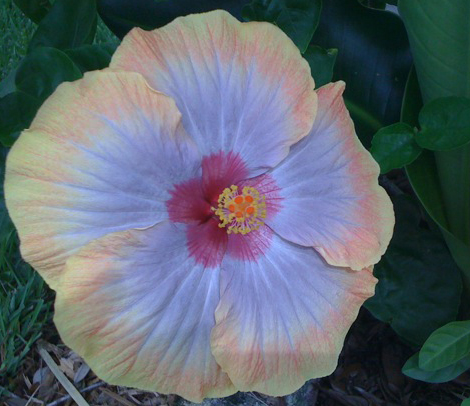
A flower I spotted in the Old Northeast. my neighborhood in St. Pete, earlier this week.

Whenever I tell my grandma I’ve been super busy, she responds with the same advice.

“Maaaaallary, you need to stop and smell the flowers.”

“I know, I know,” I tell her, rolling my eyes. Slow down? Yeah right.

The other day, though, I followed her advice. Literally. As I was running, I saw a flower that was calling for attention. It had perfect purple petals with a hint of yellow on the edges and a bright pink center. I stopped to catch my breath and studied it for a minute, wishing it was more fragrant. As sweat dripped off me and fell onto my phone, I snapped a photo of the flower. Click.

Then I ran away.

I’m always running — figuratively and literally. My mind regularly races with thoughts as I think ahead to the next hour, the next day, the next week. I’m like the Energizer Bunny, always going, going, going.  I can relax more when I’m with others but it’s a lot harder when I’m by myself. I spend much of my alone time focusing on food and exercise to the point where it’s hard to focus on anything else.

With time, I’m learning to find a new focus and slow down.

My grandma helps remind me of the importance of this. She lives out the cliche she preaches, literally stopping to smell flowers when she sees them in the grocery store or when she walks by her garden. Because she’s older, she naturally walks slowly and couldn’t move fast even if she wanted to. Old age has forced her to slow down.

Sometimes, we have to force ourselves to do the same. The more we stop and relax, the more we realize that we can afford to take breaks. We start to become more aware of how we feel when what we want to do conflicts with what we feel we have to do. We pay more attention to the uneasiness we feel when we start surfing the Web at night only to find ourselves doing work we should have left at the office. We try remind ourselves of the joy we get out of shutting off the computer and watching a funny movie, or curling up with a good book. We slowly begin to see the value in taking a breath, a break.

We’re not always going to make time to stop and smell the flowers. When we do, though, we just might start seeing all we’ve missed.