Helping to Put Together Poynter’s Book of Election Front Pages

obamaRecently, I helped put together The Poynter Institute’s new election front page book, which features 75 newspaper front pages from around the world.

My editor, Julie Moos, thought of the idea for the book and led the institute’s efforts in putting it together in just two weeks. The goal was to have it published in time for the holidays and the inauguration. Poynter faculty member Sara Quinn co-edited the book and selected which front pages should be used. “Doonesbury” creator Garry Trudeau wrote the book’s introduction. (Definitely worth a read!)

Several Poynter faculty and staff members contributed to the book. I wrote some captions, which required doing a bit of research and, in some cases, talking to design editors at the papers I was assigned to write about. I wasn’t the sole copy editor for the book, but I helped edit it after we received the proofs. I also had the opportunity to speak Spanish with editors of publications in Spain when asking for a PDF of their front pages and permission to reprint them. I love having opportunities to use my Spanish-speaking abilities.

This book is a bit different from other books Poynter has published, such as “Best of Newspaper Writing,” in the sense that it wasn’t text-heavy. Nevertheless, it still required a great deal of editing and it helped me develop a greater appreciation for all the work that goes into putting together a book under a tight deadline. Collaboration in these kinds of projects is key.

The Obama front page book is now available at bookstores and at the Poynter store. It could make for a good holiday gift. I know my family can expect to see a few copies of it under the Christmas tree.

How Facebook, TotSpot and Other Social Networking Sites Help Transform Traditions

I wrote two stories recently for The Dallas Morning News about the ways that people are using social networking sites to transform traditions and connect with the world around them. One of the articles is about brides using Facebook to plan for their weddings. I got the idea for this story after my colleague’s fiance posted photos of her engagement, with detailed captions explaining how the engagement happened.

I started searching for Facebook wedding applications soon after seeing these photos and found that there are quite a few applications for soon-to-be brides and grooms. It was amazing to see how Facebook and MySpace are essentially replacing the need for traditional newspaper wedding announcements.

The other story I wrote is about moms who sign their toddlers up for social networking sites geared toward kids, such as TotSpot and Kidmondo. Moms actually create profiles for their children and write on one another’s walls, in essence assuming the identity of their kids. They write about “their” burps and farts, about their first steps, about how their nose scrunches up whenever they’re fed baby formula, etc.

When editing these stories, my editor, Mike Merschel, pushed me to think about the deeper meaning they relayed. We didn’t just want these to be articles that said, “Hey, look, this is a neat trend.” We wanted them to speak to something larger than that, perhaps to a universal truth that would resonate with the greater population, even with those who aren’t all that Web-savvy.

In thinking about this deeper meaning, I realized that in the case of the wedding story, social networking sites are transforming, if not replacing, traditional ways of planning weddings, making the process a more shared and open experience. In the case of the TotSpot story, social networking sites are acting as alternatives to traditional play groups and face-to-face parental interactions that some moms nowadays say they simply don’t have time for.

Nut graf for the Facebook wedding story: “Many soon-to-be brides and grooms have found that the sites do more than just make wedding planning more fun; they turn what has traditionally been a personal, behind-the-scenes process into a shared, and more transparent, experience.”

Nut graf for the TotSpot story: “The messages, of course, are from parents, usually moms, who say sites such as TotSpot provide them with time-saving alternatives to play dates and face-to-face relationships, while helping them connect with parents and children in nontraditional ways.”

For both stories, I found my sources on Facebook. I typed in “TotSpot” and “Wedding Book application,” for example, then searched through hundreds of users and sent messages to the Facebook members in the Dallas/Fort Worth area. Each time I reached out to Facebook users, about 75 percent of them responded either with a phone call or a written message.

I’d love to hear your thoughts about these articles. How else have people been using social networking sites in new and interesting ways?

The Story Behind NPR’s ‘A Changing Frontier’ Series

While surfing the Internet the other day for diversity-related stories, I came across National Public Radio’s five-part series on the U.S.-Mexican border. I was particularly struck by the way that NPR correspondent Jason Beaubien described the tension that exists between the U.S. and Mexican cities that straddle the border. They are so close geographically, but in theory, they are worlds apart.

Intrigued by the series and interested in learning more about the reporting process behind it, I e-mailed Beaubien with some questions and later talked with him on the phone. When I asked him to sum up his series in one word, he used the same, aforementioned word that kept running through my head as I read and listened to the series: tension. “Since doing this series,” he said, “I sometimes picture the border as an elastic band that’s pulled just to the brink of snapping.”

You can read my Q&A with Beaubien on Poynter Online.

Combating Loneliness and Its Myths

I was surprised to open my mailbox Tuesday night and see a New York Magazine cover story with the headline: “The Loneliness Myth.” The word “loneliness” stuck out at me because it’s a word that I’m forever trying to understand. New York Magazine provides some background on the history of loneliness, saying that it “evolved in hominids hundreds of thousands of years ago, when group cohesion was essential to fight off abrupt attacks from stampeding wildebeests. It’s nature’s way of telling us to rejoin the group or pay the price.”

Sometimes, the price can be costly. For some, repeated bouts of loneliness can lead to long-term isolation, poor eating habits, states of depression and more. It seems the best remedy for loneliness is friends, and perhaps, as New York Magazine suggests, cities. Aristotle wrote in “The Nicomachean Ethics” that “friends are the glue that bind cities together.” I found this to be true when I lived in Boston and Providence. No doubt, one of the hardest parts about moving away from home after college was leaving the family and friends and being forced to find new friends 1,300-plus miles away from home.

So, I made an effort to get to know as many people as I could in hopes of building my circle of friends. And then I dated — a lot. My friends from home joked with me and called me a “dating machine.” My single friends disregarded any notion that Florida is for old fogies and instead became convinced that it is “the place” to be if you’re young and single. My friends who were in serious relationships said they were living vicariously through me, wishing they, too, could go on fun dates. “You’re like Carrie in ‘Sex and the City’!” one friend exclaimed. Alas, it wasn’t that St. Petersburg, Fla., is full of Mr. Bigs, or Aiden Shaws, or Jack Bergers. It’s that I was actively seeking out relationships that would help me feel nourished, loved and less alone.

It’s this universal desire for companionship that led my 86-year-old grandma to start dating her next-door neighbor, Gordon, earlier this fall. For years after my grandfather died, my grandma said she never wanted to find another man. “I’ve got Frank,” she’d say. “He’s just not with me right now.” But when her neighbor of 36 years, Gordon, lost his wife seven months ago, he came knocking. “Dotty, I’m lonely,” he’d say. “Can I have a hug … and a kiss?” My grandma would call me and give me daily updates about her encounters with Gordon.

“What should I do?” she’d say, repeating the same question I grew up asking her. I advised gramz to spend time with Gordon, to give him a chance because “you never know, he could be really good company.” After a few weeks of hugs and kisses, my grandma called my dad and asked him, “How would you feel if I told you that Gordon and I are keeping each other company?” “A.K.A. dating each other?” my dad asked. “Well, yes, dating.”

Now, Gordon and gramz see each other every day. He comes over for lunch, then my grandma kicks him out. He returns for dinner, then my grandma turns on “Wheel of Fortune” and “Jeopardy,” which they watch together until Gordon goes home at 8:30 p.m. On the weekends, they have Saturday night sleepovers. Gordon jokes that they act like they’re 18. My grandma prefers the term “80teens.”

Not only are my grandma’s dating experiences cute — they’re also representative of the notion that we all have a basic need for companionship no matter how old we are. New York Magazine points out that there are public-health reasons to try to combat loneliness. Several studies, for instance, have shown that “married people are happier and healthier, while the odds of dying increase significantly among the recently widowed, something known as the ‘widowhood effect.’ There’s evidence suggesting that strong social networks help show the progression of Alzheimer’s. There’s even better evidence suggesting that weak social networks pose as great a risk for heart-attack patients as obesity and hypertension. There’s also evidence to suggest that the religious people who live the longest are the ones who attend services more frequently rather than feel their beliefs most deeply. (It’s not faith that keeps them alive, in other words, but people.)”

We need other people in our lives. We need them to feel whole, to realize that the substitutes we find for love — food, addictions, relationships for the sake of being in a relationship — pale in comparison to the real thing. When we have trouble finding the real thing and for whatever reason can’t be with friends and family at a given time, there are little ways to remind ourselves of the people around us. For me, these reminders come in the form of lights that shine from my neighbors’ house when it seems as though the rest of the world is asleep, from late-night status updates on Facebook, from the voices of my neighbors’ children as they pile into the family minivan on their way to school every morning.

Turning on my computer also helps. With AIM, and social networking sites like Facebook and Twitter, there are endless opportunities to connect with others and to remind myself that while I may live alone, I don’t have to be lonely. There’s an important distinction, I think, between feeling lonely and being alone. As an only child, I got used to having my alone time growing up and, like many people, I still like having time to myself. But when I start to feel cut off from other people, my alone time morphs into a sense of separation.

That little rascal named loneliness still sneaks into my apartment, hard as I try to shoo it out the door. The feeling I get at night is eerily similar to the feeling I got when I would come home from school as a child and walk into an empty house. For years, I grew accustomed to coming home and seeing my mom prepare me an afternoon snack. When she was diagnosed with cancer and started to undergo chemotherapy, she didn’t always have the energy to make me a snack — but she was nevertheless there. When she died, a part of me still expected her to be there, still hoped she would welcome me with a hug and kiss, a smile, a hello, even if she couldn’t get up off the couch to do so. But the reality that she wasn’t there, and never would be there, eventually sunk in and filled me with an unrelenting fear of loneliness and loss.

I’ve found that living in a neighborhood helps. Since moving out of the somewhat secluded condominium I lived in last year, I feel much more connected to the world around me. I joined my local library, and I run in my neighborhood, where I see children playing in their front yards and couples tending to their gardens. By going to local yard sales, I’ve met two of my neighbors — a mother who lives down the street and a girl my age who I’ve started running with on a regular basis. There’s something about living in a neighborhood with families that creates a sense that there are people around us who care — about their lawns, about the dogs they walk, about us.

People who live in neighborhoods and populated areas have far more opportunities to connect with the communities around them than those who live in isolated areas where neighbors don’t talk to one another or live miles apart. This relates to New York Magazine‘s description of the “myth” that New York City is a lonely place to live. The magazine argues that while New York City may be the “capitol of people living by themselves,” the city really isn’t as lonely of a place as writers like Mark Twain, J.D. Salinger and others have made it out to be.

I would argue that the “loneliness myth” also has to do with the idea that loneliness is all about the lack of other people. Sometimes, it’s about a lack of self-respect. When talking about guys, one of my friends used to say: “Before you can truly love someone else, you have to love yourself.” It’s a simple, but telling, little phrase. When we love ourselves, we begin to enjoy our own company. Hanging out with ourselves, then, doesn’t seem half-bad. When we respect ourselves, we’re more open to letting ourselves spend an hour alone in bed reading a good book, to curling up with a fleece blanket and watching a movie, to going on long walks that clear our minds.

We all deserve to treat ourselves, to be loved and to feel like we belong in this world. Whether we live alone or in the company of others, there’s hope in knowing that no matter how lonely we feel, we’re never really alone.

‘What’s on Your Page 56?’

One of my friends recently started a thread on Facebook called “What’s on your page 56?” She offered this brief description:

Page 56 Rules:

* Grab the book nearest you. Right now.
* Turn to page 56.
* Find the fifth sentence.
* Post that sentence along with the book and author. Yay.

I was reading Jenny 8. Lee’s “Fortune Cookie Chronicles” at the time, so I opened up to page 56 and wrote down the fifth sentence, which is actually rather disturbing: “The water in Hell’s Canyon in Oregon ran red with blood as more than thirty Chinese gold miners were killed and mutilated by a group of white men who had conspired to steal their gold and force the Chinese out.”

I love the serendipity of this activity. Here is a sampling of just a few of the passages people posted:

  • “‘That boy is not human,’ the wife told the doctor,” from “The Hak’awati” by Rabih Alameddine
  • “We are between just two connection points,” from “Brain Rules” by John Medina
  • “Everybody has nightmares,” from “Catch-22” by Joseph Heller
  • “To get to the truth, Luisa Santiaga told her mother that she would love to stay in Barranca and live there,” from “Living to Tell the Tale” by Gabriel Garcia Marquez.
  • “Virtually every male in America understands something about violence,” from “Guyland” by Michael Kimmel
  • “‘He’s dead,'” from “The True Adventures of The Rolling Stones” by Stanley Booth
  • “We always had something to exchange –books, articles, tapes, boxes of chocolates he received from Switzerland — for chocolates were expensive, especially ones from Switzerland” from “Reading Lolita in Tehran” by Azar Nafisi
  • “It would just be the corona of her cheeks pulsing to mouth, and my remembrance of her splendid eyes, like sitting in a box the lovely latest in France enters the crashing orchestra and I turn to Monsieur next to me, “She is splendide, non?” with Johnny Walker Scotch in my tuxedo coat pocket,” from “Tristessa” by Jack Kerouac

I don’t know the significance of the number 56, but I nevertheless like this sharing of book passages. It reminds me in some ways of found poetry, which I’ve always found interesting.

What does your page 56 say?

Having Fun with Wordle Word Clouds

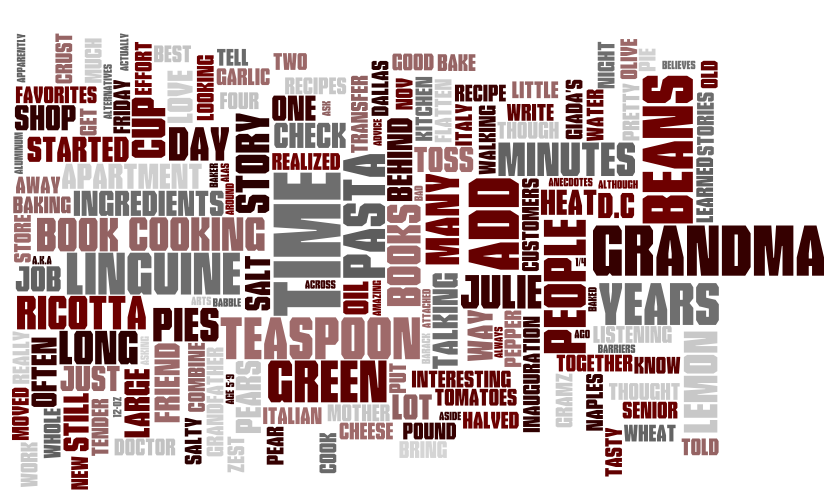
picture-4My friend and fellow journalist Matt Thompson talked about a site called wordle.net during a blogging seminar at The Poynter Institute this week. Wordle takes keywords from blogs and creates a cool, colorful word cloud that can help give bloggers a better understanding of the types of topics they typically write about.

I created a word cloud using the keywords from my own blog to see which words would appear.  It seems that the word cloud pulled from the most recent posts on my blog, which revolve around people and food. I love that the words “Time” and “Grandma” are most dominant.

What does your Wordle word cloud look like? Share a screengrab of it in the comments section of this post.

A Visit to the Book Doctor Turned Into a Story

I stumbled across the Book Doctor’s shop while walking around Dallas’ Bishop Arts District one day. It’s a tiny shop, nestled in the corner of a strip of stores.

I went into the store and started talking with the shop’s owner, Julie, a.k.a. the Book Doctor. She told me fascinating anecdotes about her customers, many of whom are book sellers or self-described bibliophiles. They seemed to carry tales that were as interesting, if not more interesting, than the books they bring in for repairs.

Julie told me that she is 12 weeks behind on orders. I wondered, with the economy the way it is, why are so many people looking to get their books repaired? Julie said she believes it’s because of the sentimental value that’s attached to books. People really do love reading, so much so that they’re willing to spend upwards of $1,000 repairing their books and Bibles.

After talking with Julie, I felt compelled to write a story about her, her shop and her customers.

You can read my Book Doctor story here.

Listening to Grandma’s Stories About the ‘Olden Days’

My grandma, who I unabashedly refer to as “gramz,” is perhaps one of the best listeners I know. I call her a couple of times a week when in need of advice, a pick-me-up or a good laugh. Regardless of what she’s doing, she sets aside time for me and makes me feel as though my stories are worth telling. Because she is so receptive to hearing what I have to say, it’s easy for me to babble on and forget that she, too, has a story that deserves to be heard.

In timing with StoryCorp’s National Day of Listening on Friday, Nov. 28, I stopped talking and started listening. During a conversation about President-elect Barack Obama’s inauguration, my grandma recounted her experience at Franklin Delano Roosevelt’s third inauguration in 1941. She was 18 years old at the time and had just moved away from her home in Jamaica, Long Island, to work for the government in Washington, D.C.

She remembers standing on her tip-toes to catch a glimpse of FDR, a mass of people surrounding her.

“I couldn’t stand still, I was so excited,” she recalls. “Being taller, people kept asking me what was going on.”

At 5’9″, gramz always had a strong presence. Although she said she was nervous about moving away from her mother and living on her own in D.C., she embraced life’s challenges at the time. She put the majority of her effort, she said, into her job, which she obtained without having gone to college. After two years as a clerk typist in the Munitions Building, she was promoted to a job in the Pentagon working as a court reporter for the U.S. Department of Defense. After marrying my grandfather, my grandma left her job in D.C. and moved to Naples, Italy, where my grandpa was stationed as a provost marshal. My dad was later born in Naples on Nov. 27, 1954.

Someday, I want to write in-depth about my grandma. I still have a lot of questions I plan to ask her about her time in Italy, her childhood and her “taboo” relationship with my grandfather, who she wasn’t supposed to date. She often talks about how her mother would have “rolled in her grave” to know that her pale, red-haired Irish-Catholic daughter had fallen in love with a handsome, dark-skinned Italian who was 10 years her senior. Love, my grandma learned at a young age, can break the strongest of ethnic barriers.

My grandma is proof that senior citizens are walking storybooks who have amazing narratives to share from “years ago,” and even from the present day. Often, the challenge for us younger folk is just knowing when to keep quiet and listen.

In Search of Some Good, Easy-to-Make Recipes

Whole wheat linguini with
Whole wheat linguini with green beans, ricotta and lemon.

The long weekend has prompted me to open some of the many cookbooks I’ve been given throughout the years. I gravitated toward Giada de Laurentiis’ cookbook because I learned a lot about the stories behind the recipes when
interviewing her this summer for a Dallas Morning News story. I bought ingredients for Giada’s fresh tomato and goat cheese with herb oil and her whole wheat linguine with green beans, ricotta and lemon. Friday night I tried out the linguine, which actually turned out pretty good.

It can be tough to motivate yourself to cook when you don’t have roommates. I often find that it’s easier to just heat up a veggie burger or throw together a salad. But cooking, I’m slowly learning, can be relaxing after a long day at work, and it doesn’t necessarily have to take a lot of time. The linguine took me about 30 minutes to make.

Here is the linguine recipe, courtesy of “Giada’s Kitchen, New Italian Favorites.”

Ingredients:
1 pound whole-wheat linguine
½ cup part-skim ricotta cheese
3 tablespoons olive oil
½ pound French green beans (haricots verts), trimmed and halved lengthwise.
1 garlic clove, chopped
1 teaspoon salt
½ teaspoon freshly ground pepper
1 cup halved cherry tomatoes
Zest of lemon

Bring a large pot of salted water to a boil over high heat. Add the pasta and cook until tender but still firm to the bite, stirring occasionally, 8 to 10 minutes. Drain the pasta, reserving 1 cup of the cooking water. Transfer the hot pasta to a large heat-proof bowl and add the ricotta. Toss to combine.

Meanwhile, in a large, heavy skillet, warm the olive oil over medium-high heat. Add the green beans, garlic, salt and pepper and sauté for four minutes. Add the reserved pasta cooking liquid and continue cooking until the beans are tender, about four more minutes. Add the ricotta-coated pasta to the pan with the green beans and toss to combine. Add the tomatoes and toss gently. Transfer to a serving plate and sprinkle with the lemon zest. Serve.

I’m in search of some other recipes. What are some of your favorites?

Baking Pies, In a Makeshift Kind of Way

A tasty looking peach pie. Let's hope its looks aren't deceiving.

I convinced myself that I was well-prepared.

Nutmeg? Check. Flour? Check. Six plump peaches? Check. I had everything I needed to bake two pear pies, or so I thought.

When my friend and I started baking pies at my apartment Wednesday night, we soon realized that I was missing measuring cups. I thought I had them in my new apartment, but alas, I didn’t. They’re one of many things I had to leave behind in my old apartment. So, we grabbed a 12-oz cup from my cupboard and guestimated our way through the recipe. Now, this isn’t the best idea when it comes to baking, but it was getting late and we didn’t have time to go to the store.

When it came time to flatten the crust, we realized we didn’t have a rolling pin. Hmmm. I opened some of the drawers in my kitchen and looked for alternatives. A roll of aluminum foil. Perfect! It didn’t flatten the crust as well as we would have liked, but it worked nonetheless.

When my friend tested out the pears, she puckered her lips.

“These pears taste really salty,” she said.

“What?” I said, “I only put in a 1/4 teaspoon.” (Or was it a full teaspoon? A teaspoon isn’t that much, is it?)

I tasted a pear and could tell what she meant. It was pretty salty. I mixed the pears and ingredients together some more, which helped a little. A little salt goes a long way, apparently.

My friend and I baked pies at this time last year, and though I was worried we didn’t bake them correctly, they ended up being quite tasty. Tomorrow we’ll see if we can say the same for this year’s pies. I doubt people will tell me if they think my pie tastes bad, so I’ll be watching their expressions when they try it. I never said I was a baker, but I get some effort for trying, right?