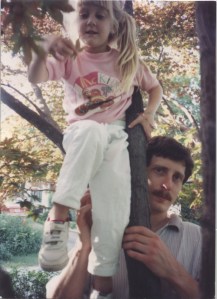
Me learning how to climb the tree in my front yard back in 1990. My dad’s standing by for support.
As a child, I used to climb the maple tree in my front yard and sit on the highest branch. With a notebook in hand and binoculars dangling around my neck, I wrote down what I heard and saw – ducks crossing the street, moms pushing strollers, sirens echoing in the distance. My neighbors, who called me Harriet the Spy, would fill me in whenever “breaking news” occurred:
“Mallary!” Mr. Graham would yell from across the street, “There have been a lot of cars speeding down the street lately. I wonder why that is.”
I made it my goal to find out why. I made observations, interviewed neighbors, and scribbled stories in my fluorescent-colored Lisa Frank notebooks. I still have these notebooks. They’re filled with license plate numbers, descriptions of passerby, and words like “suspicious.”
Not long ago, I read through one of these notebooks and felt compelled to buy a new copy of Harriet the Spy, just for fun. I have yet to read it, but I can imagine the experience will remind me of my childhood, and of my desire to look at life from treetops, where some of the best stories are told.
I used to think pick-up lines were a thing of the past. Not so. Throughout the past year, I’ve had three guys use the same pick-up line on me. I’m beginning to think there are profession-specific pick-up lines. If you’re an auditor, maybe the line would be, “Hey, can I call you if I need help with my taxes?” If you’re a travel agent, it could be: “You’re in the travel business? Can you help me book a flight for two?” Or, if you work at a bakery maybe it’s: “This is one heck of a pastry. I have to say, you’re one of the sweetest girls I’ve met.”
The journalism pick-up line/conversation goes something like this:
Guy with bad pick-up line: “Hey, how’s it going?
Me: Hi, good thanks, you?
Guy: Pretty good. Just hanging out. So, um, what do you do?
Me: I’m a reporter.
Guy: Oh, you are?! Nice! What do you write about?
Me: Right now, I’m writing for a Web site and for my local paper.
Guy: Well, that means I can look up your articles online, then, right?
Me: Yup, you can.
Guy: Well, I’ll need your name to do that! (he says, opening up his phone).
Me: It’s Mallary.
Guy: Oh, well I’ll read your articles and then call you or text you to let you know what I think! What’s your number? (trying to be slick, forgetting that he’ll probably need my last name, too, to find my articles.)
I’m left trying to decide if I should give him my number.
And I’m left wondering: Do cheesy pick-up lines every really work?
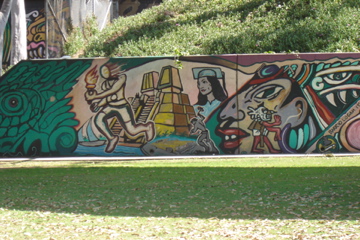
Painted stories line the walls of Chicano Park in San Diego’s Barrio Logan: a multitude of arms embracing the earth, an infant sitting in the palm of one’s hand, faces of dictators from years past. The murals serve as reminders of the justice Chicano activists sought when trying to preserve their land and heritage in the early 1970s. A message painted on a pillar supporting the highway built above the park reads: “Dejame decirle a riesgo de parecer ridiculo, que el revolucionario verdadero esta guardo por grandes sentimientos de amor.” Translated, it reads: “Let me say at the risk of seeming ridiculous, that the true revolutionary is guarded by grand feelings of love.”
Chicano Park is located just a few minutes away from where one of my best friends, Colleen, is volunteering for the year. I visited her this past weekend and caught a glimpse of what life is like in the predominantly Mexican neighborhood where she lives. The experience of spending just a weekend in her neighborhood led me to see what it was like to live in a place where I was a minority, where the faces on the walls, in the buses, on the streets, were not like my own.
With my blond hair and blue eyes, I stood out among the others on the public transportation Colleen and I used to get from place to place. Since Colleen doesn’t have a car in California, we rode the bus, the trolley and our bikes all weekend. In doing so, we saw the city from a different perspective than if we had ridden in a car. We walked through Chicano Park and studied the murals rather than driving along the road that runs through the middle of the park. We sat on the bus and interacted with the locals, who yearned for five-minute friends.
One elderly Asian woman at the trolley station held up a Padres pillow that someone had given her. She seemed overjoyed with the gift and alluded to the fact that she would sit on it while waiting for the bus. She asked who the Padres were and let out a resounding “Ahhhh” when we told her that “Padres” is the name for San Diego’s baseball team. The next day a homeless man walked up to me in a coffee shop to say he had “lost it all.” He lost his lover, his home and his money. He was once on medication but said he couldn’t afford it anymore. “I’m a Christian, I’ve got faith” he said, and walked away.
Though only a few minutes long, these conversations served as a reminder of people’s need to be heard and of the desire many of us have to share our stories with someone who will listen, no matter the color of our skin. Journalists have the ability to listen for these stories and tell them in such a way that they speak to a greater truth about the world in which we live – a truth about homelessness, poverty, one’s struggle for survival, etc. By riding the bus and by observing the details on the murals in Chicano Park, I saw diverse faces and heightened my chances of hearing diverse voices and stories.
Journalists could learn a lot from the practice of walking around parks and taking the bus in a community where they may feel as though they don’t belong. Some of the best stories are those in which journalists immerse themselves in the culture and lifestyle of those they are reporting on. When we shadow the people we cover and look at life from their perspective, when we act as conscious observers of the world, we change our experience of the story we are reporting. We don’t become part of the story, but we deepen our understanding of its meaning and importance to the diverse communities we cover.
What kinds of stories, if any, have you found from walking around or taking the bus?
I wrote a Diversity at Work blog item this week about a new documentary, “Unnatural Causes.” The documentary reveals that minorities are often unhealthier than their white counterparts, in large part because of racism and discrimination:
When I think about racism, I think about emotional pain, ignorance, the need for equality. So when I recently saw the words “racism” and “health care” clumped together, I wondered why.
In a recent Google Alert for the term “racism,” I came across a National Public Radio piece about a new documentary series titled “Unnatural Causes: Is Inequality Making Us Sick?” The documentary looks at the ways that racism affects our health. Many minorities, the documentary says, have greater health issues than their white counterparts. The documentary sites several examples of this, including one about black mothers in the U.S. being far more likely to have premature births and low-birth weight babies than white women.
Lou Smith, co-executive producer of the documentary, said during the NPR interview that this problem is not innate to being black, but rather to the conditions of race that black people live with.
When I write a story, I try to sum it up in one word. It’s a strategy that helps me stay focused on what’s important. What is this story really about? I ask myself. After I pick a word, I write toward that word. When I wrote about adults playing kickball, for instance, I decided on the word “childhood” because the adults said they were playing “to be like kids again.” Last summer, I wrote about a 43-year-old gay man who has AIDS and joined the Sisters of Perpetual Indulgence to try to promote safe sex. This was a story about hope. A story I wrote about an 86-year-old dancer who dances with her 89-year-old husband to stay healthy was a story about survival.
If I had to pick a word for the book I’m reading now it, too, would be survival. From what I’ve gathered so far, “The Road” by Cormac McCarthy is about a father and son’s quest for survival in the wilderness. In reading about their travels, I’ve been struck by how nearly every sentence seems to be motivated by the word “survival.” There are no deviations. There are no chapter breaks. It’s as though you’re traveling with the main characters of the book, starving for food as you try to stave off death. It’s rare that I’m able to pick one word to describe a book.
I’ve circled some passages in the book that I think are especially well-written and that embody the idea of survival. Here’s one of them:
“They squatted in the road and ate cold rice and cold beans that they’d cooked years ago. Already beginning to ferment. No place to make a fire that would be seen. They slept huddled together in the rank quilts in the dark and the cold. He held the boy close to him. So thin. My heart, he said. My heart. But he knew that if he were a good father still it might well be as [his wife] had said. That the boy was all that stood between him and death.”
Much of the book is filled with passages like that. It’s one of those books where every word seems to matter and every passage seems to have a focus. Chip Scanlan of the Poynter Institute has written and taught at length about finding the heart of a story.
What’s your strategy for finding a focus for your stories?
“Ugh, it’s such a long drive,” I used to tell myself when thinking about my commute from Clearwater to St. Petersburg. Whereas the commute used to make me think of traffic and money spent on gas, it now makes me think of singing and dancing. During my morning drive to work, music is my coffee, giving me the jolt I need to feel awake and ready to start the day. On my way home, music is my stress reliever, my chance to be loud and to dance and sing regardless of what the drivers next to me think. Head bobbing, arms occasionally flailing, lips moving. I must look like an interpretive dancer.
I’ll sing and dance to just about anything — rap, country, classic rock, oldies. Singing so much to and from work has actually helped strengthen my voice, making it easier to project my voice when I turn to the stage. Reviving my passion for singing has given me a chance to find my voice. When I sing loudly, I feel more confident than usual and reassured by the fact that just because I may sometimes seem quiet, I have another side that’s finally starting to show beyond the confines of my car.
Last month, I sang on stage at one of my colleague’s birthday parties. My legs were shaking, my hands trembling, my heart racing. I sang “Lean on Me” and Carrie Underwood’s “Before He Cheats.” It was the first time I’d sung solo on stage since playing Marion the Librarian in “The Music Man” in seventh grade. Senior year of high school, I sang “Lean on Me” in a talent show with my best friend Linsey, hence the reason I like reenacting the song. And “Before He Cheats,” is, well, just an empowering song to sing.
The same band I sang with at the birthday party asked me to sing “Lean on Me” and “Before He Cheats” at the Biff Burger this Friday and Saturday night. The restaurant looked like a fun place based on an outdated photo I saw online, so my friends and I went. The parking lot was dotted with antique cars as part of a late-night car show. Needless to say, my 2003 Kia Optima didn’t exactly fit in with all the old Chevys and Harleys. I should have lifted the hood to show off my not-so-impressive engine…
Lots of bikers and families were at “the Biff,” jamming to classic oldies like “Twist and Shout.” After a couple of songs, I got up on stage and sang. Nervousness seemed to disappear this time around. A little encouragement from good friends likely helped.
Later in the night, my friends and I went to O’Maddy’s, a karaoke bar in Gulfport, where we sang from our seats. We missed our queue to go up on stage, and the song I wanted to sing had already been sung. “I never play the same two songs,” the D.J. quipped, “in one night.”
I’m no Mariah Carey or Whitney Houston, try though I might to emulate their voices when their songs come on the radio. But I’m seeing the advantages of singing on stage and the ways in which music can help give us a newfound sense of confidence and peace.
I’m looking for new songs to sing during my morning and afternoon commute. I’ve wanted to make a Nora Jones CD to listen to in the car. She has such a beautiful voice.
My friend Laura called me Monday night to break the news.
“Hey Mal!” she said in a message. “There’s a new show on MTV called ‘The Paper,’ You should check it out because I think you’d find it really, really humorous.”
Considering the average age of newspaper readers is nearly 60, I find it odd that there’s a new show about teenagers working for a newspaper. The paper, called “The Circuit,” is depicted not as being old-fashioned or geeky, but rather as something that’s respected and, dare I say, cool.
When watching the show, which premiered Monday night at 10:30 p.m., I was surprised to see a group of high schoolers frantically trying to submit their applications for the editor-in-chief position. This was a big deal for them. Prior to being chosen as editor-in-chief, Amanda, the show’s main character, said that if she were to get the position it would “be the highlight of [her] life.” One boy said he would cry if he didn’t get the position. Another girl actually did cry.
The show, naturally, is overly dramatic. I don’t ever remember there being much drama in my high school newspaper’s “newsroom” (a.k.a. English classroom with a couple of computers), but I suppose no newsroom is ever completely devoid of drama. It seems the plot of future episodes will revolve around the fact that “The Circuit” staff members don’t like Amanda as an editor. It’ll be interesting to see how the show develops.
My cyber friend, Greg Linch, who is editor of the University of Miami’s student newspaper, The Hurricane, just wrote a blog post about “The Paper.” It’s worth checking out.
If you saw the show, what were your initial impressions of it?
I just wrote an article for Poynter Online about reporters, page designers and journalism professors who believe live blogging makes them better storytellers — by teaching them to be better listeners, note takers and deadline writers.
While at the Nieman narrative journalism conference earlier this month, I live blogged for the first time. The experience led me to realize that live blogging can make us better journalists by teaching us to be better listeners, note takers and deadline writers.
When live blogging, I assumed the mentality of a reporter working on deadline. I wrote and reported simultaneously, acting as my own editor under a self-imposed deadline. I wanted my readers to feel as though they were at the conference, so I included all of the key points from the talks and provided links to stories referenced in handouts.
Though live blogging made it harder for me to focus on the visual components of the workshops I attended, I retained much more than if I had just sat and listened or took notes for my own use.
I tend to learn best through reading and writing, and so my mind often wanders if I don’t take notes during a seminar or workshop. I’ve found, though, that over the years, even note taking can become perfunctory. In the back of my mind, I know I can go back and read what I’ve written, so there is no immediate need to absorb and dissect my notes as I’m writing them.
I had to focus on my notes, however, when live blogging. The need to make them accurate, thorough and interesting was heightened because I would be sharing them with others and would have little time to edit them for grammar and accuracy.
I’m the type of person who likes to-do lists. Most of my to-do lists remind me of what I haven’t yet accomplished but need to do. I want to create a to-do list of what I haven’t yet done but want to do — a check list full of things that are wild, crazy and fun.
Oddly enough, I got this idea while chewing gum. I noticed the other day that on the inside of my gum pack, there was a list of fun things to do. I think it’s part of a promotional activity on the gum maker’s part. Here’s the list:
Rhinestone your entire wardrobe (Maybe like Leslie Hall?); hopscotch across the Golden Gate bride; rebut the Theory of Relativity; become a competitive ballroom dancer; break a world record; cartwheel across the Great Wall of China; get your massage therapy license; grow our your hair and donate it; run a marathon.
I would add to the list:
Become a track star; Fly in a hot air balloon; live in South America for a year; climb the world’s tallest tree (115.55 m); write a memoir; go back and read all of my favorite childhood books; sing on Broadway; be in a dance competition; go on a roller coaster (no, I still haven’t been on one); become a mom, and a grandma, and a great-grandma; learn how to speak Italian and Portuguese; write stories that bring people justice; go skydiving; make a paper crane chain that extends across the country; open my own hand-made jewelery shop; go to Paris; be the person who’s in charge of decorating the Christmas tree in Rockefeller Center; work for a newspaper in all 50 states; see what life’s like at a giraffe’s height; create a built-in karaoke system for cars; draw a mural upside down; set a record as the world’s highest pogo-stick jumper; find a cure for cancer; become a competitive power walker; invent a business model that’ll save newspapers; read all the books I own; touch a cloud.
Last week, I wrote two Diversity at Work posts for Poynter Online — one about being biracial in today’s society and the other about the work that went into Laura Sullivan’s two-part series on the sexual abuse of Native American women. Click here for more Diversity at Work entries.


 Word on the Street