For years, people have blamed newspapers for not featuring enough women in the opinion section. It turns out, though, that the problem isn’t so much that news organizations aren’t featuring women in their opinion sections; it’s that women aren’t contributing in the first place.
I talked about this issue with Catherine Orenstein of The Op-Ed Project, as well as The New York Times’ Gail Collins, who said that “women don’t put their hands up as often as men.” The Op-Ed Project — which is designed to enrich public conversation by expanding the range of voices we hear, and especially by increasing the number of women who participate — runs a national mentoring program to help women realize their expertise and contribute to the public discourse. In working with women as part of this mentoring program, Orenstein said she’s found that women give countless reasons for not contributing more opinion pieces.
I’m not an expert in anything. You should really ask another person. I don’t want to be pretentious or snotty. I don’t have a Ph.D. …
I can relate to these statements. It has always been difficult for me to speak up in public settings. And when I’m nervous, I literally don’t speak up enough. A colleague once told me I sometimes talk so quiet he can hardly hear me. I often tell myself that I’m not smart enough to contribute, or that I don’t have anything of value to say. I know this isn’t really true, but a lack of self confidence stifles my ability to share my opinions. I’ve sat in countless meetings in which I’ve thought so much about how I’ll speak up that I’ve scared myself out of actually talking.
So I’m working on strengthening my voice. During my last review at work, I was asked to start attending more meetings at work. Since then, I’ve made a concerted effort to contribute more, and I’ve succeeded. Because I work with incredibly talented and smart people, I sometimes feel inadequate in comparison. But I realize that what I say has value and that my voice is worth being heard, just as much as everyone else’s in the meeting. I just have to keep reminding myself of that.
People at work have told me in recent months that they appreciate how much more I’ve been speaking up, and that means a lot. I’ve recognized it, too. Last week I spoke (virtually) to a journalism class at Kent State University about how journalists are using social media to connect with their audiences, and I felt so much more confident than I normally do. I think I felt confident in part because I know a lot about this topic. When I’m talking about an issue I’m passionate about or that I’ve written about, I feel much more comfortable contributing to the discussion. Having an agenda that I can look at before a meeting also helps because I can think about what I want to say ahead of time.
It’s nice to know I’m not the only woman who has trouble speaking up, but it’s unsettling to know that so many women have difficulty with this. It’s my hope that someday, more of us will realize our voices are worth being heard — not just for our own sake but for society’s sake. The public discourse is enriched when it’s filled with a diversity of voices and perspectives.
As Orenstein told me: “We’re getting only a tiny fraction of the world’s knowledge and the best ideas. There’s a huge black hole of ignorance. There’s nothing wrong with the people who have the world’s microphone … but the rest of us need to have a bigger voice.”
Yesterday’s newspaper is still lying on my kitchen table. A photo of 16-year-old Nicholas Lemmon Lindsey stares back at me and I’m left wondering, why? Earlier this week, Lindsey shot and killed St. Petersburg police officer David Crawford, a 25-year veteran. Police searched the area near my workplace Tuesday morning in what became the largest manhunt in city history. After receiving a few tips, police were led to Lindsey, who ultimately admitted to killing Crawford.
During a moment of silence yesterday at work, my colleagues shared their reflections on the news. One colleague asked how someone so young could so easily get a gun. The reality, another colleague responded, is that guns are a lot easier to get than one would hope. Lindsey bought his last week for a mere $140.
The news made me feel deeply sorry for Crawford’s family, and it motivated me to want to do more in the community to help troubled youth. Today I met with my Little Sister, who attends the same middle school that Lindsey did. It was her 13th birthday, so I brought her a ring from Target that has Ghandi’s famous quote engraved on it: “Be the change you wish to see in the world.” I have the same ring and wear it every day as a reminder that we can’t just talk about change; we have to be part of it.
If we want our community to change for the better, we have to be willing to embrace the challenges that come with change. My impact as a Big Sister is small; I’m meeting with just one girl for just one hour a week. But it’s something. Sometimes, having one person in your life who cares and encourages you to make good choices makes all the difference. And sometimes it doesn’t, but you have to hold onto hope that it can.
Me and Mr. Quinn in back of his house on the water.
Last weekend I got to catch up with one of my great mentors, John Quinn, at his winter home in Cocoa Beach. My boyfriend Troy and I went there for a Chips Quinn reunion — a yearly event for those who have gone through the Chips Quinn program.
The program, which is aimed at diversifying newsrooms nationwide, offers training to young minority journalists and sets them up with journalism internships.
While I’m not a Chips Quinn scholar, I’m an “honorary Chipster” as Mr. Quinn likes to say. Quinn, who co-founded USA Today, went to my alma mater, Providence College, and took me under his wing after I got a journalism scholarship in his name there. Ever since I got the scholarship, he has invited me to the Chips Quinn reunions in Carolina, R.I., where he lives during the summer, and in Cocoa Beach.
Mr. Quinn, who lives smack in the middle of Al Neuharth‘s house and Frank Vega‘s house, always likes to point out that he and I were both editors of Providence College’s student newspaper, The Cowl, and that we graduated 62 years apart from each other. He shares stories about how the college had to stop printing The Cowl during the war, and I share stories about how much has changed since then.
Me, my crazy beach hair, and Troy.
I’m grateful to have had so many mentors who helped me get to where I am today and who, over the years, have become not just role models but good friends. I wrote a story about this last year for Providence College’s alumni magazine, which you can read here. (See pages 27 and 28.)
Longreads, a site that posts long-form stories, posted a link to it. Friends and strangers commented on the post, and some people messaged me to say that they, too, have struggled with an eating disorder and found comfort in knowing that they weren’t alone. These are the messages I hold dear; they remind me why I need to keep sharing my story so that in helping myself, I can help others. I measure the success of a piece not just by how cathartic it was for me to write, but by how many people say they saw a piece of themselves in it.
I got just one note with constructive criticism, which I expected; it’s hard for people to offer criticism on a piece that’s so personal. The person said she thought the part about my eating disorder came too abruptly at the end, and she wanted to see me write more about this. That is my intention; I just need some time to sort out what I want to say and how I want to say it. I’ve had enough time to process my mother’s death, so it’s easier to write about it with depth and perspective. When you’re still struggling with something, though, it’s harder to write about it with the distance you need to look back and make sense of it all.
I think one way to approach it is to start developing other characters in my narrative — particularly my dad and my grandmother. They were there with me throughout my eating disorder and saw me at my worst. Writing about my relationship with them will inevitably mean writing about food and how they helped me through my difficulties with eating — and in some cases perpetuated these difficulties.
One of my mentors, Roy Peter Clark, has always said that a page a day equals a book a year. My goal, then, is to try to write for 30 minutes a day. I have to be realistic and acknowledge that some days I won’t have time to write, but I’m going to try my best. I think getting in the habit of writing regularly about food and relationships will make it easier to confront some of the issues I’ve been too afraid to commit to paper.
I’ve also been reading a lot of food memoirs and essays for inspiration. I’m reading “Best Food Writing” — part of a series of books that contain the year’s best essays on food — and I just started reading Dayna Macy‘s “Ravenous” tonight. I plan to read “Day of Honey” by foreign correspondent Annia Ciezadlo next. Reading about others’ experience with food gives me ideas and the motivation I need to move forward in my own efforts to write a food memoir. And so do your comments!
I’ve been writing personal essays about my mom for three and a half years now and am constantly reminded of how much I love to keep her memory alive through writing. Now, I’ve taken all of those essays and strung them together. I plan to build on the narrative so that I can eventually turn it into a memoir about how my mom’s death has affected my relationships in life, particularly my relationship with food.
Given that my mom died 14 years ago today, it seemed like as good a time as any to publish this narrative and solicit your feedback. As you read through the narrative, what strikes you about it? What parts do you like/dislike? What unanswered questions do you have? (I plan to write more about the eating part that I write about at the end, but need some time.)
Here’s what I’ve mustered up the courage to write so far …
*****
When I was younger, my mom always called me beautiful.
“I’m so lucky to have such a beautiful little girl,” she would tell me, holding me tight.
I’d take the compliment, believing her words to be true. I never had reason to doubt my mom because as a little girl, I thought she always knew best. Mom knew how to take care of the many scrapes I got whenever I fell off my bike; she knew how to satisfy my hunger with her home-cooked meals, and she always had an answer to my questions: Mom, why does our cat always bring dead mice to our doorstep? How do caterpillars turn into butterflies? Will you play pretend with me, pretty please?
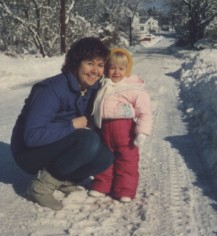
Mom and me in front of our house in Massachusetts after a snowstorm. Brrr.
Sometimes Mom would get frustrated with me when I asked too many questions. Her frustration mounted into a raging temper whenever I lost something. I would do everything I could to fill the void and ignore the loss, never mentioning the pair of earrings I lost or the $10 bill I misplaced in the school cafeteria one day.
Loss and I never got along well.
One time, I lost my bottom retainer and tried to smile with my mouth closed so Mom wouldn’t see. I had accidentally thrown it away, maybe in the middle school cafeteria where all retainers go to die. I was convinced at one point that the lunch ladies at Holliston Middle School must have been hired for the sole purpose of digging kids’ retainers out of the trash. “I had my retainer in a napkin … and I think I threw it away,’ was all it took for the gloves to come out and the search to begin.
Somewhere nestled between half-eaten bologna and mustard sandwiches and mac and cheese was my bottom retainer. Maybe the janitor will find it and be nice enough to return it to the lost and found at school, I thought. But no.
“Mal, where’s your bottom retainer?” Mom asked one afternoon. I had smiled too wide when I came home from school.
“Um, I don’t know. I think it’s somewhere in my room.”
“When was the last time you saw it?”
“I think the other day.”
“You think?”
“Yeah, I’m pretty sure it was the other day.”
My retainer might as well have been a missing child.
“You’re not going to bed,” Mom quipped, “until you find your retainer.”
My room became the cafeteria garbage can. Every corner, every crevice, every old tissue under my bed had so much potential. Six hours passed. 11:00 p.m. Still nothing.
“Robin,” my dad said, “just let her go to bed.”
“Andy, those retainers cost $900,” she said turning to me. “And you’re paying for your new one.” That might have been OK if I had more than $75 in my piggy bank. Maybe if along with my lemonade stand I started selling bookmarks and handmade glitter disks I called Refwingems, I could make enough money …
The replacement retainer only cost $80. Mom and dad paid for it.
Days later, Mom wrote in her diary: “I got so mad at Mallary the other day for losing her retainers. But things are better now.”
*****
No matter how much Mom yelled, I still idolized her and sided with her when she and my dad got into fights. My dad was, and still is, one of the most kind-hearted men I know. I always knew he’d forgive me and love me no matter what. Sometimes I feared that Mom would love me less if I didn’t side with her, and I wasn’t willing to risk the loss. Usually after she’d yell, Mom would try to make up for it. She’d hug me and tell me I was beautiful, or she’d buy me a snack.
Even when I was really little, I always loved to eat (and play with) the meals and snacks Mom gave me. Cheerios were clearly my favorite breakfast food.
Mom always used to surprise me with a snack when I came home from school. I remember looking forward to the treats, which were different every day. For whatever reason, though, I can’t remember the majority of them anymore. All I remember are the cookies. Chocolate chip cookies. Butterscotch cookies. Girl Scout cookies. My favorite were the gingerbread men that Mom would buy from Market Basket. They were the sinfully soft kind, loaded with unhealthy frosting and a head made of solid sugar; the kind of snack that lures adults into indulging in calories and fat they don’t need but secretly want. To me, they tasted like home.
I’d savor the sugar, then jump on the couch and give Mom a hug. I’d rest my head on her shoulder and she’d ask me to tell her all about my day.
“What’d you learn today?” she’d ask.
Weeelllllll ….”
I would go on and on, letting her know about the journal entries I wrote, the jump roping contest I competed in at recess, the A+ I’d gotten on my reading quiz. I’d always “forget” to tell her about the big word I stumbled over when reading out loud, or the math problem I pretended to know how to solve but got wrong.
Mom never went to college, but she wanted her only child to have the best education and get the best grades. Actually, she wanted me to be the best at everything, so I tried as hard as I could to be the A+ student — the perfect, beautiful little girl.
We used to stand in front of the bathroom mirror together and be beautiful. I’d try to make my hair look like Mom’s, and then she’d soon take charge, putting my hair in braids, pigtails, or in a topsy-turvy ponytail. She studied cosmetology in high school and wanted to cut my hair to save money. One time, she cut my bangs so short I looked like Frankenstein.
“Oh Mal, it’s not thaaaat bad,” she said, laughing.
I tilted my head and put my little hands on my little hips.
Just like it wasn’t thaaaat bad when Mom was curling my hair for my aunt’s wedding and accidentally burnt my right ear.
“Mooooooom-ah!”
“It hurts to be beautiful!” she said.
One way to look beautiful, Mom always thought, was to wear mascara. “Always do your eyes up,” she told me.
When we weren’t doing hair and makeup on weekends, we bargain hunted. We spent nearly every Friday night at the kitchen table, drawing big circles around yard sale ads.
“Mallary, rise and shine. It’s yard-sale time,” Mom would say at 6:30 the next morning. We’d hop into our banana boat, the pet name for our yellow Grand Marquis, and cruise around town in search of treasures. Jewel-studded pins. Trinkets. Trolls. I didn’t mind getting up early with Mom, but I hated going to bed. Dad worked days and Mom worked nights, so she wasn’t usually there to kiss me goodnight. That changed when she was diagnosed with breast cancer.
*****
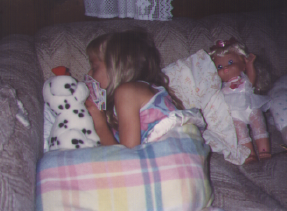
Here I am pretending to be asleep on the living room couch.
Mom became too sick to go to work, so we started to spend as much time as we could together in the evenings. Going to bed got even harder. I’d curl up on the couch with her and we’d watch all the “grown-up shows” that made me the envy of my 8-year-old friends — “90210,” “Married with Children,” “In Living Color,” and yes, even “Melrose Place.”
Dad would pay bills or read his car magazines for a while and then get up to make us a snack. Jiffy Pop popcorn. Frozen green grapes. Mocha almond chip ice cream with chocolate sprinkles.
“Mallary, it’s time to go to bed,” Mom would say after we had finished eating. I found multiple excuses to stay by her side.
“But Mom, I’m not tired.”
“But Mom, just 5 more minutes.”
“But Mommy, I don’t want to say goodnight.”
Really, I didn’t want to say goodbye.
I tried to stay by her side as much as I could and complied whenever she asked for help. One day, she asked me to clean the toilet bowl. Double ew, I thought.
“You mean I have to stick my hands in the toilet?” I asked.
“No, Mal, just use the brush.”
The brush. The brush. Maybe she meant the old toothbrush that she sometimes used to clean in between the crevices in the faucet. I didn’t want to ask for clarification. Mom was in one of those moods, when it was just better to do as you were told, when even asking a question could illicit a scream.
So I took the tattered toothbrush out from under the sink and scrubbed. And scrubbed. And scrubbed, my eyes half shut, my head turned to the side. Ewwness all around. I took a bar of Dove soap and rubbed it along the edge of the water until it looked like a bubble bath in a bowl.
“WHAT are you doing?” my mom asked, yanking the toothbrush out of my hand. “God, Mallary, I didn’t say use a toothbrush. I said use the brush — this brush,” she said, pointing to the big white toilet bowl brush peeking from behind the toilet. It should have been a funny mistake. We should have been laughing. Instead, I cried while mom huffed and puffed, and flushed the toilet, washing my 8-year-old innocence down the lonely drain.
My ability to speak up got washed away somewhere along the way, too. Mom yelled whenever I disagreed with, or contradicted, her. When Mom and I were in a craft store buying cross-stitch patterns, Mom told the cashier that the items she bought were supposed to be on sale. The cashier told her she had picked up the wrong item, that a different item was on sale, but Mom had her mind set on getting a bargain, and she couldn’t be persuaded otherwise.
“The sign said this pattern was on sale.”
“I’m afraid it was the other pattern next to it.”
“Mom, I saw the sign,” I quietly said. “It was the other pattern that was on sale.” Mom gave me the glare and got quiet as the cashier continued to scan items. Beep. Beep. Beep. When we got out of the store Mom grabbed my arm and pulled me toward her.
“Don’t you ever talk back to me like that again,” she said.
“But Mom, I didn’t ….”
“Yes you did. You made a fool of me in there. Don’t let it happen again.”
I had only tried to help, but I didn’t try to explain. I had trained myself to keep it all inside so the screaming would subside. But I couldn’t stand Mom at that moment. I reached for a pen and scribbled on a napkin when I got home that day: “I hate mom. I wish she’d die.”
So I wouldn’t risk having Mom find the napkin, I tore it up and threw it away. One less thing to lose.
*****
Me and mom in Disney World in 1988. I was 3 years old at the time.
Everyone tried to protect me and tell me Mom would be OK and that we wouldn’t lose her. When you’re little, any kind of loss is scary. Loss is taking a wrong turn in the grocery store and losing mommy in a maze of aisles. Loss is having to say goodbye every morning at the bus stop. It’s not being able to find your favorite stuffed animal at night and fearing the monster in the closet might have gobbled it up.
Mom used to reassure me, though, that she wasn’t going anywhere. Right up until she got really sick, she went to all of my school functions. One day when she came to my class to watch me give a presentation, I turned the other way. I looked around at all of my classmates’ moms. Shiny, healthy, wavy hair. Then I looked at Mom, who had decided not to wear a wig or a hat that day. “Mallary’s mom doesn’t have any hair,” I overheard two of my classmates say with a giggle. I told Mom later that day that some girls were making fun of the two of us.
“It’s OK, Mal. Being bald isn’t a bad thing. I’m starting a new trend!” she said, giggling a little. I was mad, but secretly marveled at how Mom could go from being a sick, bald cancer patient to a hip, confident trendsetter. Mom wanted to prove to herself that she didn’t need a wig to be beautiful, even if all she got were ugly stares.
I still thought she was beautiful, and I especially loved her big blue eyes. I tried to hold on to this beauty and carry a part of my mom with me wherever I went. One day, I took her old mascara out of the trash and hid it in my purple LL Bean book bag. I brought it to school and went into the bathroom. Leaning up against the sink, I painted my lashes black. I wanted to make them look like Mom’s. Instead, they turned into little tarantula legs.
“Is that mascara you’re wearing?” one of my third grade classmates asked me. “Yes,” I sheepishly said. “It’s my mum’s.”
I kept her mascara for six years. Maybelline. A pink bottle with a lime green cap. I used that mascara until there was none left, never paying attention to the expiration date. Even after I had used it all, I kept it for years in my makeup bag. It pained me to see it there and not on my mom’s lashes. But still, I couldn’t let go. Every time I looked at the mascara, I was reminded of a mom who lost the strength to put on makeup when she was 39.
*****
Mom had a lumpectomy, but then the cancer came back in her other breast. One day, she looked in the mirror, tilted her head and asked: “Mal, do you think I’m beautiful?” She had one breast, no hair and yellow skin from the cancer, which had spread to her liver.
Me and Mom on Christmas morning. Taken about a year before she was diagnosed with breast cancer.
“Of course you are, Mommy.” I truly believed she was, but as I said it, I remember doubting my own beauty for the first time. Wrapped up in a package of perfection, I never realized the ugly truth about being perfect: you can’t be. I tried to control life’s blemishes and blunders, which became more prevalent in my life the sicker Mom got.
Playing pretend was one way to escape. When you’re a little girl and your mom is diagnosed with cancer, you try to tell yourself that she’ll make it, that you can wave your fairy princess magic wand and make her all better. You believe her when she tells you she’s a soldier in a battle, that she’s the Little Engine That Could, that even though she’s lost all her hair, one breast and 35 pounds, she’ll survive.
Mom lost a lot when she was sick, but she never lost the desire to want to nourish me with food and love. When I’d come home from school, I always knew she’d be there to feed my hungry heart with hugs and kisses and fill my empty tummy.
Then one day she wasn’t there. Well, she was, but in a frightening kind of way. I could tell that something was wrong when I came home from school and saw her on the couch. Mom’s face was painted with pain, her forehead a road map of wrinkles, her cheeks a waterfall of tears.
Seeing Mom so weak made me long for some sense of normalcy and nourishment — a hug, a kiss, a cookie. “Mom, what’s wrong?” I asked when I came in the door after getting off the bus.
“Maaaaaal,” she softly screamed. “Call your father. I can’t get up.”
I tried to lift her.
“C’mon mom, c’mon mom, move. Move!”
I called Dad because he always knew how to fix stuff. He rushed home from work but was too afraid to pick her up for fear that he’d hurt her even more. It was the first time I remember thinking of my dad as being helpless.
He called 911 and we soon heard the sound of sirens. The EMTs couldn’t lift her either. “It hurts,” Mom said, shutting her eyes. “It hurts.” So they scooped Mom up in the blanket she was resting on and carried her onto a stretcher. BamBam! They shut her inside the ambulance and drove away.
Dad and I drove to the hospital. Mom was hooked up to an IV and was getting platelets. I was only 8 when she started going to the hospital regularly, but big words like mastectomy, platelets, radiation, transplant and chemotherapy soon became a regular part of my vocabulary.
That afternoon, she asked me to look inside her purse and take out her lipstick. It was Rosie Red lipstick, the kind Mom and I had been wanting to get ever since we heard Rosie O’Donnell talk about it on her show.
“Now, don’t put a lot of it on,” she said, handing me the Rosie Red lipstick. “You only need a little bit.” I only wore a little, if I wore it at all. I wanted to save it.
Me and Dad.
By the time we got home it was late, and I hadn’t eaten dinner, let alone my afternoon snack. Dad made “the usual” — the ever-so-simple spaghetti and peas. I liked the meal the first five times we ate it, but after a while the spaghetti seemed to get harder, the peas mushier.
“Daaaaad. Again? Why can’t we have Mom’s pasta primavera? Or her macaroni and cheese?”
Mealtimes were a constant reminder that Mom was too sick to cook and that hard as he tried, Dad just didn’t know how to nourish me in quite the same way.
“Maybe tomorrow, Mal,” Dad would say. “C’mon, you love spaghetti.” He worked full-time and was trying to take care of an ailing wife and a young daughter who craved the kind of care that only moms can give.
“I used to like spaghetti,” I said. “But it doesn’t taste good anymore.”
Dinnertime felt so lonely without Mom. Something was missing, and food wasn’t filling the void. It never really does. I missed Mom’s meals and my after-school cookies. I was tired of coming home to an empty house. I was tired of the hideous hats Mom wore to hide her baldness or to “make a fashion statement,” as she preferred to say. I was tired of seeing Mom confined to a bed when everyone else’s mom seemed healthy enough to attend school functions and cheer for their sons and daughters at soccer games.
Mom was just busy, I told myself. She was fighting in a battle and hiking up a hill. She was living out metaphors that, depending on whether or not you were playing pretend, suggested an ascension toward recovery or, more realistically, toward Heaven.
*****
Me and mom in Disney World, 1988.
Sunday, February 9, 1997. All I wanted that afternoon was a mother to comfort me. But the one person who I wanted to console me couldn’t. Her body was frail, her skin yellow, her eyes shut. The cancer had spread not just to her liver, but to her bone marrow and her brain.
The night before Mom died, my grandma suggested I sleep at her house. It wasn’t right, she said, to see my mother in so much pain.
Throughout the three years that my mom was sick, I thought she would survive. At least, that’s what everyone had been telling me. As an 11-year-old, I didn’t want to believe otherwise, didn’t want to face the “essential female tragedy,” as poet Adrienne Rich calls it — the loss of a mother to a daughter, a daughter to a mother.
On the day Mom died, I was in her childhood bedroom, sitting on her bed. The phone rang. My grandma answered.
“Yes? Oh my God …”
My grandma rushed upstairs, sat on the bed next to me and said, “Mal, your mom’s passed away.” So final, so hurtful, so terse.
We piled into my grandparent’s blue Buick and headed toward my house. I lay across the backseat, resting my head on my grandma’s lap, holding onto the Rosie Red lipstick Mom had given me. Nervously, I twisted the cap back and forth, crushing the stick. Then I started to cry. Are you OK, Bob?” my grandma asked my grandpa. He was crying too hard to speak and all he could do was raise his hand. Still today, I remember how much it shook.
When I got home, I held on tight to my dad and for the first time in my life, saw him cry. I spent a few minutes at my mother’s side but wasn’t ready to let go when the men in black came and took her away.
That night, all I wanted to do was go to bed. The hospice workers and family friends were gone by 7:30 p.m., leaving me and Dad in a house that no longer seemed like home. He turned on the TV just in time for the start of “America’s Funniest Home Videos.” Canned laughter ensued. I wondered how people could be happy when it seemed the whole world should be sad.
Skipping dinner, I went to bed feeling empty. I pulled the covers over my head and stared into the darkness, hoping I’d wake up to find that what had happened that night was nothing but a bad dream. In denial, I pretended things were fine and told myself not to cry.
“Erase it from my mind, erase it from my mind,” I whispered, scratching my head and repeating a refrain that I often said when something bad happened. I didn’t know that, years later, everything I had temporarily erased would leave such a lasting mark.
“Do you want to talk, Mal?” Dad asked.
“No. I just want to be alone.”
Dad turned off the light. I peered out from under the covers, hoping he’d still be there. He kissed me on the forehead and stayed by my bed in silence.
*****
Mom used to read to me to help me fall asleep.
Even after Mom died, I kept trying to pretend everything was fine. Mom wasn’t there to tell me she’d be OK, so I tried to be OK for her. I went to school the day after she died and told my sixth-grade teachers that I was fine and ready to move on. I wanted to be strong.
“Dad,” I said the day after she died. “I want to write a eulogy for Mom’s funeral.” “Eulogy” was one of those big words that I had heard Dad talk about behind closed doors. I remember looking it up in the dictionary, hoping I’d never have to hear one about my mother.
And yet, I wrote one about Mom and read it at her funeral, composed and without tears. The eulogy, all 480 words of it, was my attempt to comfort everyone else and perhaps convince myself that all would be well. Part of it read:
“Everything happens for a reason, although, that reason is often hard to find. But believe me, sooner or later in life you will find that reason. Now we should all still cry, and we should always keep Robin in our hearts, but we cannot let it bother us for the rest of our lives. We can’t keep going back to that old chapter, but look forward to the new chapter in our lives, and just hope that it brings us the best of luck and much happiness.
“This is hard to do, I know, to find that new chapter, but we can all do it if we try. Just think, my mother, Robin Jo Tenore, is walking along the streets of gold, she’s having the time of her life. She no longer suffers from pain. She is now in the hands of God, she is now in Heaven. A place where she truly belongs.”
I remember feeling disconnected when I read the piece, confused as to why I felt the need to write about my mom’s death in a Hallmark card kind of way.
At the time, I thought I was strong. And I was, but I didn’t realize that being weak when we need to be can make us strong later on. When we cry, when we make ourselves vulnerable. When we readily admit that something as devastating as losing a mom just plain sucks, we’re being true to ourselves. Hiding these realities only delays the grieving process, making us surrender to sadness later instead of embracing it in the moment.
But try telling that to an 11-year-old.
*****
When you’re that age and your mom dies, you fear you’ll forget her. So you hold onto everything that is hers and look for ways to keep her memory alive. You write stories about her. You ask family members for details about her life. You dig up old home videos and tapes that help you make better sense of the woman she was — and the woman you may or may not want to become. For years after my mom died, I felt as though I had lost all control, so I searched for ways to hold onto whatever memory of her I could, even memories that didn’t make sense for a little girl to hold on to.
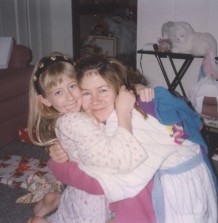
Me and Mom all dolled up. Note the pink puffy sleeves and the silver flats.
I asked my dad, for instance, to keep Mom’s clothes in the closet so I could wear them — oversized as they were — to school. I kept Mom’s wigs in a Ziploc freezer bag in one of my dresser drawers. Mom had two of them. One was dark brown and shoulder length. The other was lighter and shorter. She wore them with hats. Purple hats. Striped hats. Straw hats with sunflowers. I’d try on her wigs and her hats, then tear them off when memories of Mom’s chemo treatments got in the way. I held onto Mom’s shoes, her nail polish, her eyelash curler.
I was living in a fantasy world, and my dad was afraid to let reality take that fantasy away. The first Christmas after Mom died, he wrote “Love Mom and Dad” on all of my gifts. He talked about her a lot, often in the present tense. He saved what was hers until three years later, when we moved to a new house across town. The memories of all that had happened in the house I grew up in were too hurtful to be reminded of every day. “Mal,” Dad told me, “we need to let go.”
I’ve since let go of a lot of what was Mom’s. I let go not because I wanted to but because in holding on to so much from the past, I couldn’t bear the weight of it all. I held on to her jewelry, her journals and her bike. I still wear her unassuming, tiny wedding ring sometimes. I keep shoe boxes containing photos of me and her. And that rusty eyelash curler? It’s in my makeup bag.
I like to think Mom responds via signs. When I’m thinking about her or am in need of a hug, I’ll sometimes hear Sarah McLachlan’s “I Will Remember You” — the song she dedicated to me before she died — on the radio. On other occasions, I’ll look at the clock and see Mom’s “special 7:24 time,” which is symbolic of her July 24 birthday.
Not long ago, for instance, I came across a sign when I read this passage from “Stuffed,” a food memoir by Patricia Volk. The passage reminded me of Mom and how she always called me “beautiful” and “gorgeous.”:
“I swore to myself that if I ever had a daughter, I’d make sure she wasn’t tyrannized by beauty. Life would be different for her. She would never wonder, Am I gorgeous? Not because she was or wasn’t, but because it wouldn’t matter. I’d devalue gorgeous. Gorgeous would be a fact of life, a nonadvantage. Brains, wit, drive and kindness, waking up every morning wondering, What’s next? — who needs gorgeous if you’ve got all that? Gorgeous would be neither a plus nor a minus, just there, like the Great Barrier Reef. My girlchik would never have good days or bad days based on makeup. She’d never enter a room less confident thanks to her hair. Beauty would be a nonissue. The plan was simple; If I never told her she looked good, she’d never wonder if she looked bad.
“Then I had a daughter. A daughter!
” ‘Look!’ I showed my husband her toes in the delivery room. ‘They’re like fringe! Did you ever in your life see anything so gorgeous?’
“Everyone who came to the apartment saw the toes. They were all the same length, straight and perfectly shaped. ‘Aren’t they like little pink piano keys?’ I said to everyone. ‘Doesn’t she look like a Sarah Bernhardt peony? Did you ever see anything so pink?’ I praised her earlobes and her navel. I praised her ankles and her chin. Her nostrils, her dark eyes, her thighs. I was out of control, couldn’t help myself. What difference did it make? She couldn’t understand.
“I called her Polly after my Gloria Swansonish grandmother. I allowed myself to revel in her beauty. I told myself when she started to speak, I’d stop. Then I couldn’t. She was too gorgeous. To test my objectivity, I invented the Looking Game. I still play it. When Polly’s back is turned, I say to myself: I am looking at this person for the first time. What do I think? And then, when she turns around, I look at her as if she’s a stranger, as if I’ve never seen that face in my life and am forming a first impression. Always I am struck by her gorgeousness. It never fails. And along with this observation comes a great, dambreaking, mother-lode of love. It’s the gorgeous-love connection, the gorgeous-love one-two. And it was realizing this recently that suddenly I understood: Gorgeousness in my family is love. Saying ‘You are gorgeous’ is saying ‘I love you.’ To love someone, no matter what they look like, is to see them as beautiful.
“I don’t love my children because they’re gorgeous, even if they’re gorgeous because I love them.”
I read this passage right before going to bed. The next morning, I woke up a little frantic, realizing I had forgotten to set my alarm. When I looked at the time on my phone, it was 7:24.
Running my finger across the time, I whispered I love you, too, Mom.
*****
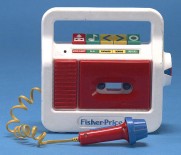
Fisher Price tape recorder. Classic.
I’m reminded of Mom in other ways, too. Last year I stumbled across a tape of me singing with my mom. The night before Mother’s Day when I was 7 or 8 years old, I had asked Mom if we could have a singalong — partly because I wanted an excuse to stay up with her, but also because I wanted to play with my new, oh-so-cool Fisher Price tape recorder. It was the kind of toy that could make any little girl think she were good enough for Broadway.
I don’t remember what I told Mom, but it was probably something to the effect of, “So we’re going to make up a song together, OK? And I’m going to sing and then give you the mic and then you’re going to sing and we’ll take turns!” It’s hardly a surprise that I sang about not wanting to go to bed.
“Ohhhh I don’t want to go to bed! But it’s a school night you can see … I’ll see you on Mother’s Day, today is a very nice day and today I think I’ll be a movie star, wait and see.”
So many of the memories I have of her are from when she was sick. I can hear the mean kids at school say, “Look! Mallary’s mom has no hair!” I can hear Mom calling for Dad’s help when she was too weak to get off the couch on her own. I can hear her crying the night she found out that the cancer had spread to her brain.
It’s harder for me to remember what Mom sounded like when she’d dance with a broom and sing her favorite songs while cleaning the house, or when she’d come to the front door and yell, “Mallaryyyyy. Come inside, hunny. Dinner’s ready!”
The tape helps me remember. It lets me replace the deafening silence of her death with the comforting sound of her voice: “Goodnight sweet Mallary, go to bed. I love you very much.”
I still wish Mom were here to tell me to go to bed. Every night I tell myself I need to go to bed early, but I hardly ever heed my own advice. My dad and I talk about our night-owl tendencies from time to time, admitting that we wish we could go back to a time when “staying up late” meant going to bed at 8:30 p.m. Sometimes, we say, we wish Mom were here to tell us goodnight. And yet we’ve learned that sometimes, you have to settle for good enough.
So I listen to the tape to hear Mom’s voice and to remind myself that she would want me to take better care of myself by getting more rest. She’d want me to keep developing my voice, too — as a writer, as a young woman and as someone who unabashedly sings while in her apartment and her car. Recently as I was driving over the Howard Frankland bridge to Tampa, I flipped through the radio stations and stopped on “Love Shack” — one of Mom’s favorites. I belted it out and thought of me and her singing our favorite part together.
“Bang, bang, bang on the door, baby. You’re what? Tin roof … rusted!”
The next song I heard was Sarah McLachlan’s “I Will Remember You.” I could feel the goosebumps forming. Driving over the water, my hair blowing in the wind, I sang the message she wanted me to take away from the song:
“I will remember you. Will you remember me? Don’t let your life pass you by. Weep not for the memories.”
As hard as I try to search for signs from Mom, I’m sometimes too late. I’ll hear the disc jockey say he just played “I Will Remember You,” or I’ll look at the clock and it’ll be 7:25 p.m. And try as I might to hold on to what is dear to me, or what I need, I still lose a lot.
Recently, I lost my retainers again. I had put the retainers in a napkin when eating breakfast with my friends, whom I was visiting as part of a bachelorette party. I didn’t realize until the next night that I’d lost them, and even then I was afraid to admit it.
Those memories of searching through napkins in the cafeteria with the middle school lunch ladies came flooding back to me when I realized my mistake. I still expected to hear Mom yell. Instead, my friends joked with me about my efforts to keep my teeth straight.
“You seriously still wear your retainers at night? C’mon!”
The same feeling of guilt I felt when I lost my retainers as a kid resurfaced when I crashed Mom’s car a couple years ago on US 19 in Florida. There are certain things in life I can’t control, so I brace for the brakes. But sometimes, there’s just not enough time. Crash, crunch, burn. I plowed into the SUV in front of me, the hood of my car turning from a plateau to a peak. I cried. It was a ’93 bimmeny blue-colored Ford Tempo. Mom had bargained it down when it was brand new from $13,000 to $9,000. I knew when I saw it that I didn’t like that big blue hunk of metal sitting in the driveway. Really, I didn’t like that it was going to replace our old car.
Me and dad have gone through a lot together. When I was sick, he was one of the few people who believed I'd get better. He was right.
But I slowly gave the car a chance and watched as my dad regularly checked its engine, doing his best to take good care of the car that he hoped would someday be mine. Before the crash, the body of it looked good — very little rust, hardly any scratches. Whatever damage it had was concealed in places where broken beauty lies — under the hood, tucked away behind a tire, somewhere deep inside the engine.
There comes a time when we begin to realize that for as much as we try to make life work, it breaks. Things fall apart. So, we learn to mend them back together as best we can and hope the stitches don’t come undone. We learn to get new cars and accept life’s changes, realizing that just because something or someone has left our lives doesn’t mean the memories have, too.
*****
I’m grateful to have so many memories of my Mom. I remember all of the good times we had, but I try not to forget that she was human. When loved ones die, there’s a tendency to put them on a pedestal and believe they were all good. But life isn’t black and white. It’s the gray areas that make us complicated and complete; it’s the flaws that make us human. Mom tried so hard to be a flawless parent with a perfect daughter — a plan that inevitably exposed the ugly side of perfection’s pied and blemished beauty.
All of this might help explain why I’m a perfectionist and why I fear failure and loss. Looking back, though, I realize that for as big of a deal as my mom made about me losing things, she almost always replaced what was missing, even when she was sick and could hardly muster the energy to drive to the store. I would hug her out of gratitude and close my eyes, not wanting to let go.
I wish Mom could replace loss with love, with great big bear hugs that only moms can give. I wish I could just throw up my hands in frustration, ask “Why couldn’t you be here right now?” and have her answer me. For as much as I’ve moved on, I still yearn for my Mom to be here, to make me feel full again.
Food just doesn’t do it for me. Looking for a way to gain control after my Mom died, I started to monitor what I ate. Nothing tasted good anymore, and it didn’t fill me up the same way Mom’s food did. Since Mom wasn’t there to make me meals or leave me snacks anymore, why even bother eating? After all, those super skinny girls in the “Seventeen” magazines that I peeked at in the library probably didn’t eat. How else would they have such perfect bodies?
It’s so much easier to focus on food and your body than it is to feel.
I figured if I stayed the same weight that I was before Mom died, then I could pretend things were still the same. If I wore my hair in pigtails and pretended I was forever young, then people would care for me. I’d be the little girl, the one without a Mom, the one who needed their love and attention.
Dad and I live 1,500 miles away from each other. I always look forward to the late summer, when he usually visits. Here we are on my front porch last year.
My battle with anorexia led to four hospitalizations, two stays in a specialized medical unit at Children’s Hospital in Boston, and a year-and-a-half-long stay at Germaine Lawrence, a residential treatment facility for troubled girls in Arlington. I’m better — so much better than I ever thought I could be, thanks in large part to the choices I’ve made and to my supportive dad. But still, I struggle.
When I went home for Christmas, I told Dad I was craving one of the gingerbread men that Mom always used to buy. I didn’t buy one, though, because I figured I didn’t really need it. Too unhealthy.
Two days later, my dad handed me a bag from Panera Bread.
“Here, Mal, this is for you.”
He had a big smile on his face. I peered inside and saw a gingerbread man.
“Thanks, dad,” I said, pretending not to want the treat. “I’m not hungry now, though. I’ll have a piece later.”
But then I changed my mind. It hurt me too much to say no. I wanted my dad to know how much his gesture meant to me, so I broke off a piece of the smiling gingerbread’s head. It was harder than I remembered, the taste of ginger wasn’t quite the same, and there wasn’t nearly as much frosting as there should have been. Not like the kind Mom used to buy. The spaghetti and peas equivalent of Mom’s pasta primavera.
You wouldn’t think eating a gingerbread man’s head would be that difficult. But when you’re used to a routine, deviations make way for chaos and temptation. I often eat the same thing every day for breakfast, lunch and dinner because it helps me feel in control. When I’m feeling lonely — because my friends are out at dinner and I’m being a workaholic, because I miss my mom — my first instinct is to sneak something from the nearest candy jar, head for the vending machine or open the refrigerator door in search of nourishment. Other days, I don’t feel like eating at all.
I’m trying to find healthier ways to feel full, and to let go.
I’ve found that when we experience loss, we have a tendency to hold on to what we’re afraid will be taken from us. It’s understandable, but in doing so we can miss the point: everything that is good is a gift, freely given. When I’ve tried to hold on too tightly to the people in my life, I’ve missed the experience of the gift of their friendship, love and nourishment. To fill this void, I too often turn to food.
I know, though, that all the cookies and gingerbread men in the world can’t satisfy me. So I’m learning to fill the emptiness with something other than food, and to eat when I’m hungry and stop when I’m full. Mom would want me to. Sometimes, because I’m not perfect, I slip up. And that’s OK. I don’t want to keep playing pretend.
I like to think that my Mom, who died of breast cancer when I was 11, sends me signs. When I’m thinking about her or am in need of a hug, I’ll sometimes hear Sarah McLachlan’s “I Will Remember You” — the song she dedicated to me before she died — on the radio. On other occasions, I’ll look at the clock and see Mom’s “special time” — 7:24 — symbolic of her July 24 birthday.
Mom always used to call me gorgeous, so I couldn’t help but think of her the other night when I read this passage from “Stuffed,” a food memoir by Patricia Volk:
“I swore to myself that if I ever had a daughter, I’d make sure she wasn’t tyrannized by beauty. Life would be different for her. She would never wonder, Am I gorgeous? Not because she was or wasn’t, but because it wouldn’t matter. I’d devalue gorgeous. Gorgeous would be a fact of life, a nonadvantage. Brains, wit, drive and kindness, waking up every morning wondering, What’s next? — who needs gorgeous if you’ve got all that? Gorgeous would be neither a plus nor a minus, just there, like the Great Barrier Reef. My girlchik would never have good days or bad days based on makeup. She’d never enter a room less confident thanks to her hair. Beauty would be a nonissue. The plan was simple; If I never told her she looked good, she’d never wonder if she looked bad.
“Then I had a daughter. A daughter!
” ‘Look!’ I showed my husband her toes in the delivery room. ‘They’re like fringe! Did you ever in your life see anything so gorgeous?’
“Everyone who came to the apartment saw the toes. They were all the same length, straight and perfectly shaped. ‘Aren’t they like little pink piano keys?’ I said to everyone. ‘Doesn’t she look like a Sarah Bernhardt peony? Did you ever see anything so pink?’ I praised her earlobes and her navel. I praised her ankles and her chin. Her nostrils, her dark eyes, her thighs. I was out of control, couldn’t help myself. What difference did it make? She couldn’t understand.
“I called her Polly after my Gloria Swansonish grandmother. I allowed myself to revel in her beauty. I told myself when she started to speak, I’d stop. Then I couldn’t. She was too gorgeous. To test my objectivity, I invented the Looking Game. I still play it. When Polly’s back is turned, I say to myself: I am looking at this person for the first time. What do I think? And then, when she turns around, I look at her as if she’s a stranger, as if I’ve never seen that face in my life and am forming a first impression. Always I am struck by her gorgeousness. It never fails. And along with this observation comes a great, dambreaking, mother-lode of love. It’s the gorgeous-love connection, the gorgeous-love one-two. And it was realizing this recently that suddenly I understood: Gorgeousness in my family is love. Saying ‘You are gorgeous’ is saying ‘I love you.’ To love someone, no matter what they look like, is to see them as beautiful.
“I don’t love my children because they’re gorgeous, even if they’re gorgeous because I love them.”
I read this passage right before going to bed. The next morning, I woke up a little frantic, realizing I had forgotten to set my alarm. When I looked at the time on my phone, it was 7:24.
Running my finger across the time, I whispered I love you, too, Mom.
Throughout the years I’ve gotten used to people misspelling my name. My late aunt seemed to spell it differently every time she wrote me a Christmas or birthday card, and teachers used to misspell it, too. In the third grade I started to write “Mal” on top of my papers to avoid confusion, but my mom didn’t approve.
“Mallary, stop that,” I remember her saying. “Write your full name and be proud of it.”
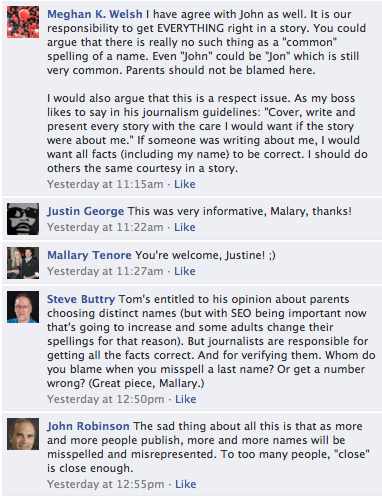
I love the unusual spelling of my name, but I’m continuously surprised by how many people misspell it. Several editors recently spelled it wrong, prompting my editor to suggest that I write about the experience. To find out more about misspelled names, I got in touch with Regret the Error’s Craig Silverman, who said they’re the sixth most common newspaper error. The error is so common, Silverman said, because journalists forget to ask for the right spelling, they do it from memory, they assume the name is spelled the “normal way,” or they’re misled by incorrect sources online.
When it comes to misspelled names, sources may assume that if a reporter got a name wrong, he or she may have gotten other more significant facts wrong, too. And if you’re the source whose name was misspelled, you can’t help but wonder just how much the journalist who interviewed you really cared. Names are a part of who we are, so we feel disrespected when journalists don’t take the time to spell them right. You can read more about this in my story …
The story generated a lot of discussion — I think because so many people can relate to having their first and last names misspelled. Here are just some of the misspellings readers shared with me on Twitter and Facebook:
Steve Buttry — Steve Butry, Buttery, Buttrey
Macy Koch — Mary Koch
Mark Follman — Mark Fullman
Meghan Welsh — Megan Welch
Mai Phoang — Mia, May, Moi, Mya, Maya, Maia. Mi Hong, Wong, Hwong, Hang
Sue Llewellyn — Sue Looellin
David Folkenflik & Eric Deggans — Both had their names misspelled by their own publications.
I was surprised when a couple of readers said that my parents are to blame for spelling Mallary “the wrong way.” One reader, for instance, tweeted: “Good story, will use it in my journalism classes. But, I’m sorry, your mother spelled your name wrong, you pay the price.” (He since removed the tweet but made a similar comment on my story.) I responded by saying that Mallary with an “A” isn’t wrong; it’s just different from the norm.
Several journalists weighed in on Facebook and shared related thoughts on journalists’ obligation to spell names right:
So, I have some good news. I recently had my annual review and found out that I’ve been promoted to associate editor of Poynter.org. I feel honored, and I’m excited to embrace the responsibilities of my new role.
For the past couple of years, my title has been copy editor. While I respect all the hard work that copy editors do, I never liked having this title. I mostly report and line edit stories, so I’ve always thought the “copy editor” title was a bit misleading.
When I came to Poynter for a year-long fellowship in 2007, I never expected I’d be at the institute for this long; I figured I’d stay for a year and then move back to Massachusetts. Then, life happened. I really enjoy being in Florida and have carved out a life for myself here. That’s not to say I’m going to stay here forever. But it is to say that I enjoy the work I do and feel as though I’m still getting a lot of great opportunities to grow as a journalist at Poynter. Here’s to continued growth and new opportunities.
I couldn’t help but smile when I saw this Awl story about what the members of the Babysitters Club are up to these days. Growing up, I was a huge Babysitters Club fan and even started my own club. I hung up handmade flyers around town to make the locals aware of my babysitting skills (or lack thereof), and surprisingly landed some gigs. I still keep in touch with one of the moms who responded to my flyer and consider her to be a dear family friend.
As weird as it sounds, the Babysitters Club characters were like my imaginary sisters who came to life whenever I started reading. I found comfort in reading about young girls my age, and could relate to much of what they went through. As an only child, I looked to books for entertainment and was “that girl” who read a book while walking two miles to and from school every day. I was the girl who befriended the school librarian and who used to “steal” my parents’ flashlight so I could use it to read under the covers at night. I’d hold my finger next to the flashlight’s on/off switch so I could quickly turn it off if I thought Mom and Dad were going to come into my room and tell me to stop rebelliously reading.
I would feign sleep for even longer when reading Babysitters Club books about Mallory. I had never met another Mallory in real life before, so I gravitated toward my fictional counterpart, even though she spelled her name with an “o” and looked nothing like me. For whatever reason, Mallory’s name was often accompanied by a drawing of a smiley face, so I used to draw the same type of smiley face under my name whenever writing out my name at school.
It’s been years since I looked at a Babysitters Club book. (No really, I swear!) The Awl story reminded me of the girls’ quirks, and it puts a funny twist on “where the characters are today.” If you’re not familiar with the Babysitters Club series, the story probably may be hard to relate to. But if you liked the series as much as I did, then you should know …
Kristy started up a softball league with her partner Tori and works in the Baltimore public school system. She met Tori while doing Teach for America and seems to be doing pretty well for herself.
Claudia is a graphic designer who makes intricate wire jewelery. She has a live-in boyfriend named Arthur, and she wears crazy glasses, plays the upright bass and now eats sprouts instead of sweets.
Boy-crazy Stacy pursued a career in acting and modeling but couldn’t book any jobs. She had an affair with the owner of a Los Angeles club, of which she is now co-owner. She has some problems she needs to work through but is at least trying to carve out new opportunities for herself. This spring, she’s launching her own line of handbags.
Maryanne apparently doesn’t know how to use the Internet. And she didn’t marry Logan! Tear. I knew they broke up, but I always hoped they would rekindle their love for each other. I remember reading about their middle school romance and thinking Logan was a cutie, at least based on the cover illustrations of him.
Dawn has “kind of gone off the deep end.” She owns and operates a self-sustaining llama farm, wears lots of bucket hats and makes her own yarn. The only Babysitters Club member she talks to regularly is Mary Anne.
Mallory graduated from Riverbend boarding school with honors, then went to Regis College, where she majored in women’s studies and English. (Go Mallory!) She ended up getting pregnant, though, and had to drop out of school. Known for her red frizzy hair and oversized glasses, Mallory has some mad skills when it comes to playing Mario Kart for Wii.
Jessi seems to be living a relatively normal life. The talented ballerina, who always wanted to be a professional dancer, joined a dance company but was forced out of it due to a knee injury. Now she’s in physical therapy school.
Shannon, the overachiever of the group, is now a competitive dog breeder. (Talk about randomness!) She especially likes the Cavalier King Charles Spaniel and has so far raised just one champion dog, Puttencove Promise.
Logan didn’t do so well later in life. He got caught up in a gang called The Badd Boyz, was arrested for stealing car radios, dropped out of Student Council and even ditched the Babysitters’ Club. Not cool, Logan, not cool.
This week I started reading “Stuffed,” a food memoir by Patricia Volk. The book is a tribute to Volk’s family members and the food they made her growing up. Each chapter, which is named after a special type of food, is about a different family member. One of the things I love about the book is how Volk captures the way that food connects us to others. Food, she reminds us, is an integral part of our relationships. We go out to eat with our spouses, we cook meals for our kids, we share recipes with friends …
Food triggers memories of childhood, major events in our life, and the loved ones we hold dear. I can’t look at butterscotch chips without thinking of my maternal grandma, for instance. We used to make butterscotch cookies together a lot when I was a kid. Baking with Grandma was especially fun because I could break the rules; she always let me eat a handful (or two, or three) of the butterscotch chips and lick the spoon without worrying about how messy I got.
Spaghetti with peas reminds me of my dad because it’s the one meal he consistently cooked after my mom died. Coffee ice cream reminds me of a guy I used to date, and lemon loaves remind me of another guy I dated. After my relationship with these guys fizzled out, I found myself craving the food that reminded me of them, thinking it would help me feel closer to what I had lost.
Mac and cheese reminds me of my mom. She made the world’s best mac and cheese, or so I thought as a little kid. My paternal grandma, “Gramz,” has tried replicating it throughout the years, but it never tasted quite the same. Turns out, Gramz had been using the wrong recipe. We discovered this at Christmastime after my maternal grandma pointed out that Mom’s recipe came from my great-grandmother, not from the generic mac & cheese recipe we had been following. My grandma just mailed me the handwritten recipe, so today I decided to make it. It doesn’t taste nearly as good as Mom’s, probably because she improvised it, making minor changes here and there that didn’t make it onto the recipe card.
The look, taste and smell of the mac and cheese I made still remind me of her, though. Someday, when I write a memoir about my mom, you can be sure mac and cheese will be mentioned in it. In the meantime, I’ll keep trying to perfect it.
Here’s the recipe if you want to try it:
Ingredients:
–1/2 lb Elbow macaroni
–2 cups grated cheese (American)
–1 cup hot milk
–1 cup buttered breadcrumbs (This seemed like way too much. I’d probably use a half a cup next time.)
Steps:
–Cook macaroni until tender.
–Place a layer of grated cheese in a buttered baking dish, then a layer of macaroni. Alternate until the dish is filled.
–Season with salt and pepper.
–Pour hot milk over the mac and cheese, then cover it with the buttered breadcrumbs.










 Word on the Street