In Need of a Lede? Tweet about It

It all started with a Tweet.

I was at work, struggling to come up with a lede for one of my short stories about an art fair. My editor happened to be away from his desk so, in need of some inspiration, I Tweeted: “Having one of those ‘ugh, I just need to write this lede and then I can sail through this story’ type of moments.” I got five responses, including one from Steve Buttry, the editor of The (Cedar Rapids, Iowa) Gazette. He Tweeted me a link to a handout he put together for a writing workshop in 2002. The handout is a wonderful resource for those who need some inspiration or a reminder about what works, and doesn’t work, in ledes. I especially like the following tips:

1.) Avoid the blank screen.

2.) Identify the emotion.

3.) Tell your story in three words.

4.) Challenge prepositions and conjunctions.

5.) Punch quickly.

6.) Tell someone about your story.

After reading Buttry’s handout, I eventually came up with a lede. I find that writing ledes is often the most difficult part about telling stories. I often spend more time than I need to crafting a lede, which prevents me from delving into the actual story. Maybe sometimes it’s better to just write the rest of the story and then let the lede write itself.

Amy Gahran, editor of The Poynter Institute’s E-Media Tidbits, suggested as much in her response to my Tweet. “I find I write my best ledes when I leave them for last,” she Tweeted. “YMMV, of course.” (YYMV stands for “your method may vary.” When you only have 140 characters to express your thoughts, you start to learn all sorts of acronyms.) Normally, this method doesn’t work for me, but I tried it out on the art fair story and found it to be successful. What method works best for you when writing ledes?

Still scratching your head, wondering what a Tweet is? I wrote some articles about Twitter last year that may be of help:

“Newsies Twittering on Twitter” and “Experimenting with Twitter: How Newsrooms Are Using It to Reach More Users.”

On a Sara Bareilles Kick

There are some songs I can listen to over and over again without getting tired of them. One of these songs is Sara Bareilles‘ cover of Peter Gabriel’s “In Your Eyes.” Mind you, I only found out about the song two weeks ago, but I’ve been listening to it a couple of times a day in between other tunes I like.

I’m hoping Sara sings it when I see her in concert this Wednesday at the House of Blues in Dallas. Having listened to so many of Sara’s songs from her CD, “Little Voice,” I have a feeling I might leave the concert nearly voiceless. I love belting out her songs and trying to imitate her voice. Part of what I like about her, too, is that every time I hear her perform on TV or talk during interviews, she seems so down-to-earth. I’m curious to see what kind of concert she’ll put on this Wednesday. Can’t wait!

Click here to listen to part of Sara’s newest tune, “Winter Song.” It’s a duo she sings with Ingrid Michealson.

FlyLady Flies to Dallas to Share Housekeeping Tips

I had fun writing this story about Marla Cilley, also known as the FlyLady. Haven’t heard of her? I hadn’t either.

She’s a woman who started a Yahoo! group that has nearly 500,000 members. The FlyLady sends up to 15 e-mails a day to help encourage her “FlyBabies” to keep a clean house and love themselves. (The acronym FLY stands for “finally loving yourself.”)

The FlyLady came to Dallas earlier this month to share tips and testimonials as part of her annual FlyFest event. FlyBabies from as far away as Australia and Canada flew in for the event. Some purchased hundreds of dollars worth of FlyLady merchandise and waved feather dusters in the air as their cleaning queen spoke. I’d never seen anything quite like it before. For a better idea of what the FlyLady is like, watch this video (with sound).

Color by Numbers (in Narratives)

Let’s face it: Journalists aren’t known for being good with numbers. But that doesn’t mean they don’t write about them. A slew of recent headlines involving numbers come to mind, including: “Dow Closes Up 936, Biggest Point Gain Ever,”; “Bengal’s Wide Receiver Changes Last Name to Ocho Cinco”; and “Marry Me at 8 on the 8th, OK?”

Numbers are important details (think ages, room numbers, times, distances), that can help give inanimate objects distinguishable identities. Consider, for example, an article from The Washington Post‘s Walter Reed series written by Anne Hull and Dana Priest:

Behind the door of Army Spec. Jeremy Duncan’s room, part of the wall is torn and hangs in the air, weighted down with black mold. When the wounded combat engineer stands in his shower and looks up, he can see the bathtub on the floor above through a rotted hole. The entire building, constructed between the world wars, often smells like greasy carry-out. Signs of neglect are everywhere: mouse droppings, belly-up cockroaches, stained carpets, cheap mattresses.

This is the world of Building 18 …

The number 18 is a detail that makes the building seem more like a character than a setting. Take a look at another passage from the same article:

The common perception of Walter Reed is of a surgical hospital that shines as the crown jewel of military medicine. But 5 1/2 years of sustained combat have transformed the venerable 113-acre institution into something else entirely — a holding ground for physically and psychologically damaged outpatients. Almost 700 of them — the majority soldiers, with some Marines — have been released from hospital beds but still need treatment or are awaiting bureaucratic decisions before being discharged or returned to active duty.

Hull and Priest weave numbers into almost the entire narrative without making the piece seem as though it’s bogged down with technicalities. Numbers are sometimes better represented in charts or graphs, but often they add color and depth to what may otherwise just be an average story.

When writing stories, it’s important to keep in mind the “magic number three.” Roy Peter Clark, vice president and senior scholar at The Poynter Institute, suggests writing out lists or examples in sets of threes. “In storytelling,” he says, “three is the magic number. Four is too many.” Lots of things are grouped in threes: The father, son and the holy spirit; Larry, Moe and Curly; Sex, drugs and rock-and-roll.

The New York Times highlighted the number three
in a Sunday Styles piece this week. I like the article for two reasons: 1.) It puts an unusual twist on the news about New York City Mayor Michael Bloomberg running for a third term and 2.) It asks a rather obscure question (“Whence, then, the lure of three?”) and leaves readers with an epiphany moment that makes them think, “Ahh, it makes sense now!” New York Times reporter Andy Newman writes:

Throughout history and across disciplines, from the triple crown of horse racing to the trilogy as bid for literary greatness, the No. 3 has represented the pinnacle of achievement, the triple crème de la crème: the Nile, the Tower of Pisa, the smile on the Mona Lisa.

Perhaps the wise man on “Schoolhouse Rock” said it best:

“Three is a magic number./Yes it is; it’s a magic number./Somewhere in the ancient, mystic trinity/You get three as a magic number.

The number three has always been my “magic,” or lucky, number. I’ve grown to like the number 33 even more because I think it represents extra good luck. And, the native Bostonian that I am, I can’t help but think of Larry Bird and his No. 33 Celtics jersey. I’ve considered changing my lucky number to 508, though. This number seems to follow me wherever I go. It was the area code for my hometown in Massachusetts, it was the street number of my apartment in Clearwater, Fla., and it’s the street number of The Dallas Morning News‘ main building. Strange, isn’t it, how numbers find their way into our lives?

As a journalist, I may not be good with numbers, but I try to pay attention to them, if for no other reason than to tell better stories.

Have a Favorite Book? Add It to My Reading List

My top desk drawer is cluttered with tiny pieces of paper, many of which have book titles written on them. Instead of letting these scraps of paper pile up, I’ve written out the book titles below. The list is an expansion of one I created last year for my blog to keep track of books I’ve been wanting to read.

I’d like to get your help in adding to the list. Please feel free to make recommendations in the comments section of this entry.

Phew. I can finally throw away all those scraps of paper! Now I just need to find time to actually read all of these books …

The Wondrous Life of Oscar Wao, by Junot Diaz

Same Kind of Different As Me, by Ron Hall and Denver Moore

Mexican Enough, by Stephanie Griest

Water for Elephants, by Sara Gruen

Bel Canto, by Ann Patchett

The Tender Bar, by J.R. Moehringer

I Am Charlotte Simmons, by Tom Wolfe

The Diving Bell and the Butterfly, by Jean-Dominique Bauby

The Looming Tower, by Lawrence Wright

The History of Love, by Nicholas Krauss

A Room of One’s Own, by Virginia Woolf

The Waves, by Virginia Woolf

East of Eden, by John Steinbeck

White Noise, by Don Delillo

The Folded Leaf, by William Maxwell

Lonesome Dove, by Larry McMurty (I should read this one while I’m still in Texas)

The Best and the Brightest, by David Halberstam

The Member of the Wedding, by Carson McCullers

The World According to Garp, by John Irving

Sickened, by Julie Gregory

All Souls, by Michael Patrick Macdonald  

Meridian, by Alice Walker

The House of Mirth, by Edith Wharton

A Long Way Gone, by Ishmael Beah

A Thousand Splendid Suns, by Khaled Hosseini

The Namesake, by Jhumpa Lahiri

The Glass Castle, by Jeanette Walls

The Time Traveler’s Wife, by Audrey Niffenegger  

Snow Flower and the Secret Fan, by Lisa See

The Thirteenth Tale, by Diane Setterfield

Mountains Beyond Mountains, by Tracy Kidder

Persepolis: A Graphic Memoir Worth Reading

I haven’t seen the movie version of the book, but I’ve heard it’s pretty good.

Tonight I had a virtual book club meeting with friends in Virginia, Pennsylvania and here in Dallas to discuss Persepolis. Our book club, which my friend and I started last year as a way to keep in touch with each other, has expanded, so we decided to try using Skype rather than talking on the phone. It worked out pretty well. Our hands were free to flip through the pages of the book, and we didn’t have to worry about bad service or setting up a four-way phone conversation.

We had a lively discussion about Persepolis, a graphic memoir about a young woman growing up during Iran’s Islamic Revolution. The book’s author, Marjane Satrapi, tells her story through childlike drawings that help simplify complicated issues. Rather than dumb down the book’s plot, the drawings relay meaning about what is going on and what each character is facing. About halfway through the book, I started to really sympathize with Marjane. Her story speaks to universal themes that we can all relate to at some point or another — the fight to find our voice and let it be heard, the desire for companionship, the search for a place we can call home.

Being able to see Marjane’s expressions on every page — her bulging eyes, her furrowed brow — make it easier to appreciate her rebellious nature. I love how headstrong she is when speaking out against the many rules imposed upon Iranian women — rules that diminished their esteem and reduced them to voiceless conformists. Marjane defends herself and other women, and though she doesn’t always make healthy decisions, she ultimately sparks change for the better.

At times the changes in her life seem to move too quickly. In a mere two pages, she goes from being a depressed woman who doesn’t care about her appearance to a fashionable, smiling aerobics instructor. The transformation is jarring, especially when considering how long it takes Marjane to get to the point where she feels so low in life. Maybe, though, these quick transformations reflect her search for identity and the idea that changes in appearance don’t yield changes on the inside.

I like the fact that some problems remain unsolved by the book’s end. We’re left with a woman who has found a sense of peace after a life of war but who still knows she has a difficult road ahead of her — a woman who was brave enough to share a remarkable story that may have otherwise remained untold.

Persepolis is the seventh book my friends and I have read for our book club. We’ve also read Atonement by Ian McEwan; Life of Pi by Yann Martel; The Road by Cormac McCarthy; My Sister’s Keeper by Jodi Picoult; Love in a Time of Cholera by Gabriel Garcia Marquez; and Eat, Pray, Love by Elizabeth Gilbert (doesn’t it seem as though every girl has read this book?!) Next on our list is The Fortune Cookie Chronicles, written by New York Times journalist Jennifer 8. Lee.

What are some of your favorite book-club reads?

Seeking Resources for Copy Editors

Pretty soon I’m going to be entering the world of copy editing. I have copy editing experience, but I want to read and learn more about the profession. Right now I’m reading The Copy-Editing and Headline Handbook by Barbara G. Ellis. (Sounds real fun, I know!) It’s actually pretty interesting. Ellis goes into a lot of detail about headline counts, writing and editing captions, transition words and forbidden terms in text, and more.

I asked a couple of friends who are copy editors what they would suggest reading. One of them recommended the following books, some of which I’ve read:

Woe Is I and Words Fail Me, both by Patricia T. O’Connor.

The Elephants of Style and Lapsing Into a Comma, both by Bill Walsh of The Washington Post.

Writing Tools, by Roy Peter Clark.

She also suggested reading the American Copy Editors Society’s forums at www.copydesk.org and visiting Testy Copy Editors at www.testycopyeditors.com.

Another copy editor said that once you know the basics and are familiar with the AP Stylebook, copy editing is mostly a learned-on-the-job skill. He added:

If you have a good ear for writing, it helps you decide when a grammar rule can be bent or when a writer’s gimmick just isn’t working. Basically, readers should not notice the writing style, or any gimmickry or any of the mechanics of what they are reading – all they should have to think about is the subject of the story.

Check out a variety of stuff: How effectively Domino uses blurb-style writing; how The New Yorker’s writers take a complicated subject and boil it down to 10 inches; how sharp and witty Entertainment Weekly’s headlines are – but not so sharp and witty that the story itself is a letdown; or, how The New York Times Magazine’s stories tend to be about 15 inches too long, or how The Observer’s stuff doesn’t quite dot all the I’s and cross all the T’s.

Or, as far as books are concerned, how you can just sail effortlessly through Dean Koontz’s and JK Rowling’s novels, while every single word in Anthony Swofford’s or Annie Proulx’s works has a visceral punch. Polar opposites, but all rewarding.

Well said. I also like visiting The Grammar Girl’s Web site from time to time. Eats Shoots and Leaves and The Elements of Style are good resources, too.

What copy editing resources would you recommend?

Interviewing Giada De Laurentiis about Cooking, Motherhood

My family and friends know that I’m not one to cook. I have an envelope full of recipes my grandma hand-wrote sitting in my desk drawer, and I have plenty of cookbooks that once belonged to my mom, but I hardly ever open them.

Given my extensive background in cooking, one of my editors asked if I would write a story about Giada De Laurentiis. The Food Network star just came out with her fourth cookbook, Giada’s Kitchen, which features Italian dishes and desserts. Though I don’t cook, I was happy to have the opportunity to interview De Laurentiis, who is signing copies of her book this weekend in Dallas.

During the interview, De Laurentiis talked a lot about her six-month-old baby, Jade, and the communal nature of cooking. She encourages moms to cook with their kids and even has a “(Not) Just for Kids” section in her new cookbook.

I often associate cooking with motherhood, but I’ve been starting to think about it more in terms of friendship. Since moving to Texas, I’ve started to cook a little bit more with friends. (I say “a little bit” because I’ve probably cooked a total of three meals while in Texas, unless you count throwing together a salad or a peanut butter and jelly sandwich.)

It can be tough to cook when you live by yourself, especially after a long day of work. Some people say cooking relaxes them at night, but I’ve never found that to be true. One of my goals when I return to Florida, though, is to start cooking for myself more. I’ve said I’m going to start cooking for myself for years, but I figure it might actually happen if I commit my goal to writing. Maybe it’s a matter of making a couple of meals on a Sunday and then storing them up for the week, or maybe I’ll find that cooking at night actually is relaxing, especially if I can do it with friends.

I flipped through De Laurentiis’s cookbook tonight and came across some meals I think I’ll try. The whole wheat linguine with green beans, ricotta and lemon; eggplant timbale; orzo stuffed peppers; fusilli alla caprese; and the hazelnut crunch cake with mascarpone and chocolate look especially good. Maybe if I keep looking at her cookbook, I’ll feel more motivated to follow the recipes and find my place in the kitchen. Here’s to hoping!

How do you motivate yourself to cook?

Recent Dallas Morning News Stories

Here is a round-up of some recent stories and blog posts I’ve written for The Dallas Morning News:

“Nelly Plugs Away During House of Blues Show” and related blog post.
“Flogging Molly Brings Punk O’ the Irish to House of Blues” and related blog post.
“Another Chance to ‘Walk from Obesity’ on Saturday”
“The Color Purple at Fair Park Music Hall”

Adding Bob Schieffer to My Role Model List

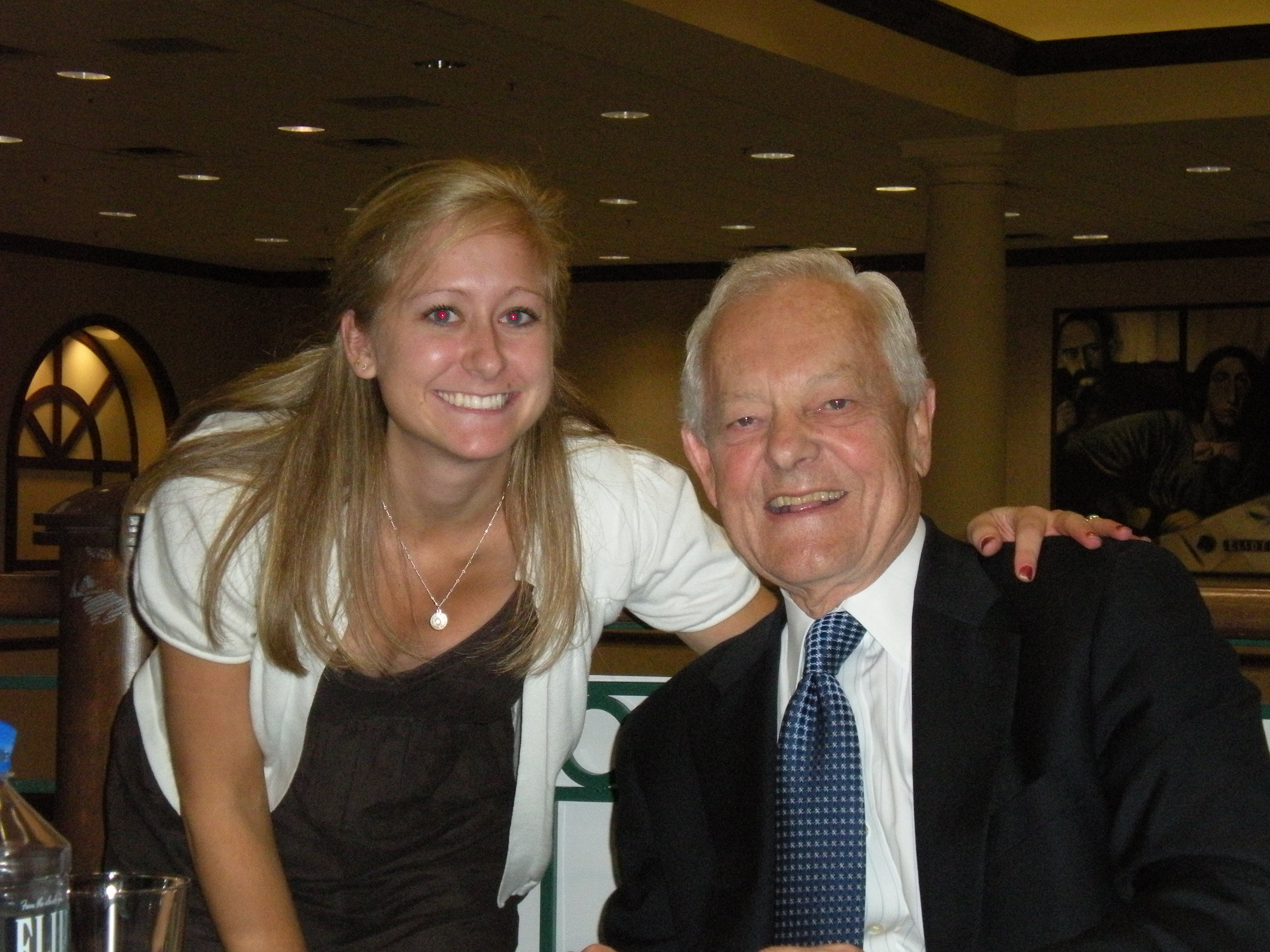
I had to wait a couple of weeks for a friend to send me this pic. Hence the late blog post.
I had to wait a couple of weeks for a friend to send me this photo, hence the late blog post.

Like a little kid in a candy shop, my eyes widened when I saw Bob Schieffer. He was at a Barnes & Noble in Dallas a couple of weeks ago to promote his new book, Bob Schieffer’s America.

I’ve been fortunate enough to meet some amazing journalists throughout the years: Tom Brokaw, Gwen Ifill, Anne Hull, Tom French, Lane DeGregory, the late David Halberstam, and more. These journalists, and several others who haven’t reached the same level of recognition, have given me hope that quality journalism is still around, even if it’s getting harder to find. In giving me this hope, they’ve served as role models who I can look up to and try to emulate.

I’d say Bob Schieffer is a pretty good role model. The longtime journalist, who grew up in Austin, Texas, and worked as a reporter for the Fort Worth Star-Telegram, has won six Emmy awards, is in the Broadcasting/Cable Hall of Fame and in 2002 was named Broadcaster of the Year by the National Press Foundation. For all his accomplishments, he struck me as incredibly humble and fun-loving when he spoke at Barnes & Noble.

He kept his talk short, focusing mostly on politics and his experiences as a journalist. He told the mostly white-haired crowd that of all the elections he has covered, the 2008 election is the most dynamic of them all. Because the race is so close, he predicted that this year’s debates will hold significantly more weight than those in years past.

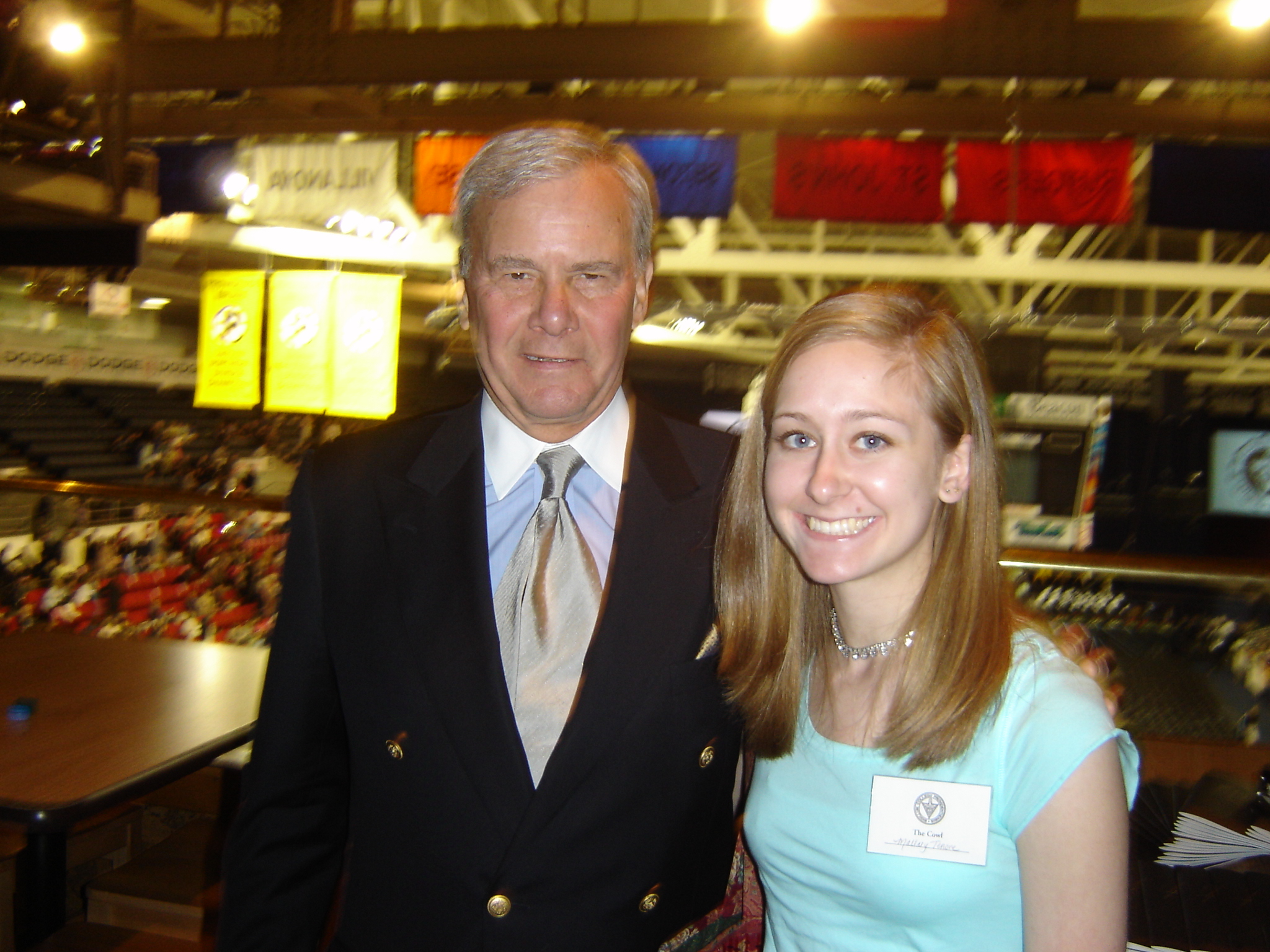
    Just for fun, I'm posting this photo of me and Tom Brokaw. It was taken three years ago when Brokaw gave the commencement speech at my alma mater, Providence College.
I posted this photo of me and Tom Brokaw just for fun. It was taken when Brokaw gave the 2005 commencement address at my alma mater, Providence College.

After Schieffer shared his stories, I waited in line for an hour to take a photo and talk with him. I mentioned my experiences at The Dallas Morning News and at The Poynter Institute, which he visits about once a year as a member of the institute’s national advisory board. When my friend asked him about the future of journalism, he succinctly said that no matter what happens, there will always be a need for news.

I smiled a lot when talking with Schieffer and didn’t bother hiding my kid-in-a-candy-shop excitement. These days, journalists need to hold onto every ounce of motivation they can get.

Who are your role models?