Books: Deal Breakers or Deal Makers?

I’ve heard my friends spew off lots of deal breakers — one of my friends has a whole list of them — but I’ve never thought of deal breakers in terms of books. One of The New York Times‘ most e-mailed stories this week is a piece by Rachel Donadio about how books play into relationships. The article mentions that some people even break up with their significant other or refuse to keep seeing someone just because of literary differences.

I’m a book-a-holic, a bibliophile who loves to read and collect used books, but I wouldn’t break up with a guy just because he didn’t like reading or because of a difference in literary tastes. It is an added bonus, though, if the guy likes reading and can share this pleasure with you. If this is the case, you can chat about books and read them together. C’mon, you have to admit that’s a cute idea. Plus, if he likes books, you don’t have to rack your brain trying to figure out what to get him for his birthday or Christmas!

I’ve found that sometimes reading a book that another person likes can draw you closer to the person by giving you a sense of what they relate to and what they find interesting. I’m always intrigued if a guy introduces me to a new book/author, rather than listing off titles I’ve heard all too many times, like “Catcher in the Rye.” I’d categorize this as one of the “cool books” that people often put on their list of literary favorites. It’s safer to say you like a book if lots of people like it.

More than 300 people responded to the Times article to highlight the books they like — and the books they’d prefer their significant others to stay far away from. They’re worth a look.

So, do you consider books to be deal breakers or deal makers?

‘Largo Adults Get Kicks from Childhood Game’

picture-7.png

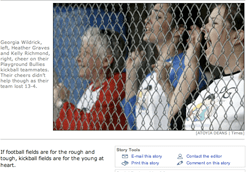
Screengrab of St. Pete Times story. Photo taken by Atoyia Deans, St. Petersburg Times.

A story I wrote about adult kickball appeared in today’s issue of the St. Petersburg Times. I played kickball in an adult league last fall and hadn’t really thought about why I played, other than the fact that I wanted to meet people. In interviewing other kickball players last week, I found that many of them play to escape the stress of work/adult life and just be a kid again, even if only for an hour.

———————————————

If football fields are for the rough and tough, kickball fields are for the young at heart.

“Out here you can be goofy,” said 30-year-old Justin Taylor. “You can be a kid again.”

Justin is a member of the Bust N Balls, which faced off against the Playground Bullies at Whitesell Softball Complex field in Largo Thursday night.

The teams are part of an adult kickball league organized by the city of Largo’s parks and recreation department.

The men and women on both teams revert to a time when recess and naps were staples of daily life, a time when the space between bases seemed much bigger and the risk for getting hurt much smaller. [Read more…]

Launching an Origami Paper Airplane — From Space

I’ve been making paper cranes, turtles, flowers and hearts for 10 years now. I’ve got boxes of the paper creations all over my house back in Massachusetts. A couple of weeks ago, I got out my origami paper and started making dozens of cranes and turtles while watching TV. By the end of the night, I had made nearly 30 of the little critters.

Now with instructional videos on YouTube, learning origami is a lot easier than having to look at paper instructions, which I find are hard to follow. A friend from Japan taught me how to do origami. She started me off with real tiny paper and taught me the importance of making sure every fold lined up. A sloppy fold could mean a broken wing on a crane or a lopsided leg on a turtle. Since learning all this, I’ve become fascinated by paper folding, which is why an Associated Press article about the Japanese wanting to launch a paper airplane from space caught my eye yesterday.

The AP reports:

Japanese scientists and origami masters hope to launch a paper airplane from space and learn from its trip back to Earth.

It’s no joke. A prototype passed a durability test in a wind tunnel last month, Japan’s space agency adopted it Wednesday for feasibility studies, and a well-known astronaut is interested in participating.

A successful flight from space by an origami plane could have far-reaching implications for the design of re-entry vehicles or space probes for upper atmospheric exploration, said project leader Shinji Suzuki, a professor at Tokyo University’s Department of Aeronautics and Astronautics.

The article continues:

“You may think it’s impossible, but we scientists are all extremely interested. I think it’s a great experiment,” said Miyazaki, the Nihon University engineer.

“No matter how it turns out, a paper craft flight from space would tell us many things,” Miyazaki said. “The fact that a paper shuttle has endured the harsh environment in the lab tests also provides valuable data for future aerospace technology.”

Seems pretty interesting. Talk about having to make precise folds …

Blogging Tips from a Budding Blogger

picture-2.png

A chart showing how many people have read my blog throughout the past month. Readership spiked significantly after I did some live blogging at the Nieman narrative journalism conference. This was in large part because my blog was linked to on Poynter Online.

I’ve caught the blogging bug. This month, I live blogged at a conference for the first time and I created a new diversity blog for Poynter Online called Diversity at Work. Based on what I’ve learned about blogging since I started Word on the Street last July, I decided to teach some people at work how to blog.

Starting with the basics, I put together a handout, which I’ve copied and pasted below. I hope you’ll share your ideas/add to what I’ve written.

——————————————–

Blog: (Web log = blog)

Free blogging software:
WordPress
Blogger
Blogsome

Paid blogging software:
MoveableType and TypePad

Some benefits of blogging:
You learn how to write concisely.
You learn how to fine tune your writing
You learn how to write for an audience.
You learn how to engage in a conversation with readers through the comments section of your blog
You learn how to think visually – What photos can you take to go along with your blog? Is there a quick video you can create to better demonstrate/show what you are writing about

Ways to promote your blog:

–Think about search engine optimization (SEO). In other words, think about how you can optimize the chance of your blog appearing in people’s searches online. When blogging about Elie Wiesel’s talk at Eckerd College, for example, I could have written “Highlights from Wiesel’s talk” as my lead, but I wanted people to find my blog, so I included the keywords “Eckerd,” “Talk,” and “Elie Wiesel” in my headline: “Elie Wiesel: Highlights from His Talk at Eckerd.”

–Use social networking sites to alert people as to when you’ve written a new blog post. I have my WordPress blog fed to my Facebook page (Click here for more information about this.) Every time I publish a new post, it gets uploaded to my Facebook page and appears in my friends’ newsfeeds so that others can read it. If I have a post that I especially like, I also post a link to it on my Twitter page.

–Comment on other people’s blogs. Often, you can leave a link to your own blog, which can help you expand your readership.

–Blog during conferences and let others around you know that you’re blogging. Share with them the URL of your blog. I blogged during the Nieman narrative conference last week and was surprised to see how many people asked me what I was doing as I typed away on my computer. People were interested in reading my blog and wanted to know what the experience of live blogging was like.

–Don’t let your blog die. So many people start blogs, write a couple posts, and then neglect them. I call it “the case of the dying blog.” Set reasonable goals for yourself. I try to write three to four posts per week. Even if I don’t have a huge readership, I want to provide fresh content for the people who do read my blog.

Cautions to take when blogging:
Remember that whatever you put on your blog is searchable in search engines. If you are a journalist, you want to be careful not to write anything that could be considered biased or overly opinionated. I often go by New York Times reporter Jenny 8. Lee’s advice: Don’t write something that you wouldn’t feel comfortable putting under your own byline

Searching blogs:
Technorati and Google’s blog search

Blogs I like:
Mom in the Mirror – Julie Moos’ blog

Immigration Chronicles – Houston Chronicle’s immigration blog

The Double Breasted Dust Jacket — a blog about books

Buzzmachine – Jeff Jarvis’ interactive journalism blog

Pressthink – Jay Rosen’s blog

For additional resources about setting up a blog, read Steve Outing’s Poynter Online article, “What Journalists Can Learn from Bloggers” and “What Bloggers Can Learn from Journalists.”

On Twitter: RSS-fed v. Manually Updated Posts

Lots of news organizations have created Twitter pages, and some have created multiple pages for  for news about business, traffic, entertainment, etc. I just noticed that similar to The New York Times, The (Portland) Oregonian has quite a few Twitter pages:

Oregonian news: http://twitter.com/oregonian
Oregonian traffic: http://twitter.com/OregonianTraff
Oregonian sports: http://twitter.com/OregonianSports
Oregonian biz: http://twitter.com/OregonianBiz
Oregonian entertainment: http://twitter.com/OregonianEnt

The Oregonian just created a new political page, Oregonian2008, which features manually updated posts. The latest post says: “We’re going to try Twittering live from the scene during Obama campaign appearance at Memorial Coliseum Friday. Reply with suggestions, etc!” I’ll be interested in seeing how The Oregonian uses its Twitter political page throughout the 2008 presidential campaign.

As a user, I like when news organizations manually update their Twitter posts as opposed to having them automatically updated through an RSS feed. The information feels more personalized when it’s updated manually, and it seems less overwhelming. At times, I’ll get up to 10 posts all at once from news organizations that update their Twitter page through RSS feeds. On the flip side, though, RSS-fed updates may be better if you’re looking to use Twitter as a one-stop news aggregator and want to receive as much news as possible on the site. Rather than making separate visits to npr.org, nytimes.com, espn.com, and oregonian.com, etc., you can get all your news in one place — on Twitter.

If you’re a Twitterer, which do you prefer — RSS-fed updates or manual updates? If you’re wondering what the heck Twitter is, you can read more here.

Poynter’s New Diversity Blog: Diversity at Work

picture-1.png

(Excerpt from Poynter’s new diversity blog. Read more …)

My editor, Bill Mitchell, asked me a few months ago to start thinking about how Poynter Online might improve its coverage of diversity. He knew I had written a four-part series about diversity for my college newspaper, The Cowl, last year and that the subject of diversity interests me.

With the help of my gifted colleagues Tom Huang and Bill, I started conceptualizing an idea for a diversity blog called Diversity at Work (www.poynter.org/diversityatwork). I finished putting the blog together last week after lots of brainstorming about how the blog could be best served.

We’re soft launching the blog this week on our Poynterevolution blog. Next week, we will introduce it in a centerpiece item. So far, about a dozen journalists from news organizations around the world have agreed to contribute to the blog.

This is a work in progress, so I’d be curious to see what ideas you have/what you think of the way I’ve set up the blog. Feel free to add to the comments in this post or to the comments section in the Poynterevolution blog. Here is Bill’s piece on Diversity at Work.

‘Narrative on Deadline’

Sitting in on a workshop at the Nieman narrative journalism conference with St. Petersburg Times reporter Tom French and editor Mike Wilson.

Good examples of narrative writing on deadline:

St. Petersburg Times story, “Brazen Meets Kind in a Courtroom,” by Colleen Jenkins. Reporter saw this story in the courtroom. She didn’t name the characters. As a result, the reader sees the subjects of the piece — “Pinstripe Suit” and “Red Velour Sweatshirt” — the same way that those in the courtroom do.

The (Charleston, S.C.) Post and Courier story, “Firefighters Grieve after Deadly Blaze,” by Glenn Smith. Notice the first paragraph. The whole story doesn’t have to be a narrative. Sometimes, a story can just have one solid narrative paragraph.

St. Louis Post-Dispatch story by Todd Frankel. (See 10/10/07 story)

St. Petersburg Times story by Tom French, Anne Hull, and Sue Carlton (4/22/00)

St. Petersburg Times story by Tom French (2/28/03)

The question isn’t so much if you’re going to write a narrative piece or an investigative piece. The question is, “What’s the best way to tell the story?”

You don’t have to go to Baghdad for The Washington Post to do narrative work.

Common reasoning behind not writing narratives is the idea that “my editors won’t let me.” If you propose an article, sometimes the real problem is if they say yes. At that point, you have to deliver on that ambition.

Sometimes it seems easier to be dejected and assume that your editor will say no, but you have to take the responsibility to bring the story to your editor. Take stories that have a low risk factor. Take the story about a mom and daughter going back-to-school shopping. Take the spelling bee story. Take the stories that others don’t want to do and go with them.

Try to get your editor to give you objective reasons for criticisms. “Why didn’t x or y work for you?” Good editors listen. The best reporters are hungry for good, strong suggestions about how to make their stories better. Welcome high expectations, embrace revisions.

“What’s the best possible outcome of this story? How do we get there?” Good questions to ask about a story. Make it clear to your editor that you don’t mind if he/she calls you at 8 p.m. You want the story to be good, so having that willingness to collaborate is key.

If your editors ask “How do you know that?,” the detail they’re referring to may not be clear enough in the story.

Narrow the frame. Human trafficking, for example, is a topic, but it’s not a story. Zoom in tight and focus on one family, one girl, to explain the larger issue.

’50 Writing Tools in Three Hours’

I just sat in on Roy Peter Clark‘s three-hour writing workshop at the Nieman narrative conference. I’ve heard Roy, my colleague at Poynter, talk about his “Writing Tools” book a dozen or more times, but I still learned something new today. Here are some of the tools I found most helpful:

“Get the name of the dog” — Dig for the little detail that adds color to a story. Sometimes, just saying, “Tell me about such and such,” can open a world of details.

— “Pay attention to names”— Names matter. Think about how good it makes you feel to hear someone call you by your name. Would you rather someone say, “Hey, you” or “Hey, Cindy”? Sometimes names can have a strange or interesting connection to a person’s past or profession — a mother who names her daughter after her own deceased mother, a race car driver aficionado whose last name is “Racer,” etc.

— “Tune your voice” — by reading your drafts aloud. When I have the opportunity to read my pieces aloud, I find words that sound awkward, overused, or unnecessary. I always used to wonder, “How the heck do I read a piece aloud if I’m sitting in the newsroom? The great writing coach Don Fry suggests picking up the phone and reading your piece. Your coworkers will just think you’re on the phone.

— “Reveal traits of character” — One of my editors told me about an exercise she did with a reporter. Both she and the reporter went to the same place and covered the same story. When they came back to the newsroom to compare what they had reported, they both had incredibly different notes. The reporter’s notebook was full of quotes from the people she interviewed. The editor’s notebook was full of scene, dialogue, and details about the place they had visited. She listened and observed more than she asked questions. Scene and dialogue put us in a story. Roy said today that “Dialogue is a form of action. A quote is heard, but dialogue is overheard.” So true.

— “Put odd and interesting things next to each other” — Doing so helps add variety and elements of surprise to a piece. When writing a piece during the session today, I wrote the sentence: “It couldn’t have been a coincidence that I crashed in front of the Crosspoint Baptist Church. On a road that is lined with five strip joints in a nine-mile stretch, I would have been more likely to crash in front of the Oz Topless Bar or Zona Erotica.” You wouldn’t think to put a church and a strip joint in back-to-back sentences, but doing so adds verbal variety to a story.

— “Save string” — Like most reporters, I have a list of stories I want to write. I can’t always get to them, but I save string and work until I get the ball I want.

— “Recruit your own support group” — It’s amazing how helpful positive reinforcement can be. Like most people, I thrive on feedback. Sometimes all it takes is asking an editor or a trusted colleague, “What works in this story? What needs work?”

— “Limit self criticism in drafts” (I would add to this “make deadlines for yourself) —

Often, the problem is our backspace button. We tell ourselves, “Oh, that doesn’t sound good. That doesn’t make sense. I need a more compelling lead,” and then we hit the backspace button. It’s tough to write through those thoughts, but when writing drafts, the space bar and enter keys are what move us forward.

When time permits, I find it helpful to scribble the lead to my stories on paper instead of on my laptop. There’s something about the hand-to-paper motion that engages me more in the material.

… Great session. Lots of writing, laughs, and guitar playing. More to come tomorrow.

‘Ten (Not So Secret) Tips for Effective Interviewing’

I’m here at the Nieman narrative journalism conference, blogging during some of the sessions I attend. I’m sitting in on Jacqui Banaszynski‘s tips on interviewing.

Here are some highlights:

— When interviewing, know your purpose.

— Interview people in their natural habitat as opposed to a coffee shop.

— Turn every subject into a storyteller.

— Believe that everyone you’re interviewing wants to talk to you. Map out why they’d want to talk to you.

— Use props and contrivances, and think of how you can put the subjects of your story in a different place and time. “Where were you when you found x out?” “What were you wearing?” Ask questions that put people somewhere, questions that help turn them into storytellers. This is especially important for people who are shy, awkward, etc.

— “There are no stupid questions. There’s only the stupidity of not asking a question.”

— One of the best interviewing questions is sometimes just “Really?” You want to keep a conversation going.

— We don’t listen enough in life. We often think/worry about the next tough question and don’t listen as much as we should during interviews.

— “If you can think of a question that helps the people you’re interviewing to think of their world in a different way,” that’s great. Sometimes people, especially celebrities and others who are interviewed a lot, get used to the same questions and therefore repeat the same answers.

— Always go back and interview a person … again and again.

— Say to the people you’re interviewing, “Tell me about your day.” Have them walk you through it.

— The goal is to be curious, to keep moving forward, and to not worry about your own discomfort.

— “Peel the onion.” Take one question and keep going. We often ask a question, get the answer, and move on to the next question. The truth is, there is always time to ask follow-up questions, and the follow-up questions are the ones that will illicit a story. “For every question, there are five more questions.”

— If you don’t know what to ask, then you can ask the “best” question: “Really?” or just “Huh.”

— We think during interviews we have to go straight to the heart of the matter. If you have the luxury of time, you can keep developing the heart of the matter during each interview.

— “Our job as journalists is not to know, it’s to find out.”

‘Creating An Investigative Narrative’

I’m here at the Nieman narrative journalism conference in Boston, sitting in on this morning’s keynote speech, “Creating An Investigative Narrative,” with Washington Post writers Anne Hull and Dana Priest. They are explaining the story behind their award winning Walter Reed series. It’s my first time blogging live from a conference, so bear with me. Feedback is welcome.

Some notes from their talk:

Hull and Priest focused on the army’s neglect and the treatment of wounded soldiers at Walter Reed Hospital. Neither of them was prepared for the reaction, they said. They received hundreds of e-mails in response to the series.
“For the first time in my life I realized the true power we have as journalists to create change.” –Anne

Right from the start, they knew that if what they were hearing were true, it would be a big story.

Two real sources, they said, seemed like a lot to work with at first. They started a process that’s classic journalism — you start somewhere and you get more and more, and eventually you create a network of sources. At first they couldn’t see “the whole elephant.” Saw small pieces of the story and learned more throughout the process.

Investigative journalist (Priest) meets narrative journalist (Hull). Good learning experience.

What kind of access could they get? One source said, “Just come on up.” Immediately confronted with how far they could go. Could never lie about who they were. Couldn’t be in a position where someone would ask, “Well, who are you?”

Were given a map of Walter Reed so they could memorize it and figure out the layout of Walter Reed. Nothing was like she memorized it, though, Priest said. She had to stop three times and ask people on the road where the hospital was. Eventually, she learned there were two entrances. She was going through the back entrance, so everything was turned around.

Scheduling: “We pretty much lived and breathed that story for four or five months,” Hull said.

Two different “rhythms” between the two reporters. Different approaches to reporting.

When writing an investigative piece like this, you start off with people on the phone, meet them off-post, then you start interviewing them.

Hull and Priest talked with wives who were frustrated beyond belief about the treatment their husbands were getting.

The reporters needed to see things to substantiate what they were hearing about the poor conditions at the hospital. There’s an area called “the petting zoo” where the media are usually taken. They needed to get beyond that.

Didn’t quote anyone or take notes during first main interview. Just wanted to listen. “You penetrate one ring closer to where you need to be,” Hull said.

There were concerns that if they introduced themselves to soldiers, soldiers would tell commanders. There were always smokers outside of the Malone House, so Hull and Priest arranged for friends who smoke to come with them so they wouldn’t seem so out of place. They found the main subject, Josh, for their piece while he was outside smoking in the rain. “You’re literally and figuratively coming in from the rain,” Hull said.

Have to have empathy and respect, Priest said, for whatever culture you’re walking into. In immersion journalism, you don’t want to stand out, you just want to be a fly on the wall.

“The first time I heard about building 18, I just could not believe such a place would exist,” Priest said. “Cockroaches, President Bush. Mold, Donald Rumsfled. Democracy, Chaos in Iraq.” So much tension there.

The question became how they would verify what was going on in building 18, and how they would get in there. Priest and Hull were first taken to a room that didn’t look so bad. Soldier said there’s a lot of depression here and people aren’t doing well.

“We’re in an era of journalism where a lot of journalists are doing the talking,” Priest said. “The art of listening is so fundamental to what we do. If you have a heightened ability to do that, you can pick up so much.”

Patience is also key. In terms of building sources, you have to be patient. How do you do that? Two tracks: One is feeding the beast and doing daily journalism, the other is having a long-term project. Starting with easy questions, easy subjects, and working to the harder things is important. Took months for Priest and Hull to cultivate their sources.

Priest and Hull got into building 18. They had to find a way to get into the building and into the individual rooms. Priest had a camera. She said she whipped it out and quickly took pictures. The photos didn’t come out well, though. The photo staff was not impressed, Priest said, laughing. The thought of having a photographer come back with them seemed out of the question, but it worked.

Have to put everything in context — talk about soldiers at Walter Reed, then relate that to the army, then to the war in Iraq.

When you contrast the photo of that moldy room with that shining promise given to the soldiers, it’s eye-opening. Hull and Priest had to describe as much as possible from what they’d seen, not just from what they’d heard. They ate at the Red Lobster with the soldiers (the soldiers loved this restaurant), and spent hours and hours with them in their rooms. For every soldier in the story, Hull said, there were about 10 soldiers who called to tell their story.

“Oh by the way, we heard someone died last night.” A soldier would say this during a phone conversation with Hull or Priest. That would be something, then, for them to check out. Soldiers gave them tips, created an intense relationship.

“The tricks that people employed to survive were incredible,” Hull said. “It’s stuff you can’t find in medical records.” Asked people for their medical records once they got to know them.

Reporters have to drive their relationship with editors, have to determine what a story is and what it’s like. You have to do it with diplomacy and respect, but you’re the ones out there, and you know what the story is.

The lesson to me is you have to be diplomatic, be disrespectful, you have to give editors something because they’re going to talk to other editors about how you’re using your time, Priest said. It’s really important that reporters stay in the drivers seat regarding what’s happening with a story.

They didn’t think so much about creating a beautiful piece of writing, Hull said, so much as exposing what was going on. Showdown interview: In our world of writing, we usually have questions for people at the end — fact checking, making sure things are right. But Priest and Hull had to check everything with the army, even though they didn’t know the reporters had been writing this story. Called on a Monday or Tuesday before Sunday publication. Called in the nicest way, said they had a story they’d been working on, told them what the story was. General approach is to be friendly, you get a lot more out of it. They weren’t angry, didn’t know the Walter Reed that Priest and Hull had come to know.

Reporters sent 30 questions via e-mail to the army. “How many case workers do you have per soldier?” that kind of question. Gave them four days and considered a fair way to do it. Didn’t tell them about building 18. Priest and Hull were driven by an escort to the hospital. A parking spot was shoveled out for them, even though the area hadn’t been plowed for soldiers in wheelchairs.

What the military hates more than bad news is not knowing the bad news is coming. Told them about building 18 the Saturday before the first Sunday piece was published. “We wanted the full burden of what was going on to be in the paper,” Priest said. “We didn’t want to give them the chance to clean it up.” Wrote like crazy for three or so months, then spent a month writing together. “If I went two hours without talking to [Priest], it was really strange,” Hull said, laughing. “And it’s still really strange.”

… More to come at the next workshop.