I wanted to thank everyone who helped me raise money for the Race for the Cure. I ended up exceeding y $1,000 goal and raising $1,285, the majority of which will go toward local nonprofit organizations that offer screenings, breast health education, and treatment projects for those who are medically underserved. About 25 percent of the $482, 875 raised will also go toward breast cancer research.
I didn’t run the 10K nearly as fast as I had hoped; I was aiming for 7:45-minute miles but ran 8:30 miles because stomach cramps hit me about halfway through the race. Still, I’m less concerned about my time, especially since this is just the start of the race season here in Florida. Most of all, I’m just happy I met my goal and that so many friends, family members and even strangers donated to a cause that’s near and dear to my heart. It’s amazing how much spreading the word on Facebook and Twitter helps!
During the race, I thought of those who donated and the people in their lives who they said have been affected by breast cancer. I also thought of the two people I ran the race for — my maternal aunt and my mom. I know they’d be proud.
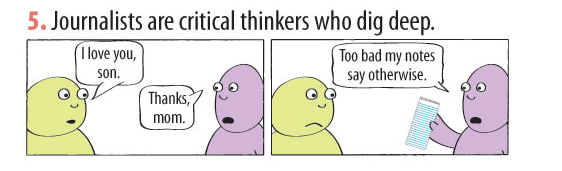
Patrick Garvin, a graphic artist at the Florida Times-Union, sent me an e-mail earlier this week with a link to a comic strip he just created. The comic is based off of one of Jill Geisler’s popular Poynter Online columns from last year, “10 Reasons You Should Hire a Journalist.” Garvin said he created it in honor of a colleague who was recently laid off. It’s a good visual representation of Jill’s column and a reminder of all the marketable skills journalists have. (And of how awesome they are!)
Shafer said that in the eight years that he’s reported on fake trend stories, only one reporter has contacted him in response — two years after the fact. Journalists don’t like owning up to having written fake trend stories, in some cases because they don’t think the “trends” they’ve written about are fake. As an experiment, I sent a tweet via Poynter’s Twitter account saying that we would give a free travel mug or T-shirt to the first journalist who owned up to writing a fake trend story. Not surprisingly, no one responded!
Given this family history, I can’t help but worry that someday I might get breast cancer. There’s not a whole lot I can do to prevent it, though, except do my best to live a healthy lifestyle and try to raise money for cancer research.
I’ve been passionate about this cause for several years. In college, I helped start my college’s Relay for Life efforts and was always moved by all of the people who came out to show their support for cancer research. It made me realize how many people have been affected by cancer, directly and indirectly.
Though I hate asking people for money, I’ve been asking people to donate what they can, even if it’s just a few dollars. I first let people know about the race earlier this month on Facebook and Twitter and got donations from friends and from acquaintances who I haven’t talked to in years. In just a few days, I raised more than $500, so I upped my fundraising goal from $100 to $1,000.
Now I’m starting to reach out to more people in hopes that they’ll help me reach my goal. The money for the race goes toward breast cancer research and local nonprofit organizations that offer screenings, breast health education, and treatment projects for those who are medically underserved. If you’re interested in donating, you can visit this page for more information.
I’d greatly appreciate any contribution you can make! With every stride I run and every dollar you donate, we’ll be making steps together toward finding a cure.
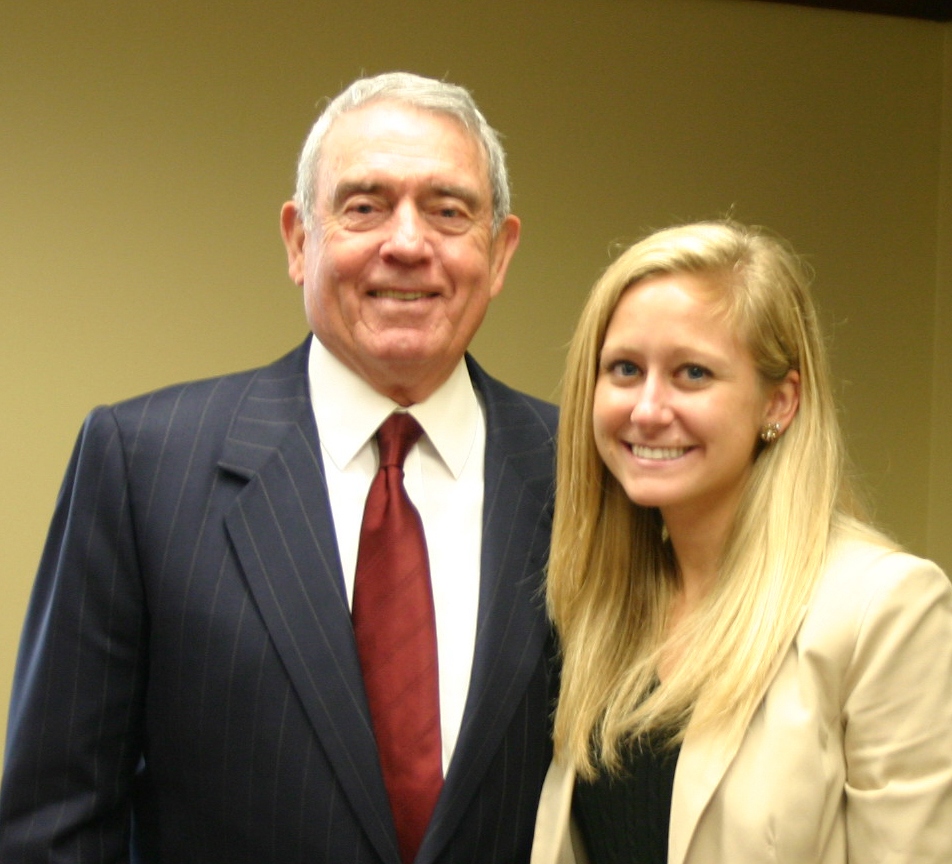
Last week I got to meet legendary journalist Dan Rather. I wasn’t nervous in the days leading up to the interview, but then an hour or so beforehand, I could feel my stomach start to turn. At the same time I felt as excited as a little kid on Christmas morning, and was reminded of why I love my job so much.
I had spent a good deal of time researching Rather’s career as a journalist, and I had gone over the questions I planned to ask him with my editor, so I felt prepared. But I still couldn’t help but think: Rather has interviewed some of the world’s most powerful figures. He knows what a good interview entails, so you better make this a good one!
By all accounts, I think the interview turned out well. Rather was late, (through no fault of his own), but I still got to talk with him for about a half-hour. When he saw me, he gave me a warm handshake and smile and apologized for being late. He started off asking me if I worked full-time at the institute — a question that lots of people ask me, I think because I look young enough to be an intern. After I quickly told him about my job, Rather said, “OK, let’s get to work!”
I only had time to ask him five of the questions I had prepared, in part because he offered such detailed responses to each of them. Toward the end of the fourth question, Rather was called to the dinner that was being held at Poynter to honor him. Instead of rushing out of the interview, though, he said: “I’m going to let this young lady ask one more question because she was so patient while waiting for me.” So I asked him about social media — something he’s started to gain an appreciation for but doesn’t regularly use as a journalist.
Me and Ted Koppel, who spoke at Poynter in September 2009.
Not surprisingly, Rather shared many traditional views of journalism, but also seemed to see the promise in emerging technologies. His responses helped show just how much the industry has changed — and in some ways how it’s remained the same — since he began his career as a journalist in 1950.
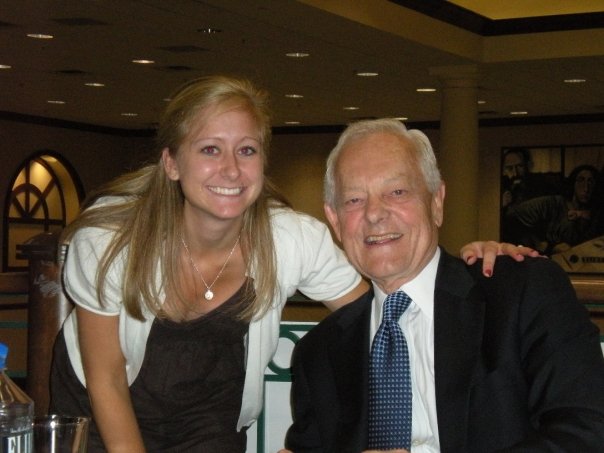
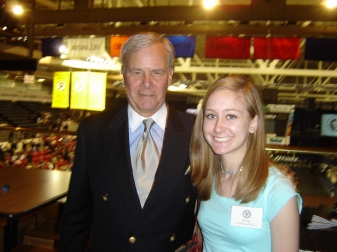
It was a real treat and honor to talk to Rather, and I’m so glad I was given the opportunity to do so. Rather is one of a few well-known broadcasters I’ve been lucky enough to meet throughout the years. (See pictures for more details.)
Here’s a link to the story I wrote about the interview, and here’s a link to the full transcript. For those who are interested, I’m also including a list of the questions I planned to ask Rather, knowing I’d probably only have time to answer about a quarter of them:
State of the news industry
–Last year, you called upon President Obama to form a commission to help save journalism jobs and create new business models to keep news organizations alive. You’ve been vocal in recent years about the “perilous state of America’s news industry,” saying “American journalism is in need of a spine transplant.” What do you think is most at risk in today’s news industry?
–If you could, how would you change evening network news?
–You’ve criticized news ownership, pointing out that many news organizations are now run by large, corporate entities that have interests and agendas that run contrary to the interests of the public. Along these lines, you’ve said “the news stops with making bucks.” What do you think needs to be done to change this problem? And hasn’t news always, at least in part, been about ratings and money?
The Internet
Met Bob Schieffer at a 2008 book signing in Dallas when I was interning at The Dallas Morning News.
–You said in a Huffington Post story that until recently, you had no idea what Twitter was. “Much of what we tweet, or post, or chat away at under the guise of news, are distractions,” you wrote. Lots of journalists nowadays, though, use Twitter to report and disseminate stories. How important do you think social media is to today’s journalism?
–In a Washington Post column last year, you wrote that newspapers are the foundation on which hard news rests. More specifically, you said: “The old news model is crumbling, while the Internet, for all its immense promise, is not yet ready to rise in its place and won’t be until it can provide the nuts and bolts reporting that most people so take for granted that it escapes their notice.” Can you say more about why you think the Internet isn’t ready to rise up to the old news model? What will it take for it to rise up, and do you think it ever will?
Coverage
–At the Democratic National Convention in 2008, you said the news is now filled with “so-called political debates, where the one thing assured not to happen is genuine debates and where the questions the public really cares about seldom seem to get asked.” What do you think needs to be done to improve political coverage?
–Along these lines, how effective do you think PolitiFact, and other efforts to fact-check political news, are?
Me and Tom Brokaw, who was the Providence College commencement speaker in 2006, the year before I graduated.
–You were a correspondent during the Civil Rights movement and have said that your desire to report on these injustices was one of the reasons you decided to become a journalist. What’s missing in today’s diversity coverage?
–You’ve gone from anchoring a nightly news broadcast to managing a more niche show, “Dan Rather Reports,” on HDNet. On the show, you focus on international coverage and investigative stories. How do the stories you cover now differ from, or compare with, the stories you covered for CBS?
–When major news stories break today, what are your first instincts?
Killian documents
–What did you learn from the controversy over the Killian documents?
–You said in a UC Berkeley interivew last year that you didn’t realize the power of bloggers until a group of conservative bloggers questioned whether the Killian documents were falsified. What role do you think bloggers play in today’s news media industry?
Craft of journalism
–You’ve talked a lot about courage, saying “courage is being afraid but going on anyhow.” What makes a courageous reporter in today’s world?
–What do you think would be a healthy “news diet” for consumers? What sources and resources should they turn to?
–You’re known for some of your classic expressions, which I remember from the 2004 elections. (ie “George Bush is sweeping through the South like a big wheel through a delta cotton field”; “There’s no question now that Kerry’s rapidly reaching the point where he has his back to the wall, his shirttail’s on fire and the bill collector’s at the door”; “This presidential race has been crackling like a hickory fire for at least two hours”; and “John Kerry’s lead is as thin as turnip soup.”)… Your voice really comes through in those expressions. How important is it to have a voice as an “objective” journalist?
Additional questions
–You recently traveled to Iraq to interview General Raymond Odierno, the commander of U.S. forces in the region. How is covering this war different from the other wars you’ve covered?
–If you could interview one person, who would it be? What would you ask?
–What’s been your most challenging story to report?
I’ve gotten to write a lot of fun and interesting stories at work lately, and I feel as though I’ve really started to develop my beat as a media news reporter. I’ve made contacts and have a much better understanding of the industry and of what constitutes a good story idea than I did when I started out at Poynter in June 2007. It’s comforting to look back and see how far you’ve come and at the same time realize how much more you want to learn.
Last winter, I heard from a volunteer at Germaine Lawrence, the all-girls residential facility where I was treated for anorexia from September 1999 to January 2000. The volunteer, named Andy, wanted to see if he could interview me for a video project he was putting together for Germaine Lawrence’s 30th anniversary gala. Of course I said yes. I wanted to tell my “success story” in hopes that others could benefit from it and see that it’s possible to heal from the wounds of the past.
I met with Andy for the first time when I went home for Christmas. At first I felt uncomfortable telling my life story to a stranger. But I could sense that he genuinely cared about what I was saying, so I let myself open up to him. About a week later he came to my house to take pictures of me, my dad and my grandma. I later mailed him other photos, as well as journal entries and poems I had written when I was sick. One of the poems was titled “Black Flower” — a metaphor for anorexia. When writing out the poem on a piece of scrap paper years ago, I drew a picture of a black flower on one side of the paper and a colorful flower on the other side to represent what I thought recovery would look like.
Life’s a lot more colorful now.
Andy used the poem in the video, which he recently showed at the Germaine Lawrence gala. The event attracted about 300 people and raised a significant amount of money for the girls undergoing treatment. I owe a lot of where I am today to Germaine Lawrence, where I was afforded the time to work on my issues and connect with staff members and a therapist who cared enough to listen to my story and who helped me work toward a new chapter in my life, namely recovery.
Recovery is a delicate balance between stepping toward the future and back into the past. The trick is making sure you don’t get stuck dwelling on life there. In revisiting my past, I’ve learned a lot about how losing my mom when I was 11 led me to have an eating disorder. Feeling as though I had lost control when Mom died of breast cancer, I sought to find something I could control. It seemed easy enough at the time to try to control what I ate. So I started to restrict my food intake, first depriving myself of meat, then sweets, then carbs. Little did I know, my attempts at finding order in life would lead to total chaos.
Fourteen years later, I still have a love-hate relationship with food. The hard part about being in a relationship with food is that you can’t ever really divorce yourself from it. For as much as you grow to fear and loathe it, you need it to survive. Food is something to be celebrated and enjoyed with friends. A labor of love you prepare and serve to your family. A fixture in your daily life that makes you feel both good and guilty.
When I’m tired or stressed, food becomes my savior and my enemy. It’s something I can indulge in one day and then deprive myself of the next. Others who have struggled with an eating disorder or disordered eating know what this is like. When you’re home alone and no one’s looking, you’re free to let your desires take over. So you go in search of the food that you’ve been craving but wouldn’t let yourself eat in front of others. You sink your teeth into the forbidden fruit, (which is usually in the form of apple strudel or blueberry cake), until a bite leads to a binge. When it’s all over, you scold yourself for getting to the point where you feel ashamed and gross, like a gluttonous girl with no self control. Then you restrict the next day to prove to yourself that control isn’t completely out of reach. You forget altogether what it’s like to eat when you’re hungry and stop when you’re full.
If only I were 10 pounds lighter, I’d be happier, you tell yourself. But if and when you lose the 10 pounds, you find yourself wanting to lose more. Or you focus so hard on maintaining your new weight that you rebel and sink your teeth into those chocolate chip cookies you’ve been resisting, or that ice cream you stuck in the back corner of the fridge, hoping you could trust yourself not to sneak a spoonful. How easy it is for one spoonful to turn into one serving size, or two or three or four.
The irony of disordered eating is that it’s rarely about food. It’s about the emotions that drive you to turn to food, or rebel against it, when you don’t know what else to do. It’s about the desires you suppress, and the problems you tried burying long ago, hoping they’d never resurface. I’ve learned that when I’m having trouble with eating, I need to try to find my emotions. They’re always there; it’s just a matter of deciding whether I want to acknowledge them or keep burying them. It’s a lot easier to shovel food inside than it is to dig for feelings.
I’ve done a lot of digging throughout the years. When I start to forget how far I’ve come, I think back to the days I would spend calculating how many calories I consumed and how many I needed to burn. Those were the days when I would lie in bed and exercise when I should have been sleeping. They were the days when I stopped hanging out with friends because I was afraid they’d make fun of me for being “overweight” — at 66 pounds.
I talk about these low points and others in the video that Andy put together. For months I’ve wondered whether I should post the video on my blog, and whether I should be so open about my ongoing steps toward recovery. My ambivalence stems from my fear of vulnerability and the uncertainty of knowing how others will react. I’ve found, though, that people tend to respond positively to stories about overcoming difficulties in life. At their core, these are stories about survival. We all need to tell our stories — not necessarily publicly, but at least to someone who will listen and let us know we’re not alone. I’ve decided that if my story can help even one person feel less alone, then it’s worth telling. Here’s to hoping my story helps you. …
I wanted to give you a quick update on my blog post about cooking one homemade meal a week. I haven’t been cooking as much as I’d like, but I have made some of the dishes I blogged about, and I’ve been trying to make more of an effort to prepare different meals for myself instead of eating the same thing every night.
In the past month or so, I’ve made cilantro and lemmon hummus, mushroom burgers, garlic green beans, pasta salad, and a birthday cake from scratch. Of all the veggie burgers I’ve made, these mushroom burgers were the best. They fall apart easily when you’re cooking and eating them, but they’re simple to make and they definitely satisfied my vegetarian cravings. They have a pretty strong mushroom taste, so you may not like them if you’re not a big fan of mushrooms. I’d still recommend giving them a try, though.
Below are photos of some of the dishes I’ve made. …
I served the mushroom burgers with a side of garlic green beans. They looked a little wilted, but they still tasted good!Here's a concoction I came up with myself: Bow tie pasta with arugula, red peppers, goat cheese, pine nuts and pesto. Yum.This is supposedly "the best birthday cake ever," according to the recipe. I'm not sure I would give it such a high accolade, but it certainly tasted good. Next time, I would make each layer a little thinner.
After 10 days of traveling to New York City, Cape Cod, Providence and Boston, I’m back in Florida. The trip was packed with fun activities and little rest, but I still came away feeling rejuvenated.
One of my favorite parts of the trip was going for a late-night run across the Brooklyn Bridge. My friends and I were planning to get up at 6 a.m. and run, but we didn’t want to have to get up that early. After seeing “Mama Mia” on Broadway, we thought, “why not just run now?” So at 11 p.m. we went for a six-miler and ran over the Brooklyn Bridge and back. There were lots of people still walking and biking along the bridge, which I didn’t expect that late at night.
On one side of us was the Empire State Building. On the other, the Statue of Liberty. Wide-eyed, I looked at the lights, the view and the full moon above us. When we turned around and ran back across the bridge, it seemed as though we were running into the city. I felt so small and insignificant in comparison. There was something humbling about the experience of feeling dwarfed by something that’s so much larger than you’ll ever be.
Sarah McLachlan singing "I Will Remember You."
My other favorite part of the trip was going to the Lilith Fair with my cousin and two of my best friends. It meant so much to me to be with them and to have them all meet one another. The concert, which featured a variety of female artists, was a let-down for some. Ticket holders had complained prior to the concert because several big-name stars, including Norah Jones, Kelly Clarkson and Carly Simon, had backed out. But we still enjoyed it, and because of the low turnout, we got to move from the lawn to seating closer to the stage.
We caught up, sang loudly and got overly excited when Sara Bareilles came on stage. (She’s my favorite singer and is a pretty entertaining performer.) Sarah McLachlan, who runs the Lilith Fair, came on stage last. She sang “I Will Remember You,” the song my mom dedicated to me before she died. My friend put her arm around me and we sang together. I got the chills and called my dad so he could hear the song, too. He texted me to say “Thanks for sharing that with me. Love, Dad.” (Don’t you love when parents sign their IMs and text messages as though they’re writing a letter?)
That song will always carry a special significance. It often comes on the radio when I’m thinking of my mom or wishing I could ask for her advice. Seeing Sarah and visiting New York City reminded me of my mom, as she loved Sarah’s music and the city. The day I started my vacation to New York City was actually her birthday. She would have been 54.
I’m on vacation this week, so that’s why I haven’t blogged much lately. Instead, I’ve been exploring New York City, Cape Cod and Boston (and journaling about my adventures!). I’ll be back in action next week with updates from my trip. Hope everyone’s having a good week.





 Word on the Street