I interviewed Slate’s Jack Shafer, The Atlantic’s Andrew Sullivan and others to find out what role they think journalists should play in covering the speculation. To go along with the story, I also moderated a live chat with Poynter’s ethics guru, Kelly McBride, and Michael Triplett, a journalist and lawyer who has covered the Supreme Court and who’s on the National Lesbian and Gay Journalists Association‘s board of directors. We had hundreds of people in the chat, many of whom asked questions and shared their thoughts on whether to report on Kagan’s sexual orientation. (You can see a replay of the chat at the bottom of the story I wrote.)
After Kagan's nomination, The Wall Street Journal ran a front-page photo of Kagan playing softball, prompting some readers to question whether the paper was playing off a stereotype. In a Politico story, the Journal denied such claims.
I’m less interested in whether Kagan is a lesbian and more interested in the role that journalists have in acknowledging the discussion that people are having about her sexual orientation. The Fifth Estate has acknowledged the speculation. Should the mainstream media just ignore all the chatter? What’s the harm in addressing it?
Some may argue that addressing it would distract from the news and the facts, but what if we turned that argument around and asked: How might journalists engage new audiences by fostering a dialogue about the chatter? How might they help their audiences understand some of the deeper issues that are making people so upset about the lack of information about Kagan’s sexual orientation? And how might this type of dialogue inform journalists’ understanding of other issues involving the LGBT community?
These are just some questions I’ve been thinking about since reporting this piece. Feel free to share yours, too, in the comments section of this blog post.
Not a day goes by when I don’t think of my mom. It’s especially hard not to think about her in early May, when I’m surrounded by mothers and daughters spending time together, commercials advertising Mother’s Day gifts and stories about moms.
In years past, Mother’s Day has been especially difficult for me because it’s always been an in-your-face reminder that my mom’s not here. I still get sad around the holiday but it’s not as difficult for me as it once was. I realize I was fortunate enough to have a mom for 11 years. I have mother-daughter photos and memories — gifts that some people aren’t lucky enough to have.
Writing about my memories of mom has helped make Mother’s Day and the anniversary of her death easier. This year I wrote a piece about a Wall Street Journal reporter, Katherine Rosman, who just authored a book about her late mother titled “If You Knew Suzy: A Mother, A Daughter, A Reporter’s Notebook.” Using her skills as a reporter, Katherine traveled around the country to interview people who knew her mother so that she could find out more about her life story.
Katherine told me many stories about her mom when I interviewed her last week. Normally, I don’t share much personal information with the people I’m interviewing because I want the focus to be on the person I’m talking to rather than on me. But I felt compelled to tell Katherine at the beginning of our conversation that I could relate to the stories in her book because I lost my mother when I was 11. In sharing this bit of information with her, we bonded a little as motherless daughters.
Katherine’s book has inspired me even more to write a book about my mom. I’ve started to ask my maternal grandma and my dad questions about the woman that she was. Throughout the past two months or so, my dad has been sending me “chapters” about my mom that describe how he fell in love with her and what she liked/feared most about having a child. Last week, I mailed my grandma a letter asking her more specific questions about Mom’s childhood — questions that only she would know the answer to. The stories that she and my dad shares will no doubt inform my writing moving forward.
Even though I can’t be with Mom today, I feel comforted in knowing that writing can help me feel closer to her and that in talking with others who have also lost their moms, I can find ways to remember the mom I was lucky enough to have for 11 short years.
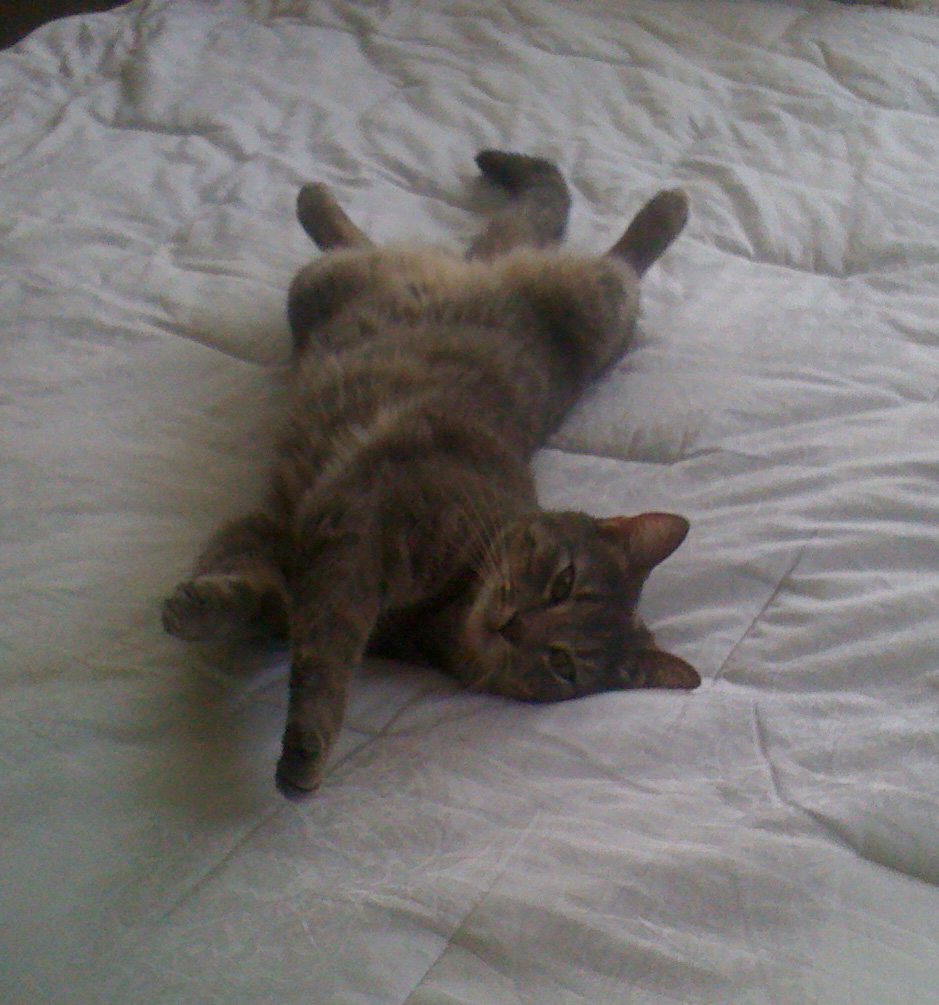
Clara resting in one of her favorite poses -- on the bed where she belongs!
My landlord finally put screens in my windows yesterday, so I naturally had all of the windows open last night. For a year, the screens have been broken, so I was looking forward to taking advantage of a cool breeze and fresh air. I didn’t expect, though, to wake up at 5:15 a.m. to see my furry feline halfway up the second-story window, her claws dug into the screen — the outside of the screen, no less.
“Clara!” I said. “Get off of there!” Mind you, that may not have been the smartest advice I’ve ever given.
Crash.
If only Clara’s claws were stronger.
If only the screens had been securer.
If only I had woken up before she managed to sneak out the window and up the screen.
I quickly shut the window, put in my contacts and rushed outside. “Clara!” I called out in a high-pitched voice. I felt like the mother rabbit in my favorite childrens’ book, “Runaway Bunny,” searching all around for my adventurous little one. Clara always comes when I call her. Not this time. After five minutes of calling and no response, I started to get teary-eyed.
It was dark and I didn’t have a flashlight, so I couldn’t see anything amidst the dog cage, the furniture and the lawn ornaments that cluttered the ground at the foot of the window. The screen laid on top of the dog cage, bent and broken.
Another creative pose.
“How could I have let her stay by the windows?” I thought, getting mad at myself. “And why did she have to be such a daredevil?”
I figured she had fallen, hurt herself and hidden somewhere to die.
The neighborhood cat, Skittles, approached me, as if to keep me company. But I didn’t want to see her. In that moment, second best wasn’t enough.
“Meowwww. Meowmeowmeowmeowwww.”
I knew it was Clara’s cry. I knelt down and saw two green eyes staring at me from underneath the house. “Clara, get over here,” I said, partly mad but mostly relieved. She decided to play hide and go seek. She’d come out for a minute, then run away when I tried to grab her. The only thing she would come out for was Skittles, who initially hissed at her but then kissed her to try and make it all better.
I ran upstairs to get food, thinking that would attract her, but had no such luck. (Of course, Skittles wanted some food, though.) The next time Clara came out to see Skittles, I grabbed onto her, swooped her into my arms and tried to not get scratched. She was not a happy kitty.
Clara sitting on the kitchen table shortly after the fall. Her eyes seem to say, "I'm sorry."
Clara’s currently strewn across the kitchen table, just barely keeping her eyes open. She knows she’s not allowed on the table, but I’m letting her rest there this morning. She’s had an eventful day so far, and being on the table is her way of letting me know she wants to be close to me. I can’t deny her of that closeness, especially not after this morning, when she seemed so far away.
Oh yes, and those windows? Unless the landlord secures them, they’ll be shut from now on. The fresh air was nice for a night, but Clara only has eight more lives to live. I don’t want to risk having her lose another one.
Last weekend I ran in my first triathlon — the St. Anthony’s Triathlon in St. Petersburg, Fla. I was part of a relay team of girls who I hardly knew a month ago but who I grew closer with as we worked together to complete each leg of the race.
Our team came in sixth out of the female relay teams, which we were pretty happy about. I ran the 10k at an 8-minute mile pace — not quite as fast as I had hoped, but decent.
Afterward, I joked with my teammates, saying I felt like a slacker for only doing the running portion of the triathlon. Now, we’re each thinking of doing a full tri — a goal that doesn’t seem so far off after having experienced what this type of race is like.
Trying to stay strong at the end of the race ...
There was a tremendous amount of energy among the athletes, and it was invigorating to see so many people — young and old — push themselves to accomplish a goal. My next goal is to run another half marathon. I hope to visit a good friend from college in Minneapolis this August and join her in running one that’s being sponsored by World Vision. There’s also a triathlon in Clearwater in July that I’m tempted to do. We’ll see how well my knee, which has been in pain recently, holds up.
Funny how runners have a tendency to run through the pain. Running has always presented me with the challenge of learning how to listen to my body and respect it when it needs rest. I tend to push myself too hard, which usually results in me experiencing greater pain for a longer period of time. I’m learning, though, that every now and then it helps to slow down.
Last week I got a tip that the AP Stylebook would be changing its style for “Web site” to “website.” I knew the news would be big but didn’t expect people to be so vocal on Twitter and in the blogosphere about their thoughts on the change. Some disagreed with the change. Others thought it couldn’t come soon enough. I always thought that “Web site” was an antiquated way of writing it, so I’m glad I can now write it as “website.”
Wanting to find out what other journalists thought about the Stylebook’s decision, I followed the buzz on Twitter and talked to New York Times columnist David Pogue and others to hear their thoughts:
“When the AP Stylebook announced via Twitter that it was changing the style for “Web site” to “website,” some users let out shouts of praise: ‘Finally!‘ ‘Yes!!!‘ ‘Yeeha!‘
“The reactions aren’t surprising, given how many people have asked the AP to change the style from two words to one word, arguing that “Web site” is an antiquated way of writing it.
“The change, which was formally announced at the American Copy Editors Society conference Friday afternoon, is effective Saturday and will appear in the 2010 Stylebook, which is slated to come out next month.
” ‘We decided to make the change because ‘website’ is increasingly common,’ said Sally Jacobsen, deputy managing editor for projects at the AP and one of three Stylebook editors. ‘We also had invited readers and users of the Stylebook to offer us some suggestions for a new social media guide that we’re including in the 2010 Stylebook, and we got a very good response and a large number of people who favored ‘website’ as one word.’ ”
I went through the articles I’ve posted on my Delicious page recently and realized that there are a lot of stories that have interested me lately. Not surprisingly, they have to do with journalism, moms, childhood and food — the subjects I like to write and read about the most. Here are some of the stories that have caught my attention throughout the past month or so:
Diary of a ‘Food Racist’: I like this piece from The Atlantic, which looks at how our associations with certain places trigger our desire for, and memory, of certain foods. The author of the piece explains that when she talks with someone from India, she daydreams of naan and saag with cubes of paneer. When she thinks of Google’s recent issues in China, she’d led to crave porky soup dumplings. She looks at whether “racist” is too strong of a word to describe her cravings and blames her mom for making her think of food in this way:
“Maybe racism is the wrong word. It is loaded and ugly and not nice. I certainly don’t have a blanket dislike for any group of people (I dislike most people equally). And I pride myself on my willingness to embrace other cultures and whatever they bring to the—literal—table. But I clearly have a nagging, deep-seated case of something that makes me frame everything in life through food.
“Frankly, blaming my mother is probably the safest bet. She’d agree, no doubt. When I was small, she went out of her way to make sure I wasn’t a picky eater by pounding her motto into my impressionable brain: ‘You don’t have to like it, but you have to try it.’ So I’d try new things and inevitably like them. Which led to an inevitable life of trying and inevitable liking. Maybe I just like too much?”
First Camera, Then Fork: A New York Times story about people’s obsession with taking pictures of their food. I’ve never been one to take photos of the food I’m eating, unless I’ve made something that I’m especially proud of. The part of the story that helped explain why people feel compelled to let the world know what they’re eating resonated with me the most:
“That some people are keeping photographic food diaries and posting them online does not surprise psychotherapists. ‘In the unconscious mind, food equals love because food is our deepest and earliest connection with our caretaker,” said Kathryn Zerbe, a psychiatrist who specializes in eating disorders and food fixations at Oregon Health and Science University in Portland. ‘So it makes sense that people would want to capture, collect, catalog, brag about and show off their food.’ “
Why is Women’s Fiction So Miserable?: This Telegraph story suggests that “women writers really can’t win. We’re damned for writing fluffy, upbeat chick-lit about shoes and cake, damned if we write about domestic abuse within a geo-political conflict.” True, there is a lot of grimness in women’s fiction and nonfiction, but it undoubtedly exists in men’s fiction, too. I think a lot of people are attracted to grimness — either because they can relate to it or because it’s so far removed from anything they’ve experienced. That’s one of the beauties of books — they let us cross into foreign territory and then just as quickly escape from it.
Window Farming: A Do-it-Yourself Veggie Venture: This NPR story highlights the growth of urban agriculture and makes me think of one of my favorite childhood books, “A Tree Grows in Brooklyn.” Major cities aren’t all that conducive to gardening, but they’re a good place for people with green thumbs to flaunt their creativity. I’ve always equated gardening with patience, a virtue that seems that much more important in an urban area. If I lived in a major city like Manhattan, I think I’d need a garden — a patch of slow growth among the streets of a harried life, a reminder to slow down.
Natalie Merchant: Globe-Spanning Poetry: This NPR Music piece showcases Natalie Merchant’s new album, “Leave Your Sleep.” I’m not a huge Merchant fan, but I love the artistry of this album, which she describes as “a thematic piece about motherhood and childhood.” The 28 songs on the album are based off of poems written by poets from all different time periods and nationalities, such as Gerard Manley Hopkins’ “Spring and Fall: to a Young Child” — a poem about an adult who’s trying to explain death to a child. Given that Hopkins is one of my favorite poets and that I can relate to the subject matter of this poem, I can’t help but be drawn to the song. I also like the more upbeat track, “Topsyturvey-World.”
An Essay by Anna Quindlen: The Amazon page for Quindlen’s new book, “Every Last One,” features a great essay about how being a newspaper reporter helped her become a better novelist. (Author Jennifer Weiner has shared similar sentiments in the past.) Here’s part of Quindlen’s essay:
“I learned, from decades of writing down their words verbatim in notebooks, how real people talk. I learned that syntax and rhythm were almost as individual as a fingerprint, and that one quotation, precisely transcribed and intentionally untidied, could delineate a character in a way that pages of exposition never could. And I learned to make every word count. All those years of being given 1,200 words, of having the 1,200 pared to 900 at 3 o’clock: it teaches you to make the distinction between what is necessary and what is simply you in love with the sound of your own voice. The most important thing I ever do from an editing perspective is cut. I learned how to do that in newsrooms, where cutting is commonplace, swift, and draconian.
” … Plot is like a perspective drawing, its possible permutations growing narrower and narrower, until it reaches a fixed point in the distance. That point is the ending. Life is like that. Fiction is like life, at least if it is good. And I know life. I learned it as a newspaper reporter, and now I reflect that education as a novelist.”
The description of Quindlen’s book is good enough to make me want to read it:“‘Every Last One’ is a novel about facing every last one of the the things we fear most, about finding ways to navigate a road we never intended to travel, to live a life we never dreamed we’d have to live but must be brave enough to try.”
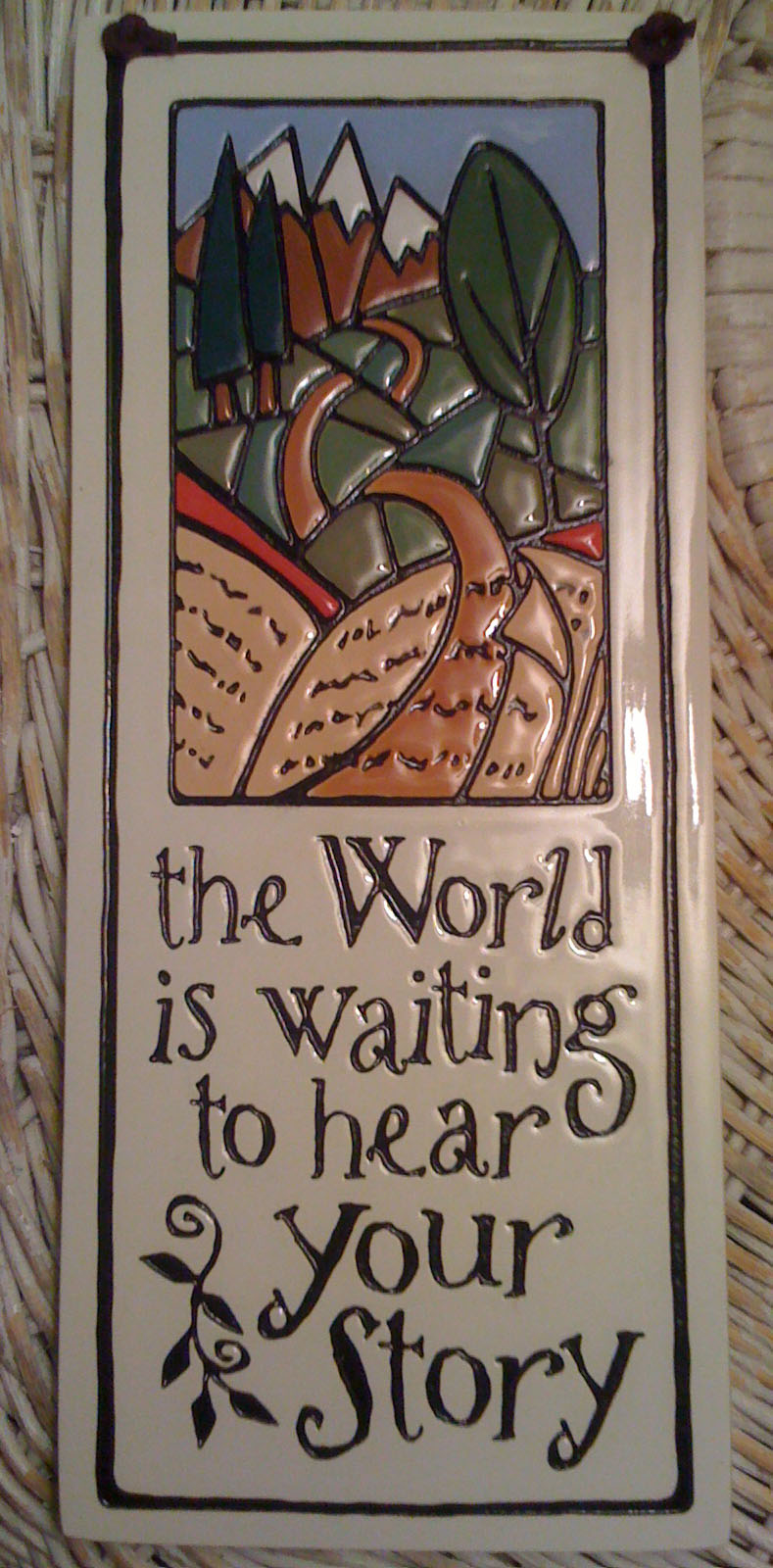
I bought this plaque last week at a store in downtown St. Pete. I hung it up in my room as a reminder to keep writing.
When I published a personal essay about my mom and food last week, I wondered what people would say — or if they’d say anything at all. To my surprise, though, the response has been overwhelming.
Friends, coworkers, former teachers and strangers have commented on my blog and sent me Facebook messages, Tweets and e-mails. I copied and pasted all of their responses in a Word document (single-spaced, size 12 font) and it’s already more than seven pages long.
Their notes have served as a reminder of how many people — men and women — silently struggle with eating issues. Knowing this is incentive enough for me to want to keep writing about why I often turn to food as a substitute for feeling.
I worried that the essay would lead people to make false assumptions about what I eat and why I exercise. It might, but more than anything I think it has helped people — even those who couldn’t necessarily relate to the experiences I laid out. One editor wrote me an e-mail, saying: “Despite the fact that this 42-year-old male reader hasn’t shared anything like your experience I still found it relevant and moving. And I bet many others like me would too.”
That’s my hope. It’s also my hope that in sharing my story, others will feel motivated to share theirs, too. It can be tempting to want to keep our more painful stories to ourselves, for our own sake or for the sake of those we love and want to protect. I would argue, though, that most stories are worth sharing.
Even if we don’t feel comfortable writing about them for an audience, I think it helps to relay them verbally, or write them down for safe keeping. Our stories make us who we are; it would be a shame to forget them. That’s partly why I write essays about my mom — so that I won’t forget. So many of the memories I have of her are from when she was sick. I want to remember the good times, too, though.
My dad’s been helping me with this throughout the past week. After he read my essay last Wednesday, he began e-mailing me stories about my mom, some of which he’s never told me before. He has e-mailed me two “chapters” so far, starting off with the day he met my mom (she was 17, he was 19), leading up to their first date at a basketball game in Massachusetts. Today Dad e-mailed me to say, “The next chapter will deal with the Disco era, something that I would like to forget, but unfortunately, will haunt me for many years to come.” Uh oh. I can only imagine the funny stories that’ll come out of that chapter!
The stories he’s written about throughout the past week have meant a lot to me. Here’s my favorite one so far:
“Our favorite place to go was the Cape. The summer before we got married, we really wanted to spend a weekend together, something we had never done. It was 4th of July weekend. We drove to the Cape with no reservations, (no pun intended). Every place we stopped at had no vacancy.
“We finally found a place in Harwich, but decided that we didn’t like it, since the rooms were only separated by glass walls with curtains. We could see into the other room if their lights were on and ours were off, so we checked out as quickly as possible. We drove all the way to Provincetown looking for a hotel/motel room, with no success. I was determined to spend the night with Mom, no matter what.
“On the way back, we stopped at every hotel between Provincetown and the bridge with no luck. There was not a room to be had. We ended up checking into a hotel in Braintree, at 3:30 in the morning! By then we were both too tired to do anything but sleep. The next day we drove to the Cape and spent the day at the West Dennis Beach, before heading back home to Framingham. We never did tell our parents about our adventure.”
I like the idea of my parents sneaking away on an adventure together. I’m sure the story of their late-night ride will make it into one of my future essays. That’s the great thing about stories — they connect families, friends and strangers, all the while reminding us that for as much as we may struggle, we’re never really alone.
Last month, I mentioned that I had begun a Poynter course on personal essay writing. My goal in the course was to write an essay about how the death of my mother has affected my relationship with food — today and in the immediate aftermath of her death.
This isn’t an easy subject for me to write about. For years I’ve struggled with figuring out how much of my past I should share with others. I’ve shared part of it through the essays I’ve written about my mom, who died of breast cancer when I was 11. In recent years it’s gotten easier for me to write about her death and to not put her on a pedestal, as people often do when writing about loved ones who have died.
But writing more specifically about how my mom’s death affected me emotionally and physically is harder, in large part because it makes me feel vulnerable. I ask myself: When you write about difficult experiences you’ve faced, how much should you share? How do you express yourself in a way that others who haven’t had the same experiences can relate to? How brave should you be?
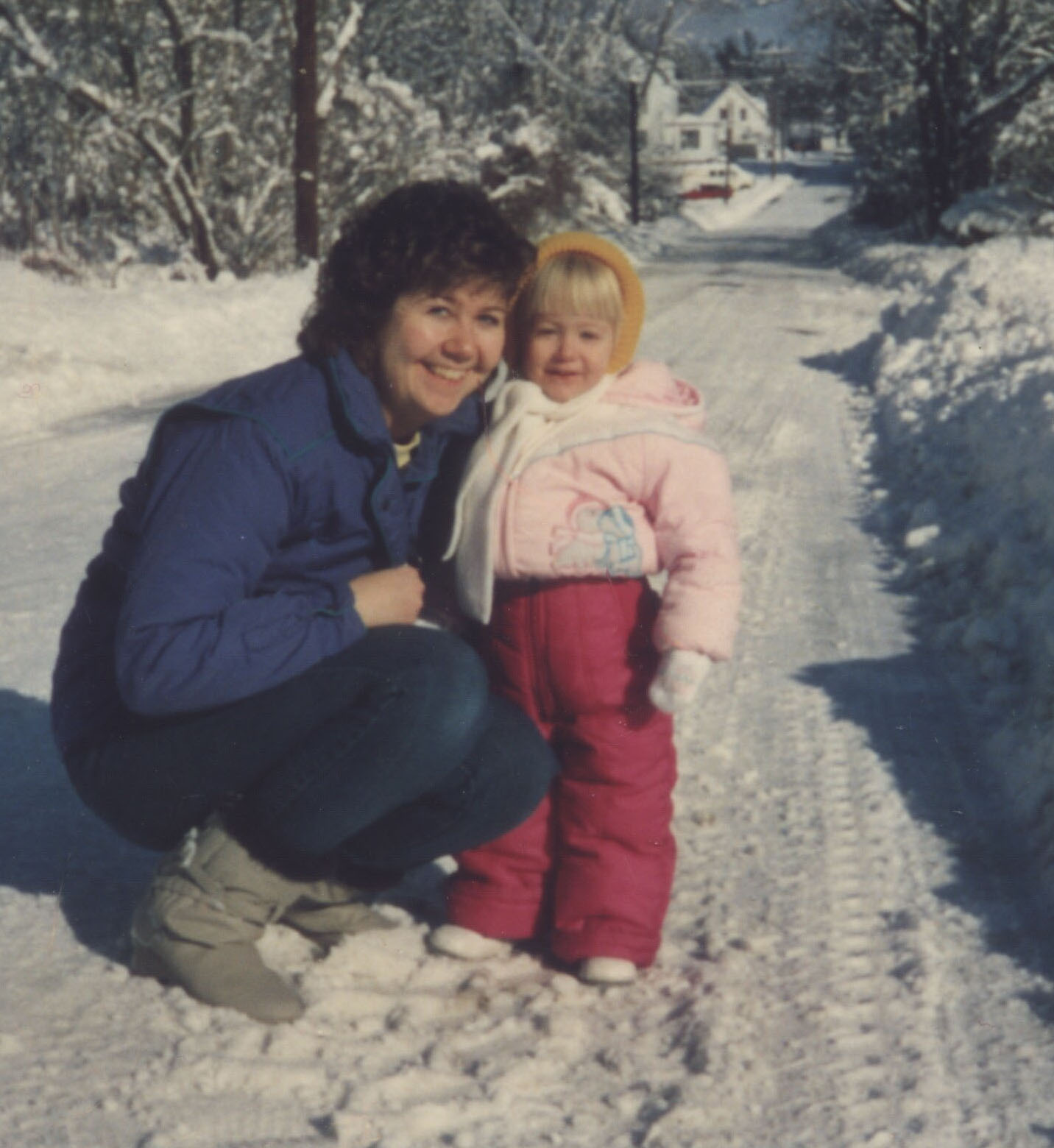
Mom and me in front of our house in Massachusetts after a snowstorm. Brrr.
I’ve decided to be brave. For the first time, I’m publishing an essay about my struggles with eating. I’ve thought long and hard about whether I should share something so personal, but I’ve realized that I don’t want to keep hiding this part of my life. Eating disorders are so often about hiding feelings, food and the desire to eat. Part of recovery is admitting that you are struggling and, in doing so, acknowledging that for as much as you try to be perfect, you can’t be.
There are ways to write about these kinds of struggles without making it seem as though you’re begging for sympathy. And I think the way you do that is to let recovery be the engine of your story — the narrative device that drives your piece forward and motivates you to want to continue moving forward, too. Healing, after all, involves movement — and a good pair of walking shoes. It’s about taking a few steps forward, a couple steps back, one step forward, and so on and so forth.
One of my favorite writers, Geneen Roth, has a hopeful take on healing, which she explains in “When Food Is Love“: “Life is what happens as you live with the wounds. Life is not a matter of getting the wounds out of the way so that you can finally live. Wounds are never permanently erased. We are fragile beings, and some days we break all over again.”
I’m still learning to be gentle with myself and to see the beauty in baby steps.
So, here’s my baby step toward writing about food and my mom. I plan to continue writing about this topic, so I’d really value your feedback on this post. I’m curious to find out what parts of the essay resonate with you, what you want to learn more about and what you think works or doesn’t work. More importantly, though, I hope you can connect to the essay and gain something from reading it.
********
Mom always used to surprise me with a snack when I came home from school. I remember looking forward to the treats, which were different every day. For whatever reason, though, I can’t remember the majority of them anymore.
All I remember are the cookies. Chocolate chip cookies. Butterscotch cookies. Girl Scout cookies. My favorite were the gingerbread men that Mom would buy from Market Basket. They were the sinfully soft kind, loaded with unhealthy frosting and a head made of solid sugar; the kind of snack that lures adults into indulging in calories and fat they don’t need but secretly want. To me, they tasted like home.
I’d savor the sugar, then jump on the couch and give Mom a hug. I’d rest my head on her shoulder and she’d ask me to tell her all about my day.
“What’d you learn today?” she’d ask.
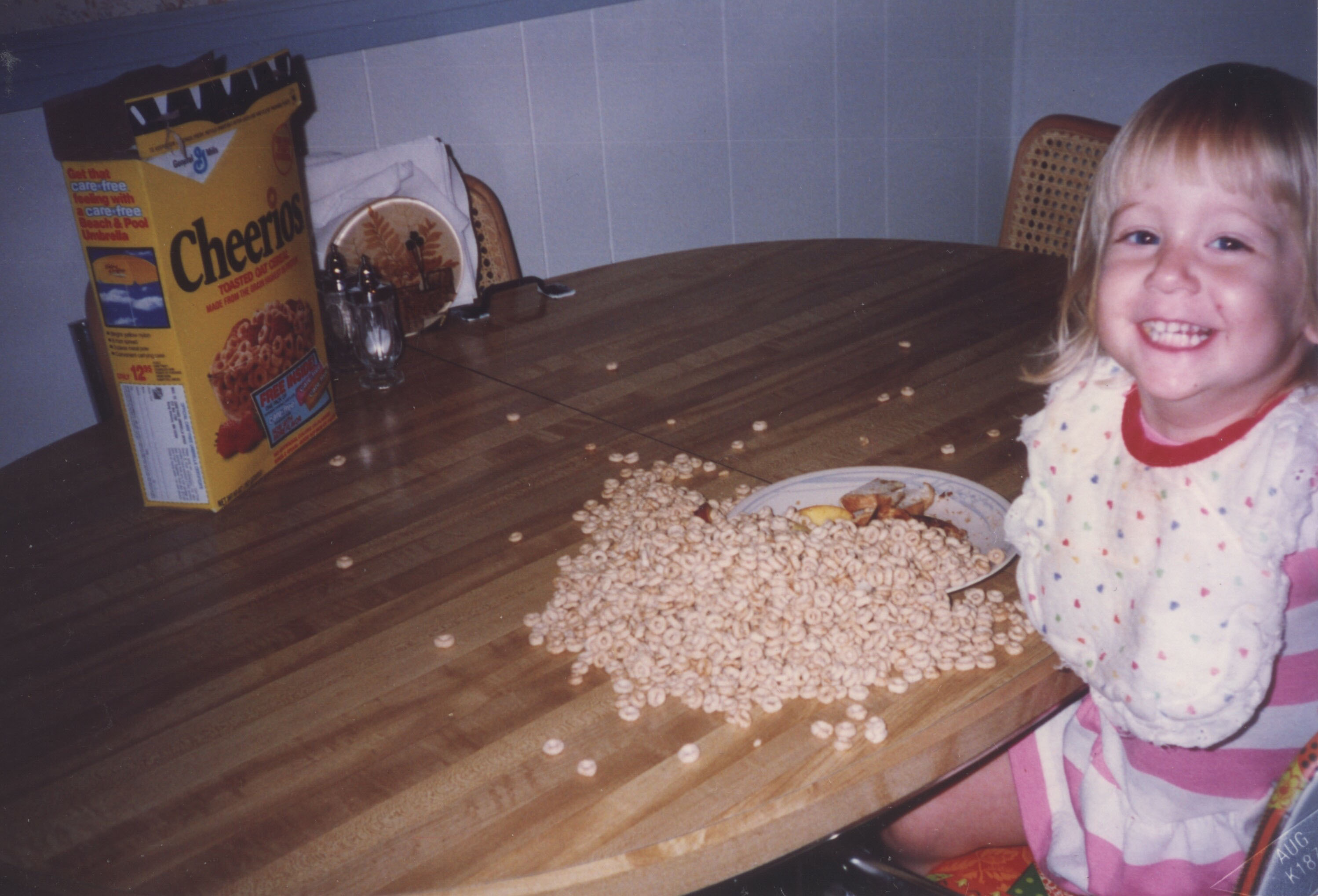
Even when I was really little, I always loved to eat (and play with) the meals and snacks Mom gave me. Cheerios were clearly my favorite breakfast food.
“Weeelllllll ….”
I would go on and on, letting her know about the journal entries I wrote, the jump roping contest I competed in at recess, the A+ I’d gotten on my reading quiz. I’d always “forget” to tell her about the big word I stumbled over when reading out loud, or the math problem I pretended to know how to solve but got wrong.
Mom never went to college and wasn’t that well-read, but she wanted her only child to be. Actually, she wanted me to be the best at everything, so I tried as hard as I could to be the A+ student, the prized daughter, the perfect little girl.
Wrapped up in a package of perfection, I tried to avoid anything that would reveal the ugly truth about being perfect: you can’t be. I tried to control life’s blemishes and blunders, which became more prevalent in my life the sicker Mom got.
When you are 8 and your mom’s diagnosed with breast cancer, it’s easy to play pretend. You try to tell yourself that she’ll make it, that you can wave your fairy princess magic wand and make her all better. You believe her when she tells you she’s a soldier in a battle, that she’s the Little Engine That Could, that even though she’s lost all her hair, one breast and 35 pounds, she’ll survive.
Mom lost a lot when she was sick, but she never lost the desire to want to nourish me with food and love. The days when I came home from school, I always knew she’d be there to feed my hungry heart with hugs and kisses and fill my empty tummy with after-school snacks.
Then one day she wasn’t there. Well, she was, but in a frightening kind of way. I could tell that something was wrong when I came home from school and saw Mom on the couch. Her face was painted with pain, her forehead a road map of wrinkles, her eyes a wishing well of tears.
Seeing Mom so weak made me long for some sense of normalcy and nourishment — a hug, a kiss, a cookie. “Mom, what’s wrong?” I asked when I came in the door after getting off the bus.
“Maaaaaal,” she softly screamed. “Call your father. I can’t get up.” It was like those “Help, I’ve fallen and I can’t get up!” commercials that Mom and I always used to make fun of. They seemed so fake, so laughable. This couldn’t have been more real.
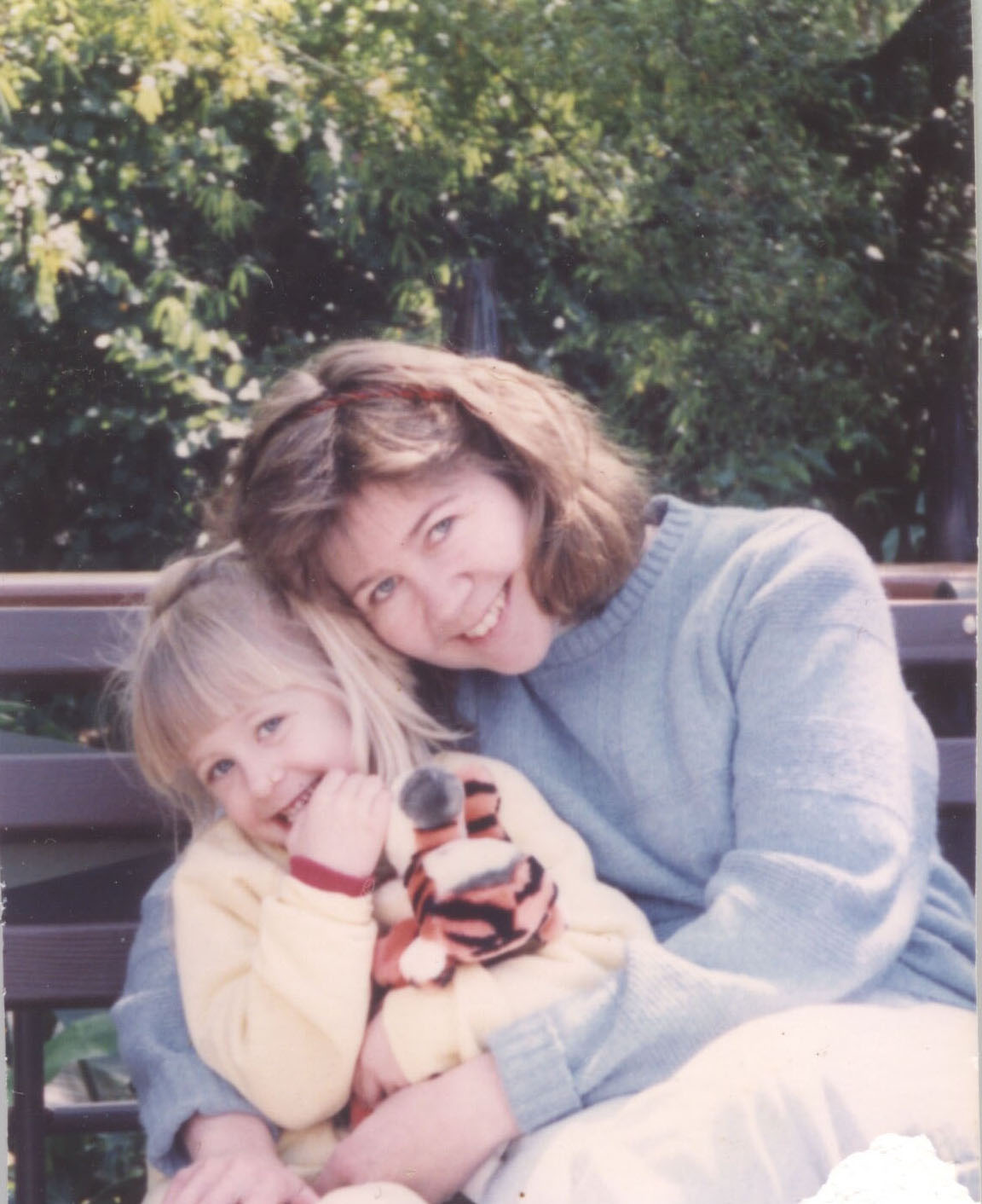
Me and mom in Disney World, 1988.
I tried to lift her.
“C’mon mom, c’mon mom, move. Move!”
I called Dad because he always knew how to fix stuff. He rushed home from work, but he was too afraid to pick her up for fear that he’d hurt her even more. It was the first time I remember thinking of my dad as being helpless.
Knowing she needed medical help, he called 911 and we soon heard the sound of sirens. The EMTs couldn’t lift her either. “It hurts,” Mom said, shutting her eyes. “It hurts.” So they scooped Mom up in the blanket she was resting on and carried her onto a stretcher. BamBam! They shut her inside the ambulance and drove away.
It was late, and I hadn’t eaten dinner, let alone my afternoon snack. That night, dad made “the usual” — the ever-so-simple spaghetti and peas. I liked the meal the first five times we ate it, but after a while the spaghetti seemed to get harder, the peas mushier.
“Daaaaad. Again? Why can’t we have Mom’s pasta primavera? Or her macaroni and cheese?”
The grainy grossness was a rude reminder that Mom was too sick to cook and that hard as he tried, Dad just didn’t know how to nourish me in quite the same way.
“Maybe tomorrow, Mal,” Dad would say. “C’mon, you love spaghetti.” He worked full-time and was trying to take care of an ailing wife and a young daughter who craved the kind of care that only moms can give.
“I used to like spaghetti,” I said. “But it doesn’t taste good anymore.”
Dinnertime felt so lonely without Mom. Something was missing, and food wasn’t filling the void. It never really does. I missed Mom’s meals and my after-school cookies. I was tired of coming home to an empty house. I was tired of the hideous hats Mom wore to hide her baldness or to “make a fashion statement,” as she preferred to say. I was tired of seeing Mom confined to a bed when everyone else’s mom seemed healthy enough to attend school functions and cheer for their sons and daughters at soccer games.
Mom was just busy, I told myself. She was fighting in a battle and hiking up a hill. She was living out metaphors that, depending on whether or not you were playing pretend, suggested an ascension toward recovery or, more realistically, toward Heaven.
When Mom died, I felt empty and defeated. The “let’s play pretend” game was up and I’d lost. But I started it up again soon after Mom’s death, this time on my own. Mom wasn’t there to tell me she’d be ok, so I tried to be ok for her. I went to school the day after she died and told my sixth-grade teachers that I was fine and ready to move on. I wanted to be strong.
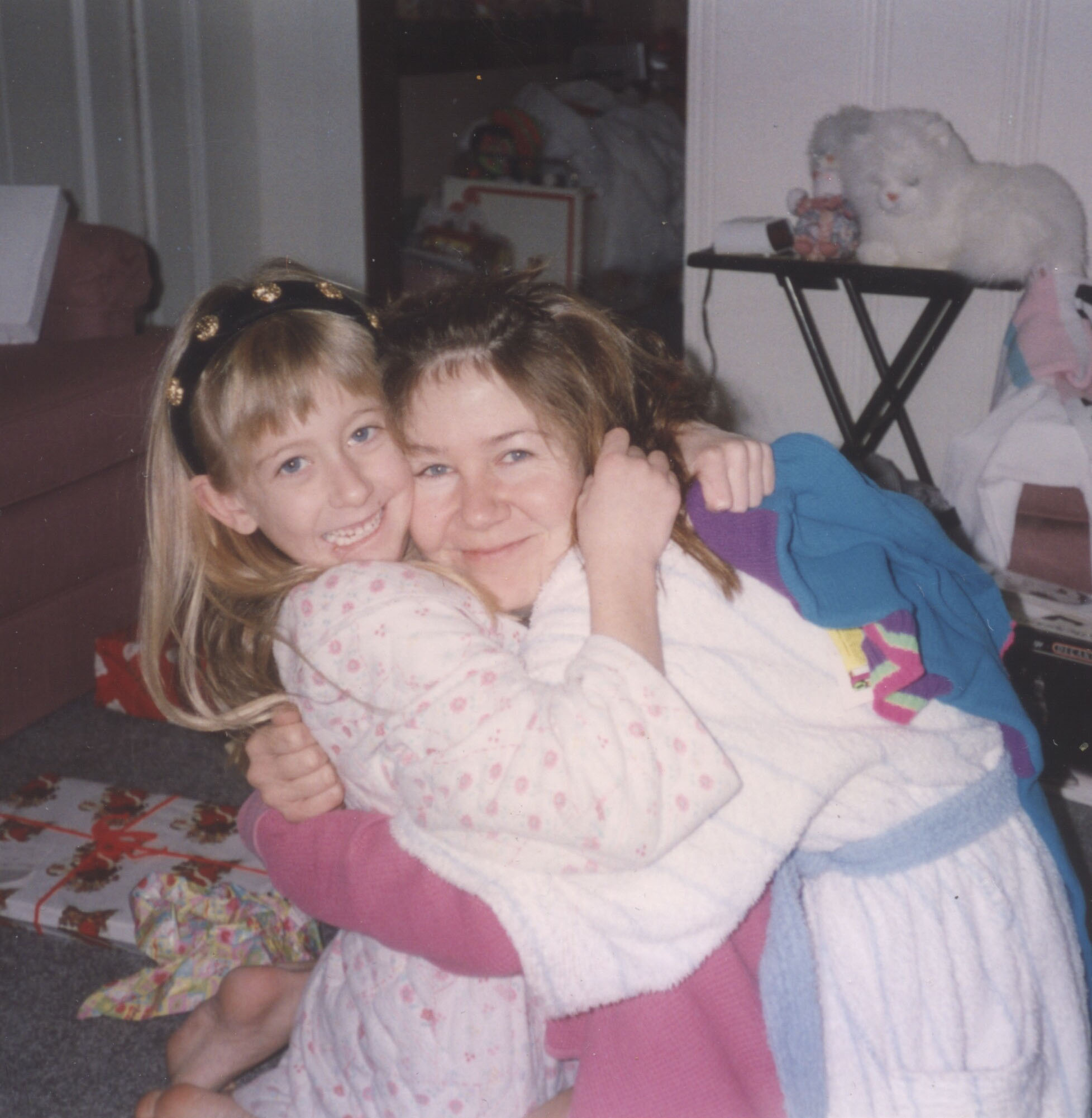
Me and Mom on Christmas morning. Taken about a year before she was diagnosed with breast cancer.
“Dad,” I said the day after she died. “I want to write a eulogy for Mom’s funeral.” “Eulogy” was one of those big words that I had heard Dad talk about behind closed doors. I remember looking it up in the dictionary, hoping I’d never have to hear one about my mother.
And yet, at age 11, I wrote one about Mom and read it at her funeral, composed and without tears. The eulogy, all 480 words of it, was my attempt to comfort everyone else and perhaps convince myself that all would be well. Part of it read:
“Everything happens for a reason, although, that reason is often hard to find. But believe me, sooner or later in life you will find that reason. Now we should all still cry, and we should always keep Robin in our hearts, but we cannot let it bother us for the rest of our lives. We can’t keep going back to that old chapter, but look forward to the new chapter in our lives, and just hope that it brings us the best of luck and much happiness.
“This is hard to do, I know, to find that new chapter, but we can all do it if we try. Just think, my mother, Robin Jo Tenore, is walking along the streets of gold, she’s having the time of her life. She no longer suffers from pain. She is now in the hands of God, she is now in Heaven. A place where she truly belongs.”
I remember feeling disconnected when I read the piece, confused as to why I felt the need to write about my mom’s death in a Hallmark card kind of way.
At the time, I thought I was strong. And I was, but I didn’t realize that being weak when we need to be can make us strong later on. When we cry, when we make ourselves vulnerable, when we readily admit that something as devastating as losing a mom just plain sucks, we’re being true to ourselves. Hiding these realities only delays the grieving process, making us surrender to sadness later instead of embracing it in the moment.
But try telling that to an 11-year-old.
Looking for something to control, I started to control what I ate. Nothing tasted good anymore, and it didn’t fill me up the same way Mom’s food did. Since Mom wasn’t there to make me meals or leave me snacks anymore, why even bother eating? After all, those super skinny girls in the “Seventeen” magazines that I peeked at in the library probably didn’t eat. How else would they have such perfect bodies?
It’s so much easier to focus on food and your body than it is to feel.
Me and dad have gone through a lot together. When I was sick, he was one of the few people who believed I’d get better. He was right.
I figured if I stayed the same weight that I was before Mom died, then I could pretend things were still the same. If I wore my hair in pigtails and pretended I was forever young, then people would care for me. I’d be the little girl, the one without a Mom, the one who needed their love and attention.
My battle with food led to four hospitalizations, two month-long stays in a psychiatric unit at Children’s Hospital in Boston and a year-and-a-half-long stay at Germaine Lawrence, a residential treatment facility for troubled girls in Arlington. I’m better — so much better than I ever thought I could be, thanks in large part to the choices I’ve made and to my supportive dad. But still, I struggle.
When I was home for Christmas this past December, I told Dad I was craving one of the gingerbread men that Mom always used to buy. I didn’t buy one, though, because I figured I didn’t really need it. Too unhealthy.
Two days later, my dad handed me a bag from Panera Bread.
“Here, Mal, this is for you.”
He had a big smile on his face. I peered inside and saw a gingerbread man.
“Thanks, dad,” I said, pretending not to want the treat. “I’m not hungry now, though. I’ll have a piece later.”
But then I changed my mind. It hurt me too much to say no. I wanted my dad to know how much his gesture meant to me, so I broke off a piece of the smiling gingerbread’s head. It was harder than I remembered, the taste of ginger wasn’t quite the same, and there wasn’t nearly as much frosting as there should have been. Not like the kind Mom used to buy. The spaghetti and peas equivalent of Mom’s pasta primavera.
You wouldn’t think eating a gingerbread man’s head would be that difficult. But when you’re used to a routine, deviations make way for chaos and temptation. I often eat the same thing every day for breakfast, lunch and dinner because it helps me feel in control. When I’m feeling lonely — because my friends are out at dinner and I’m being a workaholic, because it’s late and the guy I like hasn’t called yet, because I miss my mom — my first instinct is to sneak something from the nearest candy jar, raid the vending machine or open the refrigerator door in search of nourishment.
Dad and I live 1,500 miles away from each other. I always look forward to the late summer, when he usually visits. Here we are on my front porch last year.
I’m trying to find healthier ways to feel full, and to let go.
I’ve found that when we experience loss, we have a tendency to hold on to what we’re afraid will be taken from us. It’s understandable, but in doing so we can miss the point: everything that is good is a gift, freely given. When I’ve tried to hold on too tightly to the people in my life, I’ve missed the experience of the gift of their friendship, love and nourishment. To fill this void, I too often turn to food.
I know, though, that all the cookies and gingerbread men in the world can’t satisfy me. So I’m learning to fill the emptiness with something other than food, and to eat when I’m hungry and stop when I’m full. Mom would want me to. Sometimes, because I’m not perfect, I slip up. And that’s ok. I don’t want to keep playing pretend.
I’ve always loved window seats. So it was with great interest that I read this New York Times story about a pilot’s pleasure for seats with views. The pilot, Mark Vanhoenacker, explains his reasoning and writes about which cities offer the best views for passengers who are lucky enough to snag a window seat.
Sure, there’s something to be said for aisle seats — you have a little more leg room, you feel less claustrophobic and you don’t have to clumsily climb over other passengers on your way to the bathroom. (I’ve had to do this more times than I’d like to admit. Note to self: Lay low on the water consumption before boarding a plane!)
But window seats make airplane rides entertaining, and they make for a good escape. “Indeed,” Vanhoenacker writes, “as new security rules and ever busier airports continue to change air travel, rediscovering the romance of the window seat may be the most practical way to make flying more enjoyable.”
I couldn’t agree more. I’ll sit in the very last row of a plane if it means having a window seat. I start staring right after takeoff. Like a little kid, I practically press my nose to the window and gaze at the happenings below. I like to look at the tiny people, the cars & the boats and wonder where they’re at in their journey. If it’s nighttime, I look at the lights until they grow dim and there’s nothing left but darkness.
My curiosity then turns to the people on the plane. Where are they going? What’s their story? Maybe it’s this curiosity that compels me to always want to write on planes. No doubt, there’s something about the experience of a shared journey that lends itself to good stories and that makes you realize there’s value in looking out from within.
There’s a decent amount of variety among the nominees, but maybe not enough. In response to a Gangrey.com post about the list, The Washington Post’s Hank Stuever said:
“A very Manhattany-media list, very correct, very new-school-o’-journalism. Looked twice for any Weingarten … and decided that they mean only DEADLY SERIOUS JOURNALISM EXCEPT FOR JON STEWART.
“I think Finkel’s ‘The Good Soldiers’ shoulda been on here too. And Lane DeGregory. And …
“Oh well. Quibblin’ with Internet lists — America’s favorite new pastime.”
Other commentors agreed, suggesting that works by David Maraniss, Barry Bearak and Jim Sheeler should be added.
It’d be nice to see some quality pieces that haven’t already won numerous awards make it to the Top 10. Which stories/journalists would you add to the list?





 Word on the Street