Old Editorial Touts Newspapers As ‘Wave of the Future’

Recently I came across an editorial that I wrote for The MetroWest Daily News, the newspaper that I interned at in high school and freelanced for during winter breaks in college.

Reading the editorial, which I wrote in July 2006, the summer before senior year, made me laugh. It’s clear that I was overly optimistic about the fate of newspapers and that I was determined to change the way people thought about them. (Hey, I didn’t get voted “Most Optimistic” and “Most Likely to Change the World” in high school for nothing!)

I know that it’s not realistic to think that I can save newspapers. I still consider them a part of my daily routine and would like to see them survive. I don’t, though, think that “newspapers are the wave of the future for aspiring journalists” as I wrote in the piece.

In retrospect, I think my argument was more so that there will always be a need for news: “In a an ever-changing field that continues to become more competitive,” I wrote, “there lies a glimmer of hope for young journalists, who can rest assured that the thrill of writing and reporting will never get old.”

Different parts of the editorial make me laugh, such as the fact that the headline, “Tenore: Wave of the Future,” makes it seem as though I’m the wave of the future. Other parts, such as the unnecessary cliches, make me cringe: “Most journalists are used to living life in the fast lane.” And then there is a typo in the kicker: “In a an ever-changing field that continues to become more competitive, there lies a glimmer of hope for young journalists, who can rest assured that the thrill of writing and reporting will never get old.”

Re-reading your old work is such a good way to see how you’ve grown — as a person, a self-editor and a writer. Thankfully, I’ve grown up a little since writing the wave of the future editorial.

Will More Nutrition Facts Help Curb Obesity? Don’t Count on It

Shortly after slathering some cream cheese on my multigrain bagel Monday morning, I opened up the St. Petersburg Times to see a cover story with the headline: “Consuming Truths.”

Accompanying the story was a photo of the same type of bagel I was eating: “Dunkin’ Donuts multigrain bagel with reduced-fat cream cheese,” the caption read. “500 calories. 17 g of fat. 850 mg of sodium.”

I cringed, but ate the bagel and cream cheese anyway.

Calories and grams of fat, the Times reported, could start creeping up a lot more if health advocates who are pushing for restaurants to list nutrition information on menus get their way. Advocates believe the move could help curb obesity by making people more aware of their caloric intake.

Fifteen years after the government mandated that nutrition labels be printed on packaged foods, however, obesity among Americans continues to rise. This seems to suggest that while nutrition facts can make people more aware of how many calories, grams of fat, sodium, etc., they’re consuming, they aren’t enough of an incentive to stop unhealthy eating habits.

I agree that it’s important for people to be aware of what they’re eating, but I don’t think that giving them caloric information is the way to go about doing it. Too often, people focus on numbers as a cover-up for what what they can’t easily measure, especially when it comes to food.

I’m thinking in particular of those who have eating disorders. Calories become an obsession for them, something to be counted, written down and feared. They’re a distraction from all of the underlying emotions that cause people to restrict, binge, purge, etc.

To further complicate the problem, doctors often tell eating disorder patients how many calories they need to consume to reach their “goal weight” during hospital stays. While the patients become physically stabilized in the hospital, all of the underlying emotions and issues that led to the eating disorder continue to mount beneath the rising pounds.

The key to fighting obesity and other issues people have with food, then, isn’t to focus on numbers; it’s to hone in on what’s behind the problem of eating unhealthy. The problem, I would argue, stems from a lack of time, self-respect and community.

Americans are constantly rushing around by themselves, and many don’t have the time to give their bodies the care they need. So they turn to fast food, microwavable dinners, or no dinner at all. As the Times reported, “Most Americans consume one-third of their calories from food prepared away from home, whether at restaurants or as takeout from grocers. The U.S. Department of Agriculture says almost half of those calories come from fast food.”

Flash back a half a century ago and people were eating meals together, not waiting in line at the drive-thru. Dinnertime didn’t mean stuffing your face with a Big Mac and fries while driving to an assignment, soccer practice or a doctor’s appointment; it often meant sitting down at the kitchen table and catching up with family or friends.

Eating in the company of others nourishes people more than they might think. I notice, for example, that I always eat more when I’m alone. Very often food, when used as a remedy for stress, fills a temporary void that leaves people feeling full psychically, but unfulfilled and empty emotionally. Then there is the opposite side of the spectrum — the loss of appetite people might experience when they’ve lost the sense of companionship they once had with someone. Take, for instance, the infamous “divorce diet” that accompanies divorces in the U.S. and elsewhere.

Given the ways society has changed throughout the past few decades, it’s easy to see why a lack of time and community has made this “bowling alone” generation so obese, so out of touch with how they’re fueling their bodies.

Rather than focus on how many calories people are consuming, then, why not focus on promoting the communal nature of food? I’m often amazed by how expensive some cooking classes are. What if the same health advocates who are pushing for more nutritional facts were to push for free or low-cost cooking classes in a local community instead? Offering such classes could be a great way to help people take the time to make their own food and come to understand what goes into the food they eat.

The cooking classes could also include a “food education” section, in which nutritionists or others who are well-informed about food could explain what the numbers on nutrition labels mean. Reading that something has 6 grams of fiber in it or 35 mg of sodium, after all, means little to people who don’t know what eating fiber and sodium does their bodies.

Along these same lines, why not offer people in the community opportunities to work on farms — to feel the dirt that their carrots grow in, to see the cows where their milk comes from, to hear the chickens that lay the eggs they eat? As one student who was interviewed in a recent New York Times piece about farm internships put it, “I’m not sure that I can affect how messed up poverty is in Africa or change politics in Washington, but on the farm I can see the fruits of my labor. By actually waking up every day and working in the field and putting my principles into action, I am making a conscious political decision.”

If access to farmland is a problem, health advocates in urban areas could start community gardens that residents could care for in communion with one another. Helping people cultivate an interest in locally-grown and organic foods would likely give them a better sense of how they might be able to trade in their daily Starbucks pastry for fresh fruit from the garden, and why that matters.

Developing a sense of community around food and an understanding of where food comes from and what it does to our bodies matters when it comes to healthy eating. Knowing that a multigrain bagel with reduced-fat cream cheese has 500 calories and 17 g of fat is a very small, if not insignificant, part of that.

I’m curious to see what others think about the idea of healthy eating and what we can do as a society to enourage it. What’s your reaction to this?

Keeping Blogs Alive: How to Do It?

I moderated a live Poynter chat last week with New York University professor and PressThink blogger Jay Rosen about how to teach blogging and how to have a successful blog. There are a lot of valuable lessons in the chat, which you can replay here. We had so many questions from participants that we’re hosting a second live chat with Jay on Thursday at 1 p.m. EDT.

Speaking of blogging, I read an interesting New York Times story today about what happens when the thrill of blogging dies. I always wanted to write a story about this, but alas the Times beat me to it. It would still make for an interesting story, though, to take a look at the blogs in your local community and see which ones are defunct and which ones are thriving. I’m amazed by how alive and thriving some local Tampa Bay neighborhood blogs are.

Even still, I’m sure there are plenty that are defunct. The Times reported that, “According to a 2008 survey by Technorati, which runs a search engine for blogs, only 7.4 million out of the 133 million blogs the company tracks had been updated in the past 120 days. That translates to 95 percent of blogs being essentially abandoned, left to lie fallow on the Web, where they become public remnants of a dream — or at least an ambition — unfulfilled.”

Tear. I make it a point to blog at least a few times a week. I like to think that I have regular readers, small as my audience might be, so in many ways I feel as though I’d be letting my readers down if I were to just let my blog die. On a more personal level, blogging gives me an outlet for communicating with others in a public forum, a chance to share my stories and experiences, and a way to stay in the habit of writing on a regular basis.

Stories, Sites I’ve Been Diggin’

A couple of articles, blog posts, etc., have caught my eye recently. I share most of the links to stories I like on my Delicious page, though I’ve been using Twitter more lately for this purpose.

“Running in the Rain,” The New York Times. I’ve always loved running, especially in the rain. It brings back memories of when my cross-country teammates and I would run outside, taking in the New England autumn weather. Rain gave us a distraction, a cool reprieve, a reason to be kids who jumped in puddles, not high school seniors who were about to jump to the next stage in life. Many times throughout xc season, my sneakers would be stuffed with newspapers to absorb the dampness, only to get wet and smelly again the next day. I didn’t care, though. Running shoes were never meant to look (or smell) pretty.

“The Invitation You Can’t Refuse: Why Sonia Sotomayor Was Talking about Race in the First Place,” Slate and “Sotomayor’s ‘Empathy’ May Be Best Trait,” by Cynthia Tucker. Interesting thoughts from Tucker:

“… a thing or two ought to be said about the bizarre notion than Sotomayor should be disqualified because she has acknowledged that personal experiences play a role in her judgments. That’s a commonsense observation, but it has been cast as a breach of judicial ethics, a heresy among the black-robed Spocks who render objective judgments about the law.

“Hogwash. All human beings, including affluent white men, see life through the prism of their experiences. We cannot separate our views and values from the experiences that made us who we are.”

“Therapists Wired to Write,” The New York Times. It makes sense that therapists would have a lot of material for stories given that they hear so many intimate ones when talking with patients. Themes of love, loss, betrayal, abuse, etc. inevitably arise. The challenge is figuring out how to write stories in such a way that doesn’t break the confidentiality that therapists try to maintain with their patients. This quote from the article resonated with me:

“Everybody comes in with their own stories, and they can be so staggeringly original,” said Bonnie Zindel, the psychoanalyst who started the writing group seven years ago. “We all need stories to make sense of our lives, we’re all wired to tell stories, and nature gave us that. For us, we wonder, ‘What is the story that our patients are telling?’ There are mother stories, father stories, ghost stories and the eternal universal story of a child trying to separate from its mother.”

“Her Prince Has Come. Critics, Too,” The New York Times. In this story about Disney’s first movie featuring a black princess, critics raise a valid question: “We finally get a black princess and she spends the majority of her time on screen as a frog?” Why is that?

“onBeing,” The Washington Post. I love one of the quotes from last week’s interview with makeup artist Bailey Orenia-Sessoms: “When you have a lack of self love, you’re more susceptible to accepting society’s beauty standards and then you’ll find yourself not liking who you are year to year because every year it changes.” I never really thought of it that way before, but it’s so true.

Indexed: I’ve looked at this site for a while now and it continues to amuse me. Who said index cards were just for studying?

Mallary and the ‘Terrible, Horrible, No Good, Very Bad Day’

We all have those days, or weeks or months where everything seems to go wrong.

Alexander, one of my favorite childhood literary characters, said it best when he summed up his stroke of bad luck in the book “Alexander and the Terrible, Horrible, No Good, Very Bad Day”:

“I went to sleep with gum in my mouth and now there’s gum in my hair and when I got out of bed this morning I tripped on the skateboard and by mistake I dropped my sweater in the sink while the water was running and I could tell it was going to be a terrible, horrible, no good, very bad day.”

I’ve been having one of those no good, very bad days. I’m not one to complain or post Facebook or Twitter status updates lamenting my woes, but sometimes it feels good to admit that, yes, I am having a crappy day.

Termites are to blame for much of the frustration. They’ve taken over my apartment and are swarming throughout it every night, making the place uninhabitable. It feels like an invasion, seeing as I can’t sleep in my own bed or do much of anything in my apartment.

After nights of couch surfing, I was fortunate enough to have a genuinely caring friend/colleague let me stay in her house until my apartment gets tented. There’s no official word as to when it will get tented; it could be as long as a couple of months from now.

Meanwhile, my last contact ripped on Saturday, and my optometrist’s office has been closed for the past two days, so I’ve been practically blind in one eye and haunted by a headache.

Then tonight while running, I got hit by a car. The car was stopped at a stoplight in front of me, so I started to cross the street, but the driver didn’t have his car blinker on and he decided to turn right. He plowed into me, causing me to fall to the ground and slide under the car.

My iPod went flying and so did my wherewithal to stand up for myself and ask for the young, tobacco-chewing driver’s information. I was shaken up and could only muster an “I’m OK” and a quick glance at his license plate before he sped away.

The situation could have been a lot worse; I was left with a deep cut and bruise on my knee, a messed-up toe and a (false sense of?) hope that I won’t wake up to find that the injuries are worse than I had anticipated.

The cut knee and toe remind me of an incident that happened when I was in the fourth grade. I was walking home from school and a teenage boy who was about three times my size ran into me with his bike and kept on riding down the street.

I was reading a book and walking, as I always did, when his wheels got tangled up in my legs. My book went flying, as did my Clarinet case. A broken mouthpiece and horn laid on the side of road. So much for all those times I tried to keep my Clarinet reed from breaking.

I looked down and started to cry as the nearby crossing guard who I knew well from my daily walks rushed over to me. She called a police officer, who drove me home. Mom, naturally, was stunned to see her little, blue-eyed girl pulling up to the house in a police car.

“What happened??” Mom asked from the front door, throwing her palms up toward the sky.

“I got run over by a bike,” I said, looking forlornly down at my knees. They were bloody and sticking out of the holes in my cranberry-colored spandex.

Like any little girl, I gave my mom a big hug and started to cry. Tonight I wish I could have done the same.

“Mal, are you OK?” she asked, her shoulder getting drenched. “No, it hurts, Mooommmm. He ran over me! And now my clarinet is broken. And the pages of my book are ripped!”

“The nerve,” my mom said, just a wee bit upset.

Mom ended up finding out who the teenager was. She staked herself outside of the middle school in the afternoons with me and waited for the boy on the bike to ride by. When I pointed him out, she went up to him and asked for his name and told him to apologize to me, which he did.

Then she wrote a letter to the principal demanding that biker boy pay us $10 so I could buy a new pair of cranberry-colored spandex. Mom was like that. She would have made a good reporter, with all of the questions she liked to ask and with her admirable audaciousness.

It’s times like these that I long for Mom. Bloody knees remind me not only of the hit-and-run bike incident but of the time I fell while riding a bike in downtown Holliston, where I grew up. I was 7 and had fallen on the corner of a sidewalk, which left me with a cut ankle. I still have the scar from that day, still remember the bandages Mom used to wrap my wound, and her snotty, wet shirt that caught my tears.

Now, the tears come less frequently, but the desire to be mothered remains. I want to have my Mom here to give me a hug when I fall, I want to ask her for advice about guys, I want to sit next to her and watch TV while eating mocha almond chip ice cream with chocolate sprinkles.

I’ve got my dad — 1,500 miles away — but still, as wonderful as he is, he’s not Mom. He doesn’t “get it” like other maternal figures in my life do. Instead of telling me how to treat my cut tonight, he asked if I was OK and then said, “How is your iPod?”

Mom wouldn’t have cared about the iPod; she would have “gotten it.” She is, after all, the one who introduced me to “Alexander and the Terrible, Horrible, No Good, Very Bad Day.” It’s as though she was preparing me for those days when I got older — the ones where she wouldn’t be there to bandage my wounds or give me a great big bear hug.

Mom would have complained and gotten in a bad mood, too, if she had to deal with termites, ripped contacts and a cut-up knee and toe. But she’d also hope for a less crappy day tomorrow.

So long as there’s no gum in my hair when I wake up in the morning, or a skateboard that makes me trip and break my leg, I suppose I can consider it a far less terrible, horrible, no good, very bad day.

Here’s to hoping.
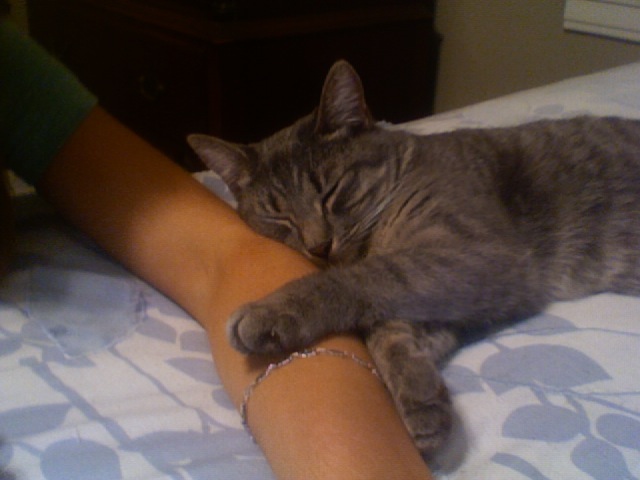
Night in the Life of a Cat-Owning Writer

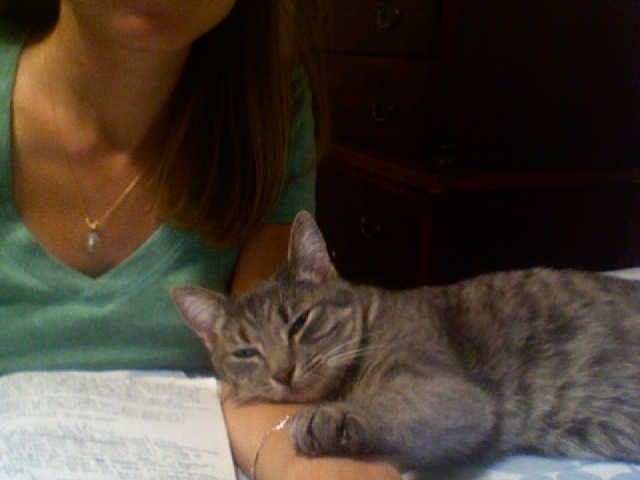
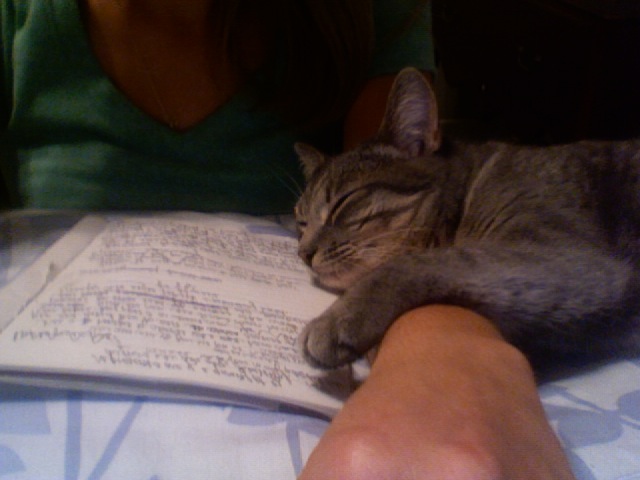
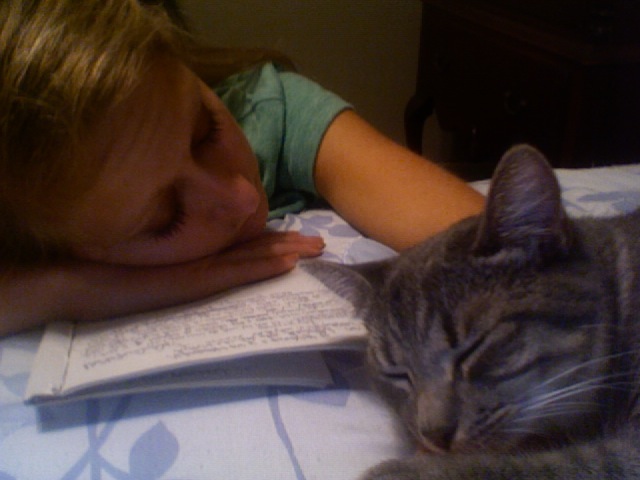
Paws of procrastination kept getting in my way the other night. I was up late working on a story at the foot of my bed with Clara the cat by my side. She kept swatting at my hands and walking all over my keyboard as I wrote, inserting typos and aklsjfklsdjfklsdjfldksjfsld neologisms into the story.

Everyone else seemed to be asleep as I wrote; my friends had signed off Gmail chat, Facebook and Twitter — sites I sign onto late at night to feel connected — and my neighbors’ lights were all off. So I liked having the company of my cat, her paw draped over my arm, her eyes half-closed, her purr as loud as a little motorboat. All the right ingredients for procrastination and distraction.

The motorboat eventually lost steam as Clara began to doze off. I kept writing and would stop every once in a while to take photos of her, trying not to get too distracted by her cuteness. The pictures are a good representation of what a typical night looks like when I’m up late writing, reading, etc.:

Photo 105

Photo 103

Photo 106

Photo 107

Photo 108

Photo 110

Journalists Look to Scribd.com For Profitable Writing, Editing Opportunities

After my editor passed along  a New York Times article last week about a site called Scribd.com, I began to wonder about the site’s journalistic application. The site just began allowing users to charge for the content they upload — a move that could prove beneficial for journalists who are looking to make some extra cash and maintain their writing and editing skills.

I looked into this for a Poynter Online story, Journalists Turn to Scribd.com as Profitable Publishing Platform,” which was published Tuesday:

Displaced journalists looking to make some money and keep up with their reporting and editing skills may find it tougher than usual these days to find freelance gigs.

At least some journalists, though, are finding pockets of profit elsewhere, realizing that the path to preserving their skills may not involve a news organization. One place they’re turning to is Scribd.com, a site that invites journalists to publish their work, reach new audiences and potentially profit from stories that cash-strapped news organizations might not have the resources to publish.

Just last week, the two-year-old site, which offers documents in 90 different languages, began allowing writers to charge for their content and keep 80 percent of the revenue.

Cole Louison, a researcher for GQ Magazine who has freelanced for news organizations such as The New York Times, said he started posting his work on Scribd.com after hearing too many editors tell him there wasn’t enough space for his stories.

[READ MORE …]

Cute Cat Sites

randomkitten.phpThe kitty lover that I am, I can’t help but appreciate watching videos and seeing photos of cats. Recently, I’ve come across some especially cute sites featuring the furry felines. Here are some of them:

The “world famous” (?) Random Kitty Generator — It’s easy to spend way too much time on this site …

Play Him Off, Keyboard Cat! — Who knew cats played the keyboard? So talented.

FUNderCats! — Cats caught on tape. They’re so mischievous (and innocently cute!)

What are some other sites to visit?

How News Orgs Are Using e-editions to Raise Circulation, Invest in Future of Newspapers

While reading Romenesko last week, I came across a MinnPost story about the St. Paul Pioneer Press‘ success with e-editions. There was a nugget of information in the story about The Commercial Appeal‘s circulation going up due to NIE e-editions, which led me to wonder if other news organizations could benefit from hearing how the paper has used the print/digital hybrid to raise circulation and attract younger readers.

For some papers, NIE e-editions are an investment in the future of newspapers, as they help train students to read the “paper” — well, a PDF replica of it — as opposed to reading stories on the paper’s Web site. I wonder the extent to which students really make that connection, though.

How does reading an e-edition make them more likely to want to buy the paper as opposed to just reading it online? Does forcing kids to read the paper in class make them view it as more of a chore that results in them not wanting to read the paper at all? And how well do papers succeed in strengthening kids’ literary skills and their understanding of local, national and global events? These are somewhat lofty questions, but I raise them out of curiosity and for discussion’s sake.

To find out more about this topic, you can read a Poynter Online story I wrote last week:

As newspapers struggle to stay ahead of the transition from print to digital news distribution, many are turning to e-editions and watching their circulation figures jump as a result.

Sounds promising, right? Yes and no. While e-editions bring in new subscribers, they don’t necessarily bring in revenue. At least one paper, however, has found that its e-edition is attracting new audiences, especially younger readers and schools, and serving as an experimental investment in the future of newspapers.

Case in point is The Commercial Appeal‘s e-edition, called “e-appeal,” which accounts for nearly 40 percent of the paper’s overall circulation. Recent Audit Bureau of Circulation figures that cover a six-month period ending in March show that the paper’s circulation climbed 31 percent as circulation industry-wide dropped 7 percent.

[READ MORE …]

Cooking/Baking Black Bean Burgers & White Bean Strawberry Blondies

Homemade black bean burgers and hummus.
White Bean Strawberry Blondies

My roommate and I, both vegetarians, started a new Sunday night tradition: making veggilicious meals. This afternoon we experimented with beans and made black bean veggie burgers and Vegan white bean strawberry blondies.

The burgers were so much better than the frozen Garden Burgers I always eat, mainly because they were more filling and they tasted a lot fresher, thanks to the chopped onion and cilantro. Mixed together, the black beans, green cilantro and white onions looked like an earthy tone hodgepodge of deliciousness.

Questioning the deliciousness of breadcrumbs, we substituted them for oatmeal, which seemed to work just as well taste-wise. The oatmeal made the veggie burgers a little mushier than they would have otherwise been, but I liked the mushiness. Since they may have been a little too mushy for buns, we used a fork and ate them with a slice of avocado and a side of hummus I made yesterday. Forget mustard or ketchup.

The brownies were just as tasty. Beans in brownies? Sounds a little strange, I know, but don’t let the beans deceive you. The brownies don’t call for any sugar or oil, and though they probably wouldn’t satisfy a sweet tooth, they’d satisfy a smoothie lover, as they taste like smoothies but in brownie form. The sugar from the jam, bananas and honey (a cheap substitute for the maple syrup the recipe called for) gives them an added sweet flavor. Both the bean veggie burgers and brownies took less than a half hour to make.

The speediness of the cooking process and the tastiness of the food proved that veggie/Vegan foods can be favorable, filling and fun to make. Don’t believe me? Whip up some of these veggie burgers and bean brownies and you’ll have a different opinion — and your fill of protein, fiber and iron for the day.